
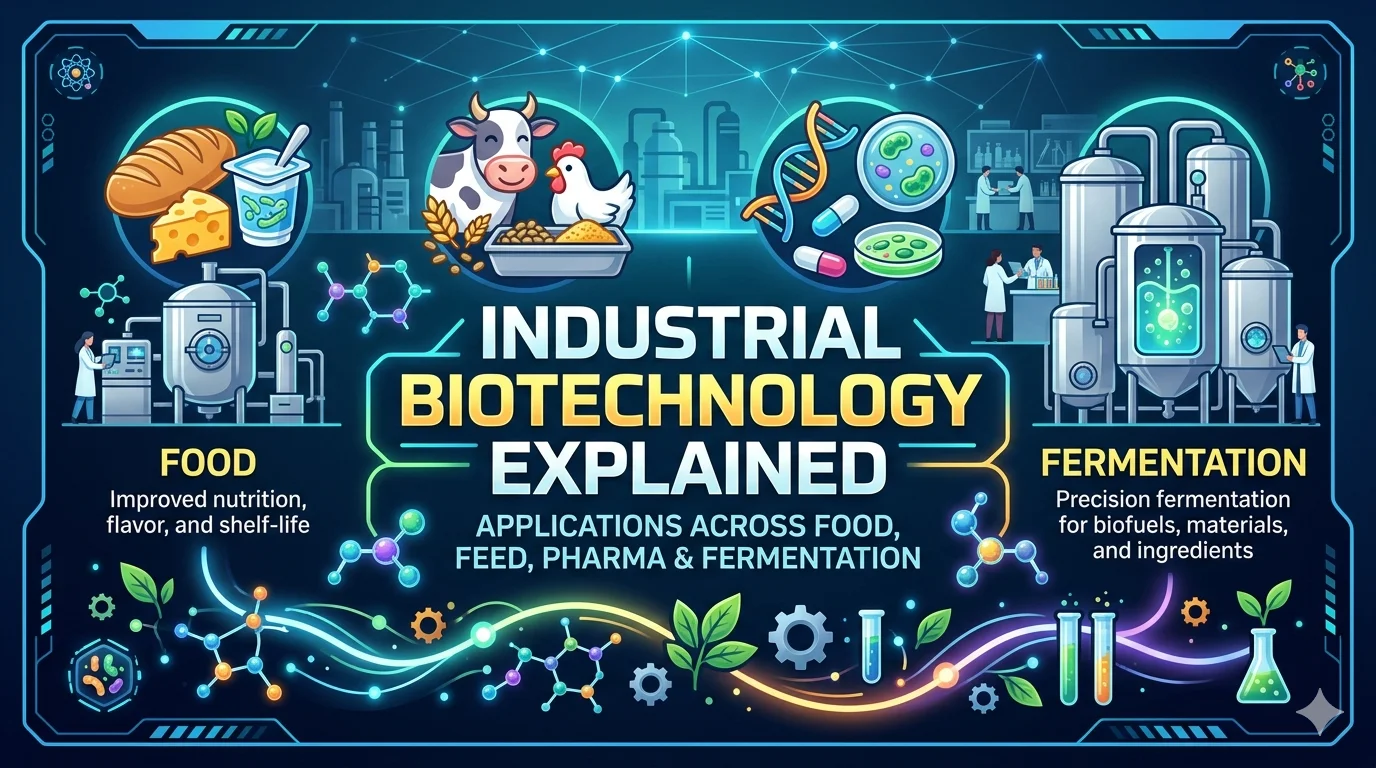
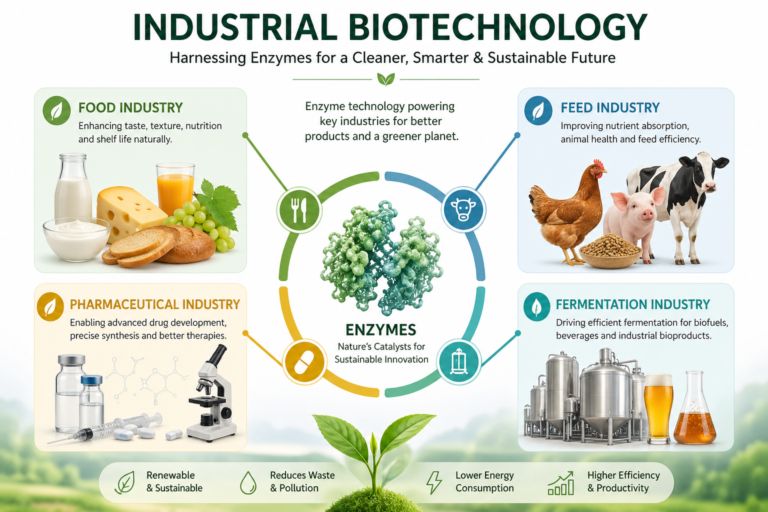
Industrial biotechnology is changing the way manufacturers process raw materials, improve production efficiency and develop more sustainable industrial processes. At the centre of many of these applications are enzymes and fermentation technologies.
For manufacturers, industrial biotechnology can provide biological alternatives for specific processing challenges while supporting efficiency, consistency and resource optimization.
In this guide, we explain what industrial biotechnology is, how enzyme technology works, and how it is applied in Food & Nutrition, Animal Feed, and industrial Fermentation, including grain and molasses-based processes.
Industrial biotechnology, often called white biotechnology, uses biological systems such as microorganisms, enzymes and fermentation processes to develop or improve industrial products and manufacturing processes.
Instead of relying only on conventional chemical processing, biotechnology uses biological mechanisms to perform specific reactions.
Enzymes are particularly important because they act as biological catalysts. They accelerate specific biochemical reactions and can help manufacturers break down proteins, starches, fibres and other complex materials under suitable processing conditions.
Industrial biotechnology combines:
The objective is to use biological processes to achieve reliable industrial performance while improving process efficiency and supporting more sustainable manufacturing.
Modern manufacturers are looking for ways to improve productivity while managing raw-material costs, energy consumption, waste and process consistency.
Industrial biotechnology can contribute to these objectives by enabling more targeted biological reactions.
Enzyme-based processes can help manufacturers:
However, biotechnology is not simply about adding an enzyme to a process. The enzyme must be appropriate for the substrate and operating conditions.
Factors such as temperature, pH, enzyme activity, dosage, processing time and raw-material composition can all influence performance.
Enzymes are among the most widely used biotechnology tools in industrial processing.
Different enzymes target different substrates and reactions.
For example:
The appropriate enzyme depends on the application and process.
This is why manufacturers often work with an industrial enzyme manufacturer that can provide technical guidance alongside the enzyme product.
The food and nutrition industry is one of the important application areas for industrial enzymes.
Enzymes can support processes involving starch, protein, fibre, carbohydrates and other food ingredients.
Depending on the application, enzyme technology can be used for:
For example, proteases can support protein hydrolysis, while enzymes such as pectinases can be used in fruit and vegetable processing. Xylanase and other enzyme systems can support specific food-processing requirements.
Leaf CleanTech develops enzyme formulations for food and nutrition applications, including products such as protease, xylanase, cellulase, beta-glucanase, papain, pectinase and other application-specific formulations.
Food-processing conditions vary significantly between applications.
An enzyme that performs well in one process may not provide the same results in another because of differences in:
Therefore, food manufacturers should select enzyme solutions based on their specific process requirements.
Industrial biotechnology also plays an important role in animal nutrition and feed manufacturing.
Plant-based feed ingredients can contain components that may limit nutrient availability or interfere with digestion. Specific feed enzymes can help break down these components under appropriate conditions.
Common feed enzyme categories include:
These enzymes can support objectives such as nutrient utilization, digestibility and feed efficiency, depending on the feed formulation and application.
Leaf CleanTech's animal feed enzyme portfolio includes enzyme solutions such as phytase, xylanase, protease, cellulase, beta-glucanase, mannanase and amylase.
Different enzymes target different components of feed ingredients.
For example, phytase targets phytate, while xylanase and other carbohydrases can act on components of plant cell walls.
The objective is not simply to use more enzymes. Instead, manufacturers need to select the right enzyme activity and dosage for the feed formulation and processing conditions.
This makes technical expertise an important part of industrial enzyme selection.
Fermentation is one of the foundational technologies within industrial biotechnology.
Microorganisms such as yeast can convert fermentable sugars into products such as ethanol and other fermentation products.
However, in many industrial processes, the raw material does not initially contain all the sugars in a form that microorganisms can readily use.
This is where enzymes become important.
Enzymes can help convert complex carbohydrates or starch into simpler fermentable sugars before or during fermentation.
Leaf CleanTech focuses on fermentation applications involving grain and molasses, providing enzyme and fermentation solutions designed around these processes.
Grains such as corn, rice, wheat, sorghum and other starch-rich raw materials contain significant amounts of starch.
Yeast cannot directly ferment starch efficiently. The starch must first be broken down into simpler sugars.
This is where enzyme technology plays a critical role.
A typical grain fermentation process can involve:
Grain → Starch → Liquefaction → Saccharification → Fermentable Sugars → Fermentation
Enzymes such as alpha-amylase and glucoamylase can support different stages of starch conversion.
Alpha-amylase hydrolyzes starch and reduces its molecular complexity, supporting the liquefaction stage.
Glucoamylase further converts starch-derived dextrins into glucose and other fermentable sugars, supporting downstream fermentation.
Leaf CleanTech provides high-temperature bacterial alpha-amylase and glucoamylase solutions for grain fermentation applications.
Molasses is another important raw material for industrial fermentation.
Unlike grain fermentation, where starch must first be converted into fermentable sugars, molasses already contains significant amounts of fermentable sugars.
However, molasses composition can vary, and fermentation efficiency can be affected by factors such as unfermentable sugars and microbial contamination.
Specialized enzyme solutions can therefore be used to support particular molasses fermentation challenges.
Leaf CleanTech provides fermentation solutions for molasses applications, including enzyme and yeast products designed around fermentation efficiency and process requirements.
The objective of enzyme application in fermentation is not simply to increase enzyme dosage.
Manufacturers need to consider:
An application-specific approach can help manufacturers identify where enzymes can provide the greatest process benefit.
One of the major reasons industries are interested in biotechnology is its potential to support more efficient use of biological resources.
Enzymes can perform highly specific reactions under suitable conditions, which can make them useful tools for process optimization.
In the right application, enzyme technology can help manufacturers:
However, sustainability benefits depend on the complete process. Enzyme technology should therefore be evaluated based on measurable process outcomes rather than assumed benefits.
Successful biotechnology applications require more than selecting an enzyme from a product catalogue.
A good solution starts with understanding the customer's process.
Important parameters include:
Different raw materials contain different substrates and compositions.
Temperature, pH and processing time influence enzyme activity.
The required enzyme activity depends on the application and substrate concentration.
Using the appropriate dosage is important for balancing performance and process economics.
The desired outcome should be clearly defined, whether it is improved conversion, digestibility, fermentation efficiency or another measurable process parameter.
Consistent enzyme activity is important for predictable industrial production.
This is why collaboration between the manufacturer and enzyme supplier can be valuable.
Food & Nutrition, Animal Feed, and Fermentation.
The company's enzyme solutions are developed around specific industrial processing requirements, with a focus on performance, reliability and application support.
For fermentation, Leaf CleanTech provides solutions for grain and molasses-based applications, including alpha-amylase, glucoamylase, fermentation booster enzymes and active dry yeast.
For food and nutrition, its portfolio includes enzyme solutions for applications such as protein processing, starch processing, baking, juice processing and other food-manufacturing processes.
Industrial biotechnology uses biological systems such as enzymes, microorganisms and fermentation processes to develop or improve industrial products and manufacturing processes.
Industrial enzymes are biological catalysts used to accelerate specific biochemical reactions in commercial processes. Examples include amylase, protease, xylanase, cellulase and phytase.
Industrial biotechnology has applications across many sectors. For Leaf CleanTech, the core application areas are Food & Nutrition, Animal Feed and Fermentation.
Enzymes can support processes such as starch conversion, protein hydrolysis, baking, juice processing, ingredient modification and other food-processing applications.
Feed enzymes can help break down specific components of feed ingredients and support nutrient utilization and digestibility, depending on the formulation and enzyme used.
Grains contain starch, which must be converted into fermentable sugars before yeast can effectively utilize it. Enzymes such as alpha-amylase and glucoamylase support different stages of this conversion.
Specialized enzyme solutions can support specific challenges in molasses fermentation, including the conversion of certain unfermentable sugars and process optimization, depending on the application.
The right enzyme depends on the substrate, raw material, temperature, pH, processing conditions, required enzyme activity, dosage and desired production outcome. Application-specific technical evaluation is recommended.
Industrial biotechnology is becoming an important tool for manufacturers looking to improve processes through biological systems.
Enzyme technology is particularly valuable because enzymes can perform highly specific reactions under suitable processing conditions.
In Food & Nutrition, enzymes support applications ranging from starch and protein processing to baking and juice processing.
In Animal Feed, enzymes can support nutrient utilization and digestibility by acting on specific feed components.
In Fermentation, enzymes are particularly important in grain and molasses-based processes, where they can support raw-material conversion and fermentation performance.
For manufacturers, the key is not simply choosing an enzyme, but selecting the right enzyme solution for the right process.
Looking for an enzyme solution for Food & Nutrition, Animal Feed, or Grain & Molasses Fermentation?
Leaf CleanTech works with manufacturers to understand their process requirements and identify application-focused enzyme solutions.
Have a specific processing challenge? Talk to our technical team about your application.
©2026. Leaf CleanTech - All Rights Reserved.