
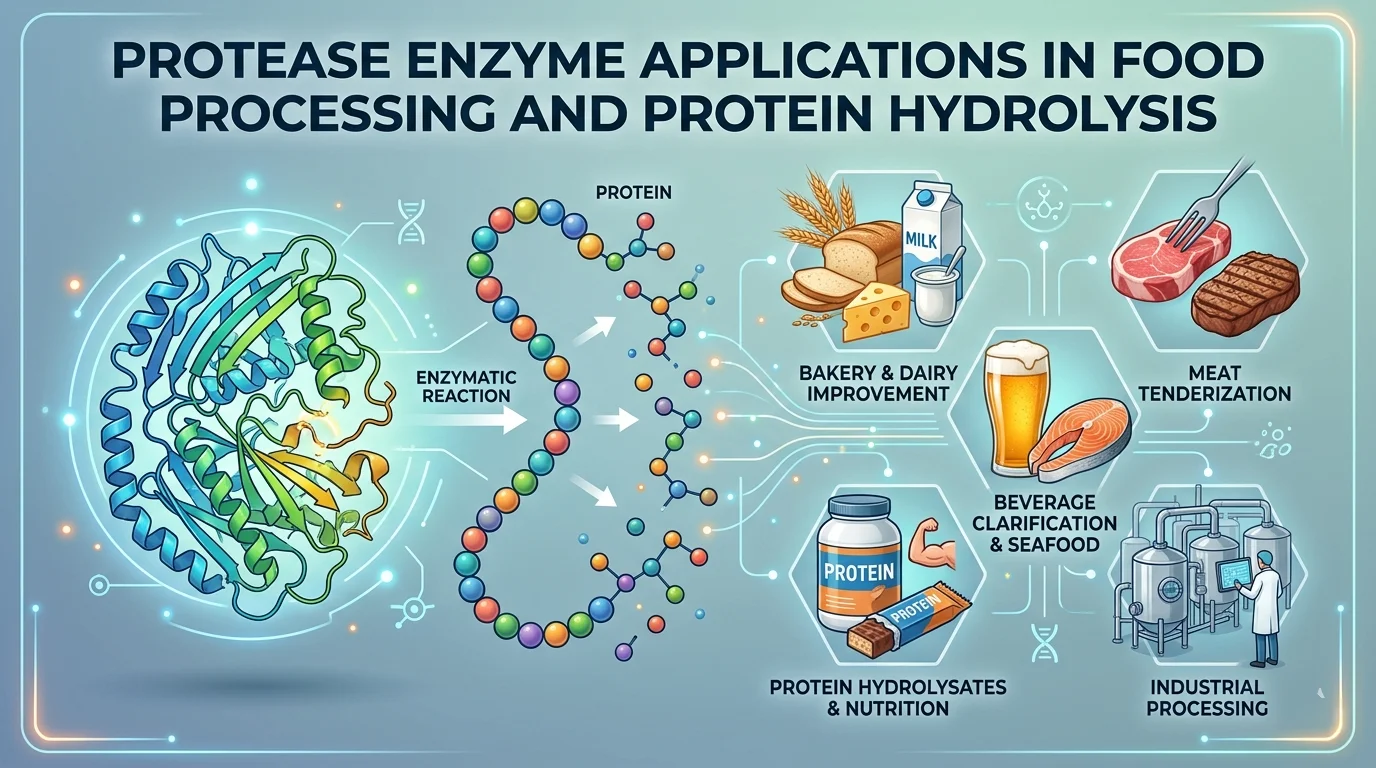
Proteins are essential components of many foods and nutritional products. However, the natural structure of proteins can sometimes create challenges related to solubility, digestibility, texture, flavour, and processing. This is where protease enzymes play an important role.
Protease enzyme applications are increasingly important across the food and beverage industry because these enzymes can break complex proteins into smaller peptides and amino acids through a controlled process called protein hydrolysis.
From plant-based protein processing and dairy products to meat tenderisation, baking, brewing, beverages, and nutritional products, proteases provide manufacturers with a practical way to modify protein functionality.
Moreover, as consumer demand grows for high-protein foods, plant-based products, functional foods, sports nutrition, and easily digestible protein ingredients, the importance of enzymatic protein hydrolysis continues to increase.
In this comprehensive guide, we explain protease enzyme applications in food processing, how proteases work, the benefits of enzymatic protein hydrolysis, major food-industry applications, factors affecting enzyme performance, and how to select the right protease for your process.
A protease enzyme is an enzyme that breaks the peptide bonds connecting amino acids in proteins.
In simple terms, proteases convert large protein molecules into smaller peptides and, with further hydrolysis, amino acids.
This natural biochemical process is known as proteolysis or protein hydrolysis.
Proteases are produced naturally by plants, animals, and microorganisms. For commercial food processing, however, proteases are commonly produced through controlled microbial fermentation and formulated for specific industrial applications.
Depending on their source and characteristics, proteases can work under different pH and temperature conditions.
Therefore, choosing the right enzyme is essential for achieving consistent and predictable results.
Protein hydrolysis is the process of breaking proteins into smaller molecular components, primarily peptides and amino acids.
When protease enzymes are used to carry out this process, it is called enzymatic protein hydrolysis.
During hydrolysis, the enzyme acts on peptide bonds within the protein structure. As a result, the original protein is gradually converted into smaller peptide fragments.
The extent of this breakdown can be controlled according to the desired application.
For example:
Consequently, controlling the degree of hydrolysis (DH) is an important part of protein-processing applications.
Although the exact process varies according to the food matrix, enzymatic protein hydrolysis generally involves several stages.
First, the selected protein source is prepared for enzymatic treatment.
Common protein sources include:
Next, the processing conditions are adjusted according to the selected protease.
Every enzyme has an optimum pH and temperature range. Therefore, controlling these parameters is essential for maintaining enzyme activity.
The appropriate protease is then added at a predetermined dosage.
The enzyme begins hydrolysing peptide bonds within the protein. As the reaction progresses, larger proteins are converted into smaller peptides.
The reaction is monitored until the desired degree of hydrolysis is reached.
This is particularly important because excessive hydrolysis can sometimes produce undesirable flavour, bitterness, or changes in functionality.
Therefore, process optimisation is necessary to achieve the desired balance.
Once the required hydrolysis level has been achieved, enzyme activity is stopped through an appropriate validated process.
This prevents the reaction from continuing beyond the desired endpoint.
Finally, the hydrolysed protein may be filtered, concentrated, dried, or otherwise processed depending on the intended application.
The resulting protein hydrolysate can then be incorporated into food, beverage, nutritional, or functional formulations.
Proteases are versatile food-processing enzymes with applications across numerous industries.
However, the specific application depends on the type of protease, protein substrate, pH, temperature, processing time, and desired result.
The following are some of the most important protease enzyme applications in food processing.
The growing popularity of plant-based foods has created significant demand for technologies that can improve the functionality of plant proteins.
Proteases can be used to hydrolyse proteins derived from:
Plant proteins can sometimes have limitations related to solubility, flavour, texture, and functional performance.
Controlled enzymatic hydrolysis can modify the protein structure and potentially improve properties such as solubility, emulsification, and foaming.
As a result, protease enzymes are increasingly relevant to:
Plant proteins contain complex structures that may limit their performance in certain food formulations.
Protease treatment can partially break down these structures. Consequently, smaller peptides may become more readily dispersed in food systems.
However, the extent of hydrolysis must be carefully controlled because excessive hydrolysis may affect flavour and other functional properties.
Therefore, application-specific enzyme selection is important.
Dairy proteins such as casein and whey are widely used in food and nutrition products.
Proteases can modify these proteins through controlled hydrolysis and are therefore used in several dairy-related applications.
Potential applications include:
During cheese production and ripening, controlled protein breakdown contributes to changes in texture, flavour, and aroma.
Furthermore, hydrolysed dairy proteins can be used in specialised nutritional formulations where specific protein characteristics are required.
Meat tenderisation is another well-established protease enzyme application.
Certain proteases can break down selected proteins in muscle tissue and connective structures. As a result, meat can become more tender.
Proteases such as papain are commonly associated with enzymatic meat tenderisation.
Applications may include:
The enzyme concentration, contact time, temperature, and method of application should be carefully controlled.
Otherwise, excessive proteolysis can negatively affect meat texture.
Therefore, controlled enzymatic treatment is essential.
Proteases are also used in the baking industry, particularly for modifying gluten proteins.
Gluten plays an important role in dough structure. However, excessive gluten strength can sometimes affect dough handling and processing.
Controlled proteolysis can modify gluten and influence dough characteristics.
Potential applications include:
Consequently, protease enzymes can help manufacturers achieve desired processing characteristics while maintaining control over dough properties.
Proteases can also have a role in brewing by modifying proteins that may contribute to haze formation and stability challenges.
Controlled protein hydrolysis can help manage protein-related characteristics in beer processing.
Potential applications include:
However, enzyme selection and dosage should be carefully evaluated because excessive protein breakdown can influence the final product's characteristics.
Protein-related turbidity can sometimes create challenges in certain beverages.
Proteases can be used in selected beverage-processing applications to hydrolyse proteins and support clarification or stability.
Potential applications include:
For acidic systems, selecting a protease that remains active under low-pH conditions is particularly important.
Therefore, acid-tolerant proteases can be considered where the processing environment requires them.
Fish and seafood processing produces protein-rich materials that can potentially be converted into valuable ingredients.
Protease-assisted hydrolysis can break marine proteins into smaller peptides and amino acids.
The resulting hydrolysates may be explored for applications in:
Consequently, enzymatic hydrolysis can contribute to better utilisation of protein-rich processing materials.
Protein hydrolysates are increasingly used in specialised nutrition and sports-nutrition formulations.
Compared with intact proteins, hydrolysed proteins contain smaller peptide structures.
Protease enzymes can therefore be used to produce protein hydrolysates from selected protein sources.
Applications can include:
The desired hydrolysis level depends on the product's formulation requirements.
Another important area of protease research is the production of peptides with potential biological activity.
During enzymatic hydrolysis, specific peptide sequences can be released from larger proteins.
Researchers have investigated food-derived peptides for potential activities including:
Therefore, protease-assisted hydrolysis has applications beyond traditional food processing and may contribute to the development of innovative functional ingredients.
Large and complex proteins may require extensive digestion before their amino acids and smaller peptides become available.
Controlled enzymatic hydrolysis can break proteins into smaller structures.
As a result, protein hydrolysates may offer improved digestibility characteristics compared with some intact proteins.
This makes protease enzymes relevant to specialised nutrition and functional food development.
However, digestibility depends on the protein source, degree of hydrolysis, peptide composition, and final formulation.
Protein hydrolysis can be achieved through enzymatic or chemical methods.
However, enzymatic hydrolysis provides a more controlled approach because proteases can be selected according to their substrate specificity and operating conditions.
| Application | Protein Source | Main Purpose |
|---|---|---|
| Plant Protein Hydrolysis | Soy, pea, chickpea, legumes | Protein modification and improved functionality |
| Dairy Processing | Casein, whey | Protein hydrolysis and modification |
| Meat Processing | Muscle proteins | Controlled meat tenderisation |
| Baking | Wheat and gluten proteins | Dough modification and improved processing |
| Brewing | Grain proteins | Protein modification and haze management |
| Beverage Processing | Food proteins | Protein hydrolysis and clarification |
| Seafood Processing | Fish and marine proteins | Protein hydrolysate production |
| Sports Nutrition | Dairy and plant proteins | Production of hydrolysed protein ingredients |
| Functional Foods | Plant and animal proteins | Production of peptide-rich functional ingredients |
| Specialised Nutrition | Selected food proteins | Controlled protein hydrolysis and digestibility |
As a result, enzymatic hydrolysis is increasingly considered when manufacturers require controlled protein modification.
There is no single protease that is ideal for every food-processing application.
Instead, enzyme selection should begin with a clear understanding of the process.
Determine whether the substrate is:
Identify the pH at which hydrolysis will occur.
Then select a protease that performs effectively under those conditions.
The enzyme should remain sufficiently active and stable at the intended temperature.
Determine whether you need limited, moderate, or extensive hydrolysis.
Consider whether your priority is:
Laboratory or pilot-scale trials can help determine the appropriate enzyme, dosage, reaction time, pH, and temperature.
This application-based approach helps reduce unnecessary enzyme use while improving process consistency.
Different proteases have different properties and application profiles.
Acid proteases perform effectively under acidic conditions.
They can therefore be considered for applications involving low-pH food and beverage systems.
Potential applications include:
Neutral proteases generally perform around neutral pH conditions.
They can be useful for applications such as:
Papain is a cysteine protease obtained from papaya.
It is widely associated with protein hydrolysis and meat tenderisation.
Depending on the formulation and processing conditions, papain can also be used in other food-processing applications.
Alkaline proteases perform under alkaline conditions and are commonly associated with industrial protein hydrolysis processes.
Their suitability for food applications depends on the specific enzyme formulation and regulatory requirements.
Choosing a protease supplier is not simply about selecting an enzyme with high activity.
Instead, successful implementation requires an understanding of the complete food-processing system.
Leaf CleanTech focuses on developing enzyme solutions around specific processing requirements.
Key areas include:
With an application-focused approach, manufacturers can evaluate enzyme performance according to their actual substrate and processing conditions.
Protease enzyme applications include protein hydrolysis, plant protein modification, meat tenderisation, dairy processing, baking, brewing, beverage processing, seafood protein hydrolysis, sports nutrition, and functional food development.
A protease breaks peptide bonds in proteins. As a result, large protein molecules are converted into smaller peptides and, with further hydrolysis, amino acids.
Enzymatic protein hydrolysis is the controlled breakdown of proteins using enzymes such as proteases. The process produces smaller peptides and amino acids and can modify protein solubility, digestibility, flavour, and functionality.
Key benefits include controlled protein modification, improved solubility, enhanced digestibility, protein hydrolysate production, texture modification, and the potential generation of bioactive peptides.
Yes. Proteases can be used to hydrolyse soy, pea, chickpea, and other plant proteins. Controlled hydrolysis can modify their solubility, emulsification, foaming, and other functional characteristics.
There is no universal best protease. The appropriate enzyme depends on the plant protein source, pH, temperature, desired degree of hydrolysis, reaction time, and final product requirements.
Proteases can break down selected muscle and connective-tissue proteins. Therefore, they can be used for controlled meat tenderisation.
Yes. Proteases are used in dairy applications including cheese processing, protein modification, casein hydrolysis, whey protein hydrolysis, and the production of dairy protein hydrolysates.
Controlled protein hydrolysis can reduce protein molecular size and may improve solubility and dispersibility in certain food formulations.
The degree of hydrolysis indicates the extent to which peptide bonds in a protein have been broken. It is an important parameter because it influences peptide size and the resulting functional and sensory characteristics.
Important factors include pH, temperature, enzyme dosage, reaction time, protein concentration, substrate structure, and the desired degree of hydrolysis.
Start by identifying the protein substrate, pH, temperature, desired hydrolysis level, processing time, and final product requirements. Application testing can then be used to determine the appropriate enzyme and dosage.
Protease enzyme applications have become increasingly important in modern food processing because they provide manufacturers with a controlled way to modify proteins.
From plant protein hydrolysis and dairy processing to meat tenderisation, baking, brewing, beverages, sports nutrition, and functional foods, proteases can support a wide variety of food-processing requirements.
More importantly, enzymatic protein hydrolysis allows manufacturers to tailor protein characteristics according to the needs of the final product.
However, successful results depend on selecting the right enzyme and controlling critical parameters such as pH, temperature, enzyme dosage, reaction time, and degree of hydrolysis.
Therefore, instead of choosing a protease based solely on enzyme activity, manufacturers should evaluate the complete application and desired outcome.
If you are evaluating protease enzyme applications for food processing, plant protein hydrolysis, protein hydrolysate production, meat tenderisation, dairy processing, or other protein-based applications, Leaf CleanTech can help identify an appropriate enzyme solution for your process.
Explore Leaf CleanTech's protease enzyme solutions or contact the technical team to discuss your specific protein-processing requirement.
[…] more about protease applications in food processing and protein hydrolysis , or explore the complete food and nutrition enzyme portfolio […]
©2026. Leaf CleanTech - All Rights Reserved.
Enzyme Supplier in Bangalore - Leaf CleanTech
April 11, 2026[…] Related resource: [Protease Enzyme Applications in Food Processing & Protein Hydrolysis] […]