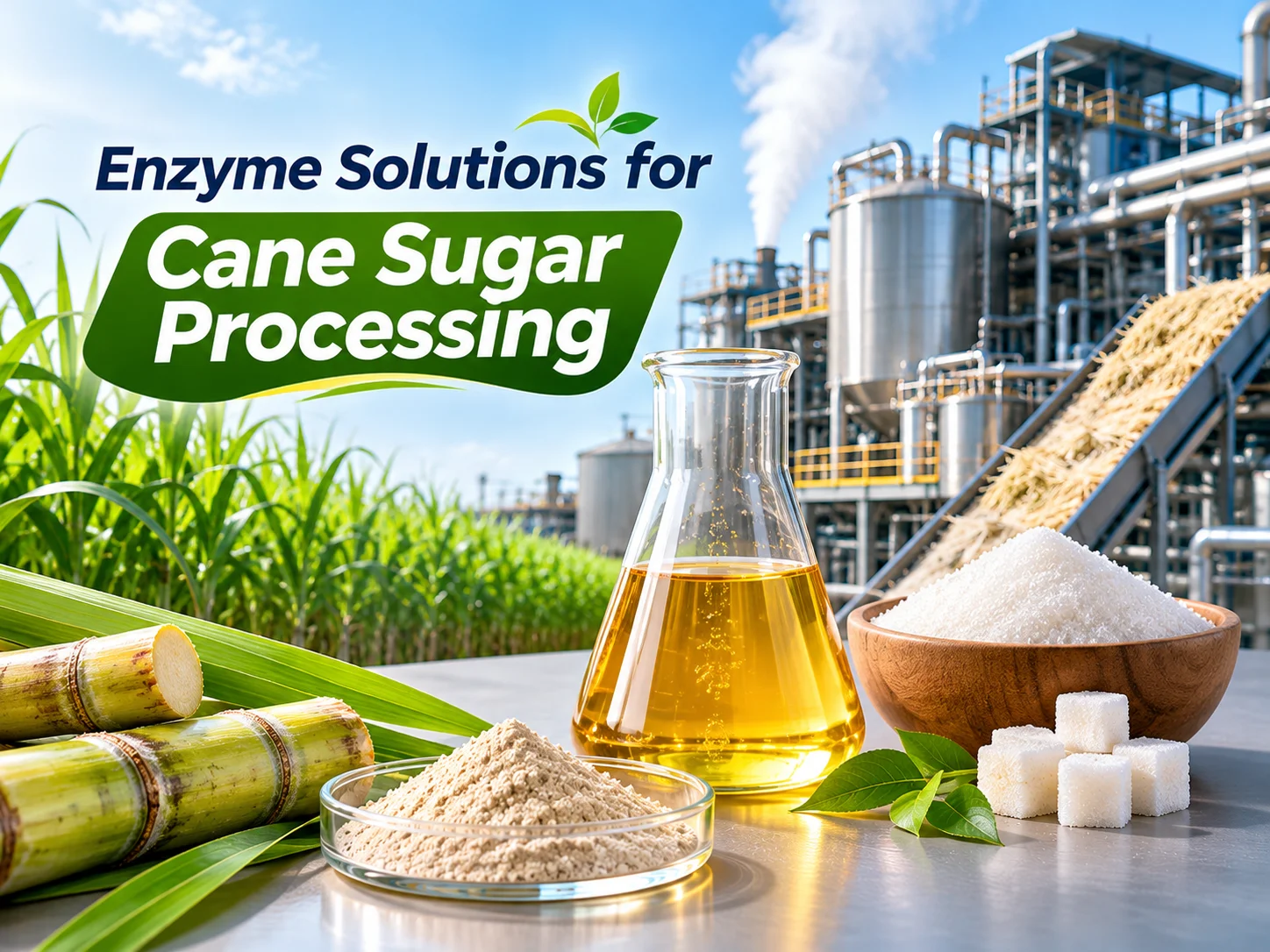
Sugarcane processing involves several interconnected operations, from juice extraction and clarification to evaporation, crystallization and by-product utilization. Each stage presents different production challenges. Therefore, sugar manufacturers and distillery operators must select suitable processing solutions based on their raw materials, plant configuration and production objectives.
Industrial enzymes offer targeted ways to support specific reactions in sugarcane-based manufacturing. For example, selected enzymes can help convert complex carbohydrates, improve sugar utilization during fermentation and address particular processing challenges. However, not every enzyme performs the same function, and the right product depends on the stage where you intend to use it.
For sugar mills with integrated distilleries, enzyme selection becomes especially important. Cane juice, syrup and molasses can serve as fermentation feedstocks. Nevertheless, each material has a different composition and may require a different enzyme strategy.
In this guide, we explain how to select enzyme solutions for cane sugar processing, what buyers should evaluate before purchasing and how to identify suitable products for cane juice, syrup and molasses fermentation.
Sugarcane contains sucrose, reducing sugars, fibre, water and other natural components. Sugar mills process the cane to extract juice and recover sugar crystals. Meanwhile, some facilities use cane juice, syrup or molasses as feedstocks for fermentation and ethanol production.
Enzymes act as biological catalysts. They accelerate specific reactions by acting on suitable substrates. Consequently, manufacturers can use selected enzyme products to address particular process requirements.
However, the application determines the enzyme choice. An enzyme that supports molasses fermentation may not serve the same purpose as an enzyme used for starch conversion or sugar processing.
| Process Area | Typical Objective | Enzyme Selection Consideration |
|---|---|---|
| Cane juice and syrup fermentation | Improve utilization of available sugars and fermentation performance. | Consider a product specifically developed for cane juice or syrup fermentation. |
| Molasses fermentation | Address unfermentable sugars and fermentation challenges. | Evaluate molasses-specific fermentation enzyme solutions. |
| Starch conversion | Break down starch into smaller carbohydrates and fermentable sugars. | Evaluate alpha amylase and glucoamylase according to the process stage. |
| Fermentation yeast management | Support consistent yeast performance and fermentation operations. | Evaluate a suitable yeast strain for the feedstock and operating conditions. |
| Sugar processing and clarification | Manage juice impurities, suspended solids and other process challenges. | Identify the specific processing issue before selecting an enzyme or process aid. |
Therefore, manufacturers should not choose an enzyme simply because it carries a sugar industry label. Instead, match the product's activity and intended application to the actual process challenge.
Before selecting an enzyme, understand how your plant processes sugarcane. A typical cane sugar manufacturing operation includes several stages, and each stage has different operating conditions and quality requirements.
Sugar mills first prepare harvested cane for extraction. The preparation process may involve cutting, shredding and crushing. Mills then extract juice through milling or diffusion systems.
At this stage, manufacturers focus on effective juice extraction and the recovery of sucrose from the cane. The extracted juice then moves to the next processing operations.
Raw cane juice contains suspended solids, colloidal materials and other non-sugar components. Clarification helps separate these impurities before the juice moves to evaporation.
Depending on the plant configuration, manufacturers use suitable clarification and filtration methods. However, the exact treatment requirements vary with cane quality, juice characteristics and plant operating conditions.
After clarification, the juice enters evaporation systems. These systems remove water and concentrate the juice into syrup. Manufacturers monitor concentration, heat transfer and operating efficiency throughout this stage.
The concentrated syrup enters vacuum pans, where controlled evaporation encourages sugar crystal formation. Centrifugation then separates the crystals from the remaining mother liquor.
The separated sugar crystals move towards drying and packaging. Meanwhile, the residual molasses can serve as a valuable by-product for animal feed or fermentation applications.
Some sugar factories integrate distilleries into their operations. These facilities can use molasses, cane juice or syrup as fermentation feedstocks, depending on their process design.
At this stage, fermentation enzymes and suitable yeast strains can support sugar utilization and fermentation performance. Therefore, sugar manufacturers with integrated distilleries should evaluate fermentation-specific enzyme solutions separately from their primary sugar recovery operations.
Fermentation performance depends on several factors, including feedstock composition, fermentable sugar availability, yeast health, temperature, pH and microbial contamination.
Even when a plant uses suitable yeast and maintains its operating conditions, certain challenges may affect fermentation efficiency. For example, some carbohydrate fractions may remain unfermented, while microbial contamination can interfere with yeast performance.
Suitable enzyme solutions can target specific challenges within this process.
Therefore, manufacturers should identify the main performance limitation before choosing an enzyme. A targeted product may help address a specific issue, but it cannot replace proper process control and sanitation.
Cane juice and syrup provide fermentable sugars for industrial fermentation. However, their composition and operating conditions may vary according to the extraction and concentration processes.
When a distillery uses these feedstocks, it should evaluate enzyme products designed for cane juice or syrup fermentation rather than automatically selecting a molasses-specific product.
LEAFFERM J from Leaf CleanTech is a specialized enzyme solution for cane juice and syrup fermentation. The product is designed to support fermentation efficiency by acting on unfermentable sugars, invigorating yeast cells and helping reduce microbial contamination.
Its application focuses on three key areas:
As a result, LEAFFERM J offers an application-focused option for distilleries that process cane juice or syrup. However, manufacturers should evaluate its suitability against their feedstock composition, operating conditions and fermentation objectives.
Learn more about Leaf CleanTech fermentation enzyme solutions or explore the complete fermentation product portfolio.
Molasses is an important by-product of cane sugar manufacturing. Sugar factories and integrated distilleries often use it as a feedstock for ethanol and other fermentation-based products.
However, molasses fermentation can present challenges related to unfermentable sugars, feedstock composition and microbial contamination. Therefore, selecting a suitable fermentation enzyme can help manufacturers address specific process limitations.
MOLZYME from Leaf CleanTech is designed for molasses fermentation. Its stated application focuses on improving fermentation efficiency through three key functions.
These functions make MOLZYME relevant for distilleries that want to evaluate additional support for molasses fermentation. Nevertheless, the actual process benefit depends on feedstock quality, yeast performance, dosage and operating conditions.
Explore molasses fermentation enzymes from Leaf CleanTech for more information about product applications.
Both products support sugarcane-based fermentation. However, they target different feedstock applications. Therefore, the first selection step is to identify whether your plant uses cane juice or syrup, or molasses.
| Comparison Factor | LEAFFERM J | MOLZYME |
|---|---|---|
| Primary Application | Cane juice and syrup fermentation. | Molasses fermentation. |
| Product Category | Cane juice / syrup fermentation enzyme. | Molasses fermentation booster enzyme. |
| Unfermentable Sugars | Helps convert unfermentable sugars into fermentable forms. | Helps hydrolyse unfermentable sugars. |
| Yeast Support | Designed to invigorate yeast cells. | Designed to invigorate yeast cells. |
| Contamination Management | Helps reduce microbial contamination. | Helps control microbial contamination. |
| Suitable Buyer | Distilleries processing cane juice or syrup. | Distilleries processing molasses. |
Selection guidance: Choose LEAFFERM J when your fermentation feedstock is cane juice or syrup. Consider MOLZYME when your plant processes molasses. If your facility handles multiple feedstocks, discuss each application separately with the Leaf CleanTech technical team.
Enzyme selection is only one part of fermentation optimization. Yeast also plays a central role because it converts fermentable sugars into ethanol and carbon dioxide.
Different feedstocks and operating conditions can influence yeast performance. Therefore, distilleries should evaluate yeast characteristics alongside their enzyme selection.
Leaf CleanTech offers LEAFALCO YEAST-M, an active dry yeast strain designed for fermentation using cane sugar molasses.
According to the product information, its intended application includes beverage, industrial and fuel-grade ethanol production. The product highlights characteristics such as faster budding, increased fermentation rate, reduced fermentation cycles, tolerance to higher alcohol concentrations and high-gravity fermentation.
These characteristics make it a relevant option for distilleries evaluating yeast solutions for molasses-based fermentation.
However, yeast selection should always account for the feedstock, fermentation conditions and plant requirements. Ask the supplier for product-specific specifications and application guidance before purchasing.
Explore Leaf CleanTech fermentation products to learn more about its enzyme and yeast portfolio.
Before placing an order, define your process requirements and compare the available products. The following selection steps can help your technical and procurement teams make an informed decision.
Determine whether your plant uses fresh cane juice, concentrated syrup, B-heavy molasses, C-heavy molasses or blended feedstocks. These materials have different characteristics, so the supplier needs accurate information before recommending an enzyme.
Review your fermentation data and identify the issue you want to address. For example, you may need to investigate residual unfermentable sugars, microbial contamination or inconsistent fermentation performance.
Match the product to the feedstock and process objective. For cane juice or syrup fermentation, evaluate LEAFFERM J. For molasses fermentation, consider MOLZYME.
Request the technical data sheet, activity information, recommended dosage, storage conditions and shelf life. Additionally, verify the packaging and minimum order quantity.
Review the yeast strain, alcohol tolerance and fermentation characteristics. If necessary, discuss the enzyme and yeast combination with the supplier before beginning a trial.
Compare a test batch with your existing process. Keep the important operating conditions consistent and record relevant performance indicators.
Evaluate enzyme consumption, fermentation performance, process costs and final output. This helps determine whether the product offers practical value for your plant.
Industrial enzyme procurement requires careful review of product quality and application specifications. Before approving a supplier, request the following information.
| Specification | What to Check | Why It Matters |
|---|---|---|
| Product Identity | Product name, enzyme category and intended application. | Confirms that the product matches your process requirement. |
| Physical Form | Powder or liquid formulation. | Helps assess dosing, handling and storage compatibility. |
| Recommended Dosage | Application-specific dosage and addition method. | Supports process planning and cost evaluation. |
| Operating Conditions | Relevant temperature, pH and process requirements. | Helps determine whether the enzyme suits your production environment. |
| Shelf Life | Expiry period and storage conditions. | Supports inventory planning and product quality management. |
| Packaging | Available pack sizes and packaging material. | Helps plan storage, handling and procurement quantities. |
| Quality Documents | COA, TDS, SDS and applicable compliance information. | Supports technical and quality approval. |
Furthermore, ask for a batch-specific Certificate of Analysis and confirm the manufacturer's quality acceptance criteria. Do not compare products only by price or product name.
A controlled application trial helps determine whether an enzyme suits your process. However, the trial should use clear objectives and measurable results.
For cane juice, syrup or molasses fermentation, consider monitoring the following parameters:
Additionally, record the feedstock composition and operating conditions during each trial. This makes the results easier to interpret and helps your team understand whether the enzyme contributed to the observed changes.
Do not assume that a single successful batch guarantees the same result under every production condition. Repeat trials can help establish a more reliable performance assessment.
Leaf CleanTech develops industrial enzyme and fermentation solutions for manufacturers across Food & Nutrition, Animal Feed and Fermentation applications.
For sugarcane-based distillery operations, its fermentation portfolio includes products designed for cane juice, syrup and molasses applications.
Leaf CleanTech offers LEAFFERM J for cane juice and syrup fermentation and MOLZYME for molasses fermentation. This helps buyers identify products according to their actual feedstock rather than selecting a general-purpose enzyme.
The fermentation portfolio also includes LEAFALCO YEAST-M for cane sugar molasses fermentation. Therefore, distilleries can discuss both enzyme and yeast requirements with the company.
Leaf CleanTech focuses on enzyme solutions for different industrial processing requirements. Its portfolio covers food processing, animal nutrition and fermentation applications.
Different plants operate under different conditions. Leaf CleanTech also offers customized enzyme formulations, allowing customers to discuss application-specific requirements with its team.
Enzyme selection depends on feedstock characteristics, operating conditions and the intended production outcome. Discussing these details with the supplier can help your team identify suitable products for evaluation.
Visit Leaf CleanTech to explore its industrial enzyme and fermentation solutions.
If your sugar mill operates an integrated distillery, explore the following products according to your fermentation feedstock and production requirements.
| Product | Application | Key Function | Product Information |
|---|---|---|---|
| LEAFFERM J | Cane juice and syrup fermentation. | Acts on unfermentable sugars, supports yeast cells and helps reduce microbial contamination. | Explore Product Information |
| MOLZYME | Molasses fermentation. | Hydrolyses unfermentable sugars, supports yeast cells and helps manage microbial contamination. | Explore Product Information |
| LEAFALCO YEAST-M | Cane sugar molasses fermentation. | Active dry yeast for beverage, industrial and fuel-grade ethanol applications. | Explore Fermentation Products |
For product specifications, dosage recommendations, packaging and application guidance, contact Leaf CleanTech directly.
Use this checklist when comparing enzyme suppliers and reviewing products for your sugar mill or distillery.
By following these steps, your team can compare enzyme options more effectively and reduce the risk of selecting an unsuitable product.
Enzyme selection depends on the process. Sugarcane-based fermentation may use specialized enzymes that target unfermentable sugars and support fermentation performance. Other sugar processing applications may require different enzyme activities. Always identify the specific process challenge before selecting a product.
Sugar processing enzymes target specific reactions within sugar manufacturing or related operations. Fermentation enzymes support the conversion and utilization of sugars during fermentation. Therefore, their applications and performance requirements differ.
LEAFFERM J from Leaf CleanTech is specifically designed for cane juice and syrup fermentation. It helps convert unfermentable sugars into fermentable forms, supports yeast cells and helps reduce microbial contamination within its intended application.
MOLZYME from Leaf CleanTech is designed for molasses fermentation. Its stated functions include hydrolysis of unfermentable sugars, yeast cell support and microbial contamination management.
LEAFFERM J is a specialized enzyme for cane juice and syrup fermentation. It supports fermentation efficiency by acting on unfermentable sugars, invigorating yeast cells and helping reduce microbial contamination.
MOLZYME is a molasses fermentation enzyme from Leaf CleanTech. It helps hydrolyse unfermentable sugars, supports yeast cells and helps manage microbial contamination during the intended fermentation application.
Not necessarily. Cane juice, syrup and molasses differ in composition and process characteristics. Therefore, manufacturers should select an enzyme based on the feedstock and application. Leaf CleanTech offers LEAFFERM J for cane juice and syrup fermentation and MOLZYME for molasses fermentation.
Unfermentable sugars represent carbohydrate fractions that yeast cannot readily use under normal process conditions. Their presence can affect overall sugar utilization. A suitable fermentation enzyme may help convert certain fractions into fermentable sugars, depending on the feedstock composition and process conditions.
Yeast converts fermentable sugars into ethanol and carbon dioxide. Its performance depends on the strain, feedstock, temperature, pH, alcohol concentration and other operating conditions. Therefore, distilleries should select a suitable yeast alongside their enzyme system.
Dosage depends on the product, feedstock composition and operating conditions. Request product-specific guidance from the manufacturer and validate the recommendation through controlled trials. Avoid applying a general dosage without considering the actual process.
A suitable enzyme may support better utilization of certain unfermentable sugars and improve fermentation performance. However, the actual effect on ethanol yield depends on feedstock quality, yeast performance, contamination levels and process conditions. Measure the results through controlled trials.
Leaf CleanTech offers fermentation enzyme solutions for cane juice, syrup and molasses applications. Visit its contact page to enquire about product specifications, availability and application guidance.
Every sugarcane-based fermentation process has different requirements. Whether you process cane juice, syrup or molasses, Leaf CleanTech can help you explore suitable enzyme and yeast solutions for your application.
Share your feedstock, fermentation conditions and production objectives with the team to discuss the right product options.
Enquire About Fermentation EnzymesSelecting the right enzyme solution for cane sugar processing starts with understanding your production process. Sugar manufacturing, cane juice fermentation, syrup fermentation and molasses fermentation each have different technical requirements. Therefore, manufacturers should identify the target application before comparing enzyme products.
For integrated distilleries, enzyme solutions can support specific fermentation objectives such as unfermentable sugar conversion, yeast support and microbial contamination management. Leaf CleanTech offers LEAFFERM J for cane juice and syrup fermentation and MOLZYME for molasses fermentation. It also offers LEAFALCO YEAST-M for molasses-based fermentation.
Before purchasing, review product specifications, discuss application conditions and conduct controlled trials. This approach helps sugar manufacturers and distillery operators make informed decisions based on process performance and commercial value.
Explore Leaf CleanTech fermentation products or contact the team to discuss enzyme solutions for your sugarcane-based manufacturing requirements.
©2026. Leaf CleanTech - All Rights Reserved.