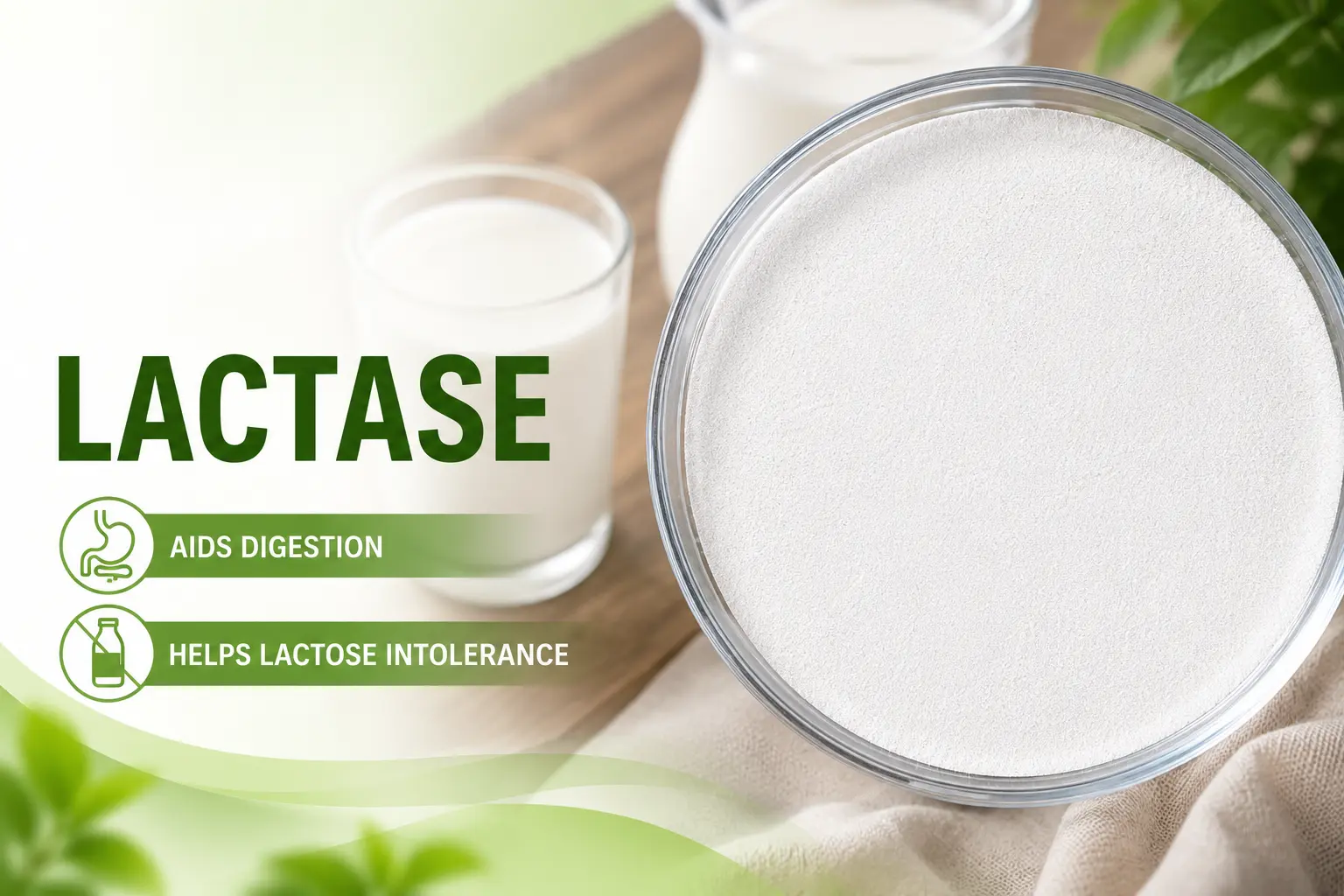
Food-grade lactase enzyme powder for lactose hydrolysis, lactose-reduced dairy products, and industrial dairy processing.
Leaf CleanTech develops and supplies food-grade lactase enzyme powder for dairy manufacturers and food processors. Lactase, also known as beta-galactosidase, hydrolyses lactose into the simpler sugars glucose and galactose.
Our lactase enzyme solution is designed for applications where controlled lactose breakdown is required, including lactose-reduced and lactose-free dairy products, milk processing, yogurt, whey processing, and other food applications.
Looking for lactase enzyme powder for your dairy process? Talk to our technical team →
Lactase is a beta-galactosidase enzyme that breaks down lactose, the primary sugar naturally present in milk and dairy products.
During enzymatic hydrolysis, lactase converts lactose into:
This reaction can be used by dairy manufacturers to reduce lactose in milk and other dairy products.
Leaf CleanTech's LEAFLACT is a food-grade lactase enzyme obtained through controlled fermentation of Aspergillus species.
Lactase is widely relevant to dairy processing because lactose can influence the characteristics and consumer suitability of dairy products.
By treating milk or another suitable dairy substrate with lactase, manufacturers can control the amount of lactose remaining in the finished product.
Lactase enzyme treatment can therefore support the production of:
The appropriate enzyme dosage and treatment conditions depend on the substrate, lactose concentration, process temperature, pH, reaction time, target lactose reduction and production process.
Lactose is a disaccharide composed of glucose and galactose.
Lactase catalyses the hydrolysis of lactose:
Lactose + water → Glucose + Galactose
The resulting glucose and galactose are simpler sugars that can be processed differently from lactose.
For industrial dairy applications, the effectiveness of lactase treatment depends on factors including:
For this reason, enzyme selection and application conditions should be evaluated according to the specific manufacturing process.
Lactase can be used to hydrolyse lactose in milk during dairy processing.
The enzyme treatment enables manufacturers to produce milk with substantially reduced lactose, subject to the process and validated analytical results.
Lactase can be incorporated into dairy-processing workflows where the objective is to reduce lactose levels.
Applications may include:
Lactase can be used in yogurt and other fermented dairy applications to hydrolyse lactose.
The treatment conditions should be selected according to the manufacturing process, fermentation conditions, desired lactose reduction and final-product requirements.
Whey contains significant amounts of lactose.
Lactase treatment can therefore be considered in whey-processing applications where lactose hydrolysis is required.
Lactase can also help address processing considerations associated with lactose crystallisation in concentrated dairy systems.
Lactase can be used where dairy ingredients require controlled lactose hydrolysis.
Potential applications depend on the composition of the ingredient, processing conditions and target degree of lactose conversion.
Leaf CleanTech's LEAFLACT is a food-grade lactase enzyme powder based on beta-galactosidase.
According to the current product information, LEAFLACT is obtained through controlled fermentation of Aspergillus species.
| Product Name | Lactase Enzyme Powder |
|---|---|
| Product Code | LEAFLACT |
| Enzyme | Beta-Galactosidase (Lactase) |
| Source | Controlled fermentation of Aspergillus species |
| Form | Food-grade enzyme powder |
| Enzyme Activity | 50,000 ALU/g |
| Purity | 99% |
| Primary Applications | Lactose-free dairy, lactose-reduced milk, yogurt, whey processing, dairy ingredients and other lactose-reduction applications |
| Pack Sizes | 1 kg and 25 kg |
| Shelf Life | 1 year when stored under recommended conditions |
| Storage | Store in a cool, dry place and keep the package properly sealed. |
Lactase provides an enzymatic method for breaking down lactose into glucose and galactose.
The enzyme can be incorporated into dairy processes designed to reduce lactose.
Lactase can be evaluated for different dairy substrates and process configurations.
Lactase enables manufacturers to develop dairy products for consumers seeking lactose-reduced or lactose-free options.
Lactase provides a biological processing approach for lactose hydrolysis rather than relying solely on physical separation methods.
The correct lactase dosage cannot be determined from enzyme activity alone. It depends on the characteristics of the dairy substrate and the desired processing outcome.
Before establishing an industrial dosage, manufacturers should evaluate:
Determine the initial lactose concentration of the milk or dairy substrate.
Define the required final lactose level based on the product specification and applicable regulatory requirements.
Lactase activity varies with temperature. The treatment temperature should therefore be selected according to the enzyme's validated operating range.
The pH of the substrate can influence enzyme activity and should be considered during application development.
Longer or shorter treatment times may be required depending on enzyme dosage, temperature, lactose concentration and the desired degree of hydrolysis.
Dosage should be established through application testing rather than assuming a universal rate for every dairy process.
Finished products should be analytically tested to verify the achieved lactose level and confirm that the product meets its intended specification.
For a process-specific dosage recommendation, contact the Leaf CleanTech technical team with your substrate and processing conditions.
Lactase performance depends on the conditions under which the enzyme is used.
Important variables include:
A formulation that works effectively in one dairy process may not automatically provide the same performance in another.
For this reason, application trials are recommended when establishing commercial processing conditions.
Lactase should not be confused with other enzymes used in dairy processing.
| Enzyme | Primary Function | Main Target | Common Dairy Applications |
|---|---|---|---|
| Lactase | Hydrolyzes lactose into glucose and galactose | Lactose | Lactose-free milk, lactose-reduced dairy products, yogurt, whey and dairy ingredients |
| Lipase | Breaks down milk fat into fatty acids and glycerol | Milk fat | Cheese ripening, flavour development and dairy fat modification |
| Protease | Hydrolyzes proteins into smaller peptides and amino acids | Milk proteins | Cheese processing, protein hydrolysis and dairy ingredient processing |
| Pectinase | Breaks down pectin and related plant cell-wall components | Pectin | Mainly used in fruit preparations, dairy beverages and fruit-containing dairy products |
| Alpha-Galactosidase | Hydrolyzes specific galactoside sugars | Galactosides | Specialized carbohydrate processing and selected dairy/food formulations |
Leaf CleanTech provides a broader food-enzyme portfolio covering lactase, protease, lipase, pectinase, cellulase, xylanase, amylase and other enzyme solutions.
Leaf CleanTech is an industrial enzyme manufacturer in India serving Food & Nutrition, Animal Feed and Fermentation applications. The company develops enzyme solutions around specific industrial processing requirements and provides technical support for application development.
Leaf CleanTech develops food-grade enzyme solutions for applications including dairy processing, baking, beverages, juice processing, protein hydrolysis and starch processing.
The right enzyme depends on the process. Leaf CleanTech can work with manufacturers to understand the application and identify an appropriate enzyme solution.
Lactase is part of a wider food-enzyme portfolio that includes proteases, pectinase, cellulase, xylanase, lipase, amylase, glucoamylase and other enzymes.
When a standard enzyme does not fully address an application, Leaf CleanTech also develops customized enzyme formulations around specific process requirements.
Leaf CleanTech's lactase enzyme can be relevant to manufacturers and processors involved in:
The suitability of the enzyme should be evaluated according to the specific substrate, process conditions and intended product.
To help our technical team recommend an appropriate lactase solution, provide as much of the following information as possible:
If you do not have all of this information, our technical team can help identify the most relevant parameters for an initial discussion.
Lactase enzyme powder is a powdered preparation containing lactase, also known as beta-galactosidase. The enzyme hydrolyses lactose into glucose and galactose.
Lactase is primarily used to hydrolyse lactose in milk and dairy products. It is particularly relevant to the manufacture of lactose-reduced and lactose-free dairy products.
Lactase is the common name used for beta-galactosidase enzymes that hydrolyse lactose. In dairy processing, the terms are often used to describe the enzyme responsible for lactose hydrolysis.
Yes. Lactase can be used during milk processing to hydrolyse lactose. The enzyme dosage and process conditions need to be established and validated for the specific milk and production process.
Lactase hydrolyses lactose into glucose and galactose.
LEAFLACT is Leaf CleanTech's lactase enzyme product. The current product page describes it as a food-grade beta-galactosidase obtained through controlled fermentation of Aspergillus species.
The current Leaf CleanTech product page lists an activity of 50,000 ALu/g. Confirm the current product specification with Leaf CleanTech before placing an order or using the value in a technical specification.
The current product information lists 1 kg and 25 kg pack sizes. Availability should be confirmed with Leaf CleanTech.
Yes. Lactase can be evaluated for yogurt and other fermented dairy applications. The appropriate treatment conditions depend on the manufacturing process and desired lactose reduction.
Yes. Lactase can be considered for whey-processing applications where lactose hydrolysis is required.
There is no single universal dosage. Dosage depends on enzyme activity, lactose concentration, temperature, pH, reaction time and the target degree of lactose hydrolysis. Leaf CleanTech can evaluate the application and recommend an appropriate starting point based on process information.
Lactose hydrolysis produces glucose and galactose, which have different sweetness characteristics from lactose. Consequently, enzymatic lactose hydrolysis can affect the perceived sweetness of the resulting dairy product.
Yes. Leaf CleanTech is an industrial enzyme manufacturer based in Bengaluru, India, and lists lactase among its Food & Nutrition enzyme products.
Yes. Leaf CleanTech also develops customized enzyme formulations for food-processing applications where a standard enzyme may not fully address the process requirement.
Looking for a food-grade lactase enzyme powder for dairy processing?
Share your application, dairy substrate, lactose concentration, processing conditions and target lactose reduction with our technical team.
We can help evaluate the application and identify a suitable lactase enzyme solution.
Leaf CleanTech Pvt. Ltd.
#371 & 372, 10th Cross, 4th Phase
Peenya Industrial Area
Bengaluru – 560058, India
Phone: +91 80 41144713
Email: info@leafcleantech.com
©2026. Leaf CleanTech - All Rights Reserved.