
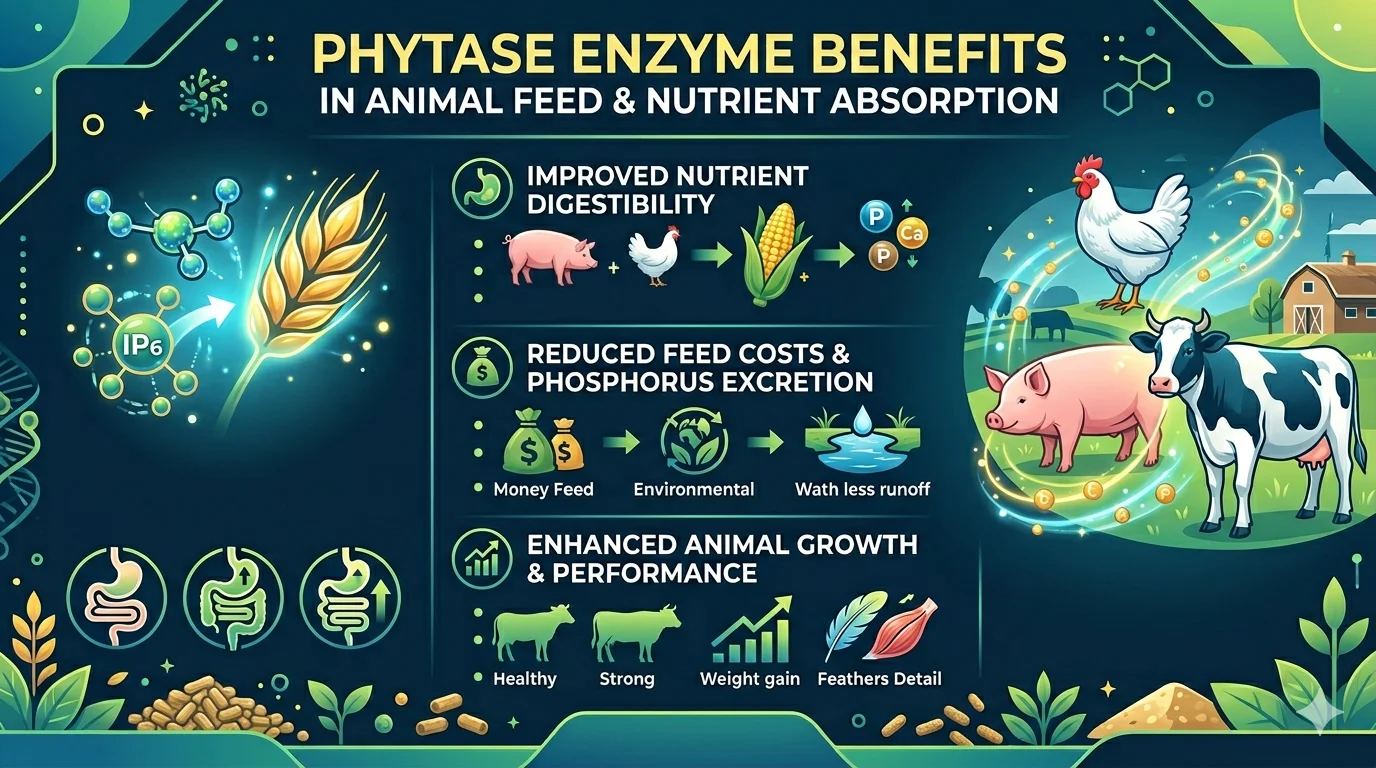
Modern animal nutrition is focused on one important goal: getting more nutritional value from every kilogram of feed. However, plant-based feed ingredients often contain phytate, a form of phosphorus that is not easily available to many monogastric animals.
This is where phytase enzyme becomes important.
Phytase helps break down phytate in feed, releasing phosphorus and reducing the anti-nutritional effects associated with phytate. As a result, animals can utilize important nutrients more effectively. Research has associated dietary phytase supplementation with improved phosphorus digestibility and, depending on the diet and application, better utilization of calcium, amino acids and energy.
Therefore, understanding the phytase enzyme benefits in animal feed can help feed manufacturers and livestock producers develop more efficient and nutritionally balanced feed formulations.
Phytase is an enzyme that breaks down phytate, also known as phytic acid or phytate-bound phosphorus.
Phytate is naturally present in many plant-based feed ingredients, including grains, cereals and oilseed meals. It acts as a storage form of phosphorus in plants. However, the phosphorus bound within phytate is not readily available to animals.
Moreover, phytate can interact with minerals and proteins, potentially reducing their availability for digestion and absorption.
Phytase works by hydrolysing phytate and progressively releasing phosphate. Consequently, more phosphorus becomes available for animal utilization while the anti-nutritional effect of phytate can be reduced.
Many modern animal diets contain substantial amounts of plant-derived ingredients. While these ingredients provide valuable protein, carbohydrates, minerals and energy, they can also contribute significant amounts of phytate.
For monogastric animals such as poultry and pigs, the ability to naturally digest phytate is limited. Consequently, a significant portion of phytate-bound phosphorus may pass through the digestive system without being fully utilized.
Adding an appropriate phytase enzyme to the feed can help address this challenge.
In simple terms:
Phytate-bound nutrients → Phytase action → Phytate breakdown → Greater nutrient availability → Better feed utilization
This makes phytase an important component of modern enzyme-based feed formulation.
The basic mechanism is relatively straightforward.
When phytase is incorporated into animal feed, it acts on phytate during digestion. The enzyme progressively removes phosphate groups from the phytate molecule.
As phytate is broken down:
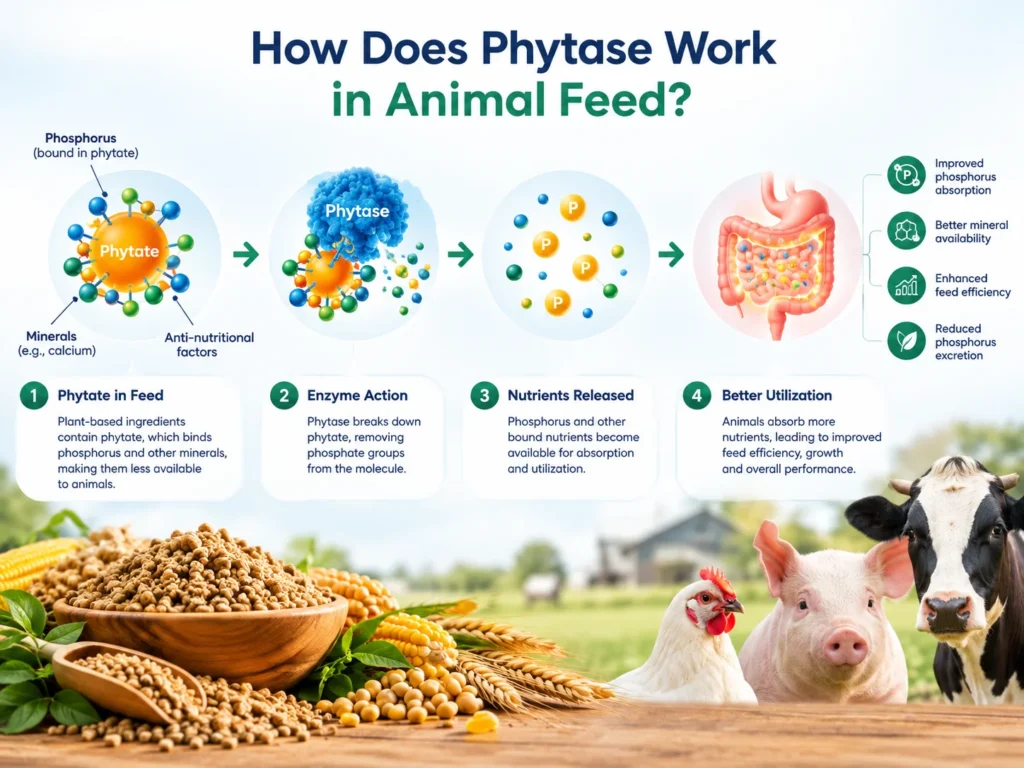
Phytase activity is particularly relevant in the upper digestive tract of poultry and pigs, although its effectiveness depends on factors such as enzyme characteristics, diet composition, phytate concentration, calcium levels, pH and animal species.
Therefore, selecting the right phytase and applying it appropriately is just as important as simply adding an enzyme to the formulation.
One of the primary reasons phytase is used in animal feed is to improve the utilization of phytate-bound phosphorus.
Plant ingredients can contain considerable amounts of phosphorus in phytate form. However, animals cannot efficiently access all of this phosphorus without sufficient phytase activity.
By breaking down phytate, phytase helps release phosphorus that can subsequently be utilized by the animal.
This is particularly important for normal skeletal development and mineral metabolism. Studies have consistently reported improvements in phosphorus digestibility and utilization following phytase supplementation.
Phytate does not only bind phosphorus. It can also interact with minerals such as calcium and other nutrients.
When phytate is degraded, these interactions can be reduced. As a result, the availability of certain minerals may improve.
In practical feed formulation, this can contribute to better utilization of the overall nutrient profile of the diet.
However, the magnitude of the response depends on the animal species, feed ingredients, phytate concentration and dietary mineral levels.
The benefits of phytase can extend beyond phosphorus.
Phytate can interact with proteins and digestive processes, potentially reducing the digestibility of nutrients. Once phytate is broken down, these anti-nutritional effects can be reduced.
Consequently, phytase supplementation may support improved digestibility of phosphorus, calcium, amino acids and energy, depending on the formulation and enzyme used.
Feed efficiency is a critical consideration for poultry and livestock producers.
When nutrients are better utilized, animals may derive greater nutritional value from the same feed formulation. Therefore, phytase can become an important tool for improving the efficiency of nutrient utilization.
Research has reported improvements in feed conversion and growth-related parameters in certain poultry and livestock feeding conditions, although results vary according to diet composition, animal age, phytase dose and other factors.
Phosphorus and calcium are essential for skeletal development.
Because phytase helps release phytate-bound phosphorus and can improve mineral availability, it can contribute to better mineral utilization in growing animals.
Studies in broilers have reported improvements in bone mineralization and bone-related parameters with phytase supplementation, particularly under diets where phosphorus and calcium availability are limiting.
Phytase can help unlock phosphorus that is already present in plant-based feed ingredients.
Consequently, feed formulators may be able to reduce reliance on some sources of supplemental inorganic phosphorus, depending on the formulation and the validated nutrient matrix used.
This can provide both nutritional and formulation benefits.
Importantly, the appropriate matrix values should be established according to the specific phytase, feed composition, animal species and production conditions rather than assuming a single value for every application.
When more dietary phosphorus is utilized by animals, less unused phosphorus may be excreted.
This makes phytase relevant not only from a feed-efficiency perspective but also from an environmental sustainability perspective.
Lower phosphorus excretion can help reduce the potential environmental impact associated with nutrient-rich animal manure and agricultural runoff.
Poultry diets frequently contain plant-based ingredients such as maize, soybean meal and other grains or oilseed products.
These ingredients can contain significant amounts of phytate. Since poultry have limited endogenous phytase activity, supplemental phytase can help release phytate-bound phosphorus and improve nutrient utilization.
For poultry producers, potential benefits include:
However, the response to phytase is not identical in every poultry diet. Factors such as phytate concentration, calcium-to-phosphorus balance, bird age, feed composition and phytase characteristics can influence enzyme performance.
Pig diets also commonly contain plant-based ingredients with phytate-bound phosphorus.
Supplementing feed with phytase can help improve phosphorus digestibility and utilization. Research has also reported effects on the utilization of other nutrients, although the response can vary depending on diet formulation and animal factors.
Therefore, phytase can be a valuable component of enzyme-based feed strategies for growing pigs and other monogastric livestock.
| Feed Challenge | Role of Phytase | Potential Nutritional Benefit |
|---|---|---|
| Phytate-bound phosphorus | Breaks down phytate and releases phosphate groups | Improved phosphorus availability and utilization |
| Mineral binding by phytate | Reduces phytate-related mineral interactions | Better utilization of minerals such as calcium |
| Reduced nutrient digestibility | Degrades phytate that can interfere with nutrient digestion | Potential improvement in nutrient digestibility |
| Limited phosphorus availability | Releases phosphorus from plant-based feed ingredients | More efficient phosphorus utilization |
| Phosphorus losses through excretion | Improves utilization of available phosphorus | Potential reduction in phosphorus excretion |
| Feed formulation efficiency | Unlocks nutrients naturally present in plant-based ingredients | More efficient use of feed nutrients |
Adding phytase to a feed formulation is not simply about selecting an inclusion rate. Several factors can influence its performance.
The amount of phytate available in the diet determines how much substrate is available for phytase.
Therefore, diets with different ingredient compositions may respond differently to the same phytase inclusion level.
Calcium and phosphorus concentrations can influence phytase efficacy and nutrient utilization.
For this reason, feed formulations should consider the complete mineral profile rather than evaluating phytase in isolation.
Poultry, pigs and other animals have different digestive conditions and nutritional requirements.
Furthermore, younger animals may respond differently from mature animals. Research has shown that animal age and dietary composition can influence the response to phytase.
Not all phytases behave identically.
Their activity can vary according to factors such as pH tolerance, temperature stability, substrate affinity and resistance to digestive conditions.
Consequently, choosing a phytase suited to the intended feed application is essential.
Feed manufacturing can expose enzymes to processing conditions that may affect enzyme activity.
Therefore, enzyme selection should consider the actual manufacturing process and expected feed conditions.
When evaluating a phytase feed enzyme, feed manufacturers should consider several technical parameters:
1. Activity level
Check the declared enzyme activity and ensure it matches the intended application.
2. pH profile
The enzyme should demonstrate suitable activity under the relevant digestive conditions.
3. Thermal stability
For processed feeds, enzyme stability during manufacturing is an important consideration.
4. Feed compatibility
The phytase should perform effectively within the specific feed formulation.
5. Animal species
Poultry, swine and other animal species have different digestive environments and nutritional requirements.
6. Formulation requirements
Phytase inclusion should be considered alongside available phosphorus, calcium, phytate and other nutritional parameters.
7. Technical support
Working with an experienced enzyme supplier can help manufacturers select and apply the appropriate enzyme solution.
Phytase is highly valuable, but it is only one part of modern feed enzyme technology.
Different enzymes target different components of feed.
For example:
Therefore, combining appropriate enzymes can help address multiple nutritional challenges within a feed formulation.
Leaf CleanTech offers enzyme solutions for animal feed applications, including phytase, protease, xylanase, cellulase, beta-glucanase, mannanase and amylase.
Feed efficiency and environmental sustainability are increasingly connected.
When animals utilize nutrients more efficiently, producers can potentially reduce nutrient losses through manure. In particular, improving phosphorus utilization can help reduce phosphorus excretion.
At the same time, making better use of nutrients already present in plant-based ingredients can support more efficient feed formulation.
Thus, phytase is not simply a digestive enzyme. It can be part of a broader strategy for efficient, economical and more sustainable animal nutrition.
Phytase is a feed enzyme that breaks down phytate, the primary storage form of phosphorus in many plant-based ingredients. This helps release phosphorus and can reduce the anti-nutritional effects of phytate.
The main benefits include improved phosphorus utilization, better mineral availability, reduced phytate-related anti-nutritional effects, improved nutrient digestibility and potentially better feed efficiency.
Poultry have limited ability to utilize phytate-bound phosphorus. Supplemental phytase can help release this phosphorus and improve nutrient utilization in plant-based diets.
Phytase breaks down phytate and releases phosphorus, thereby improving phosphorus digestibility and utilization. The actual response depends on diet composition, phytase characteristics and animal factors.
Phytate can interact with calcium and other minerals. By breaking down phytate, phytase can help reduce these interactions and potentially improve calcium utilization.
Improved phosphorus utilization can reduce the amount of unused phosphorus excreted by animals. Therefore, phytase supplementation can contribute to lower phosphorus losses from animal production systems.
Phytase is widely used in diets for monogastric animals such as poultry and pigs. However, its effectiveness depends on the animal species, feed ingredients, phytate concentration, enzyme characteristics and formulation strategy.
Consider enzyme activity, pH profile, processing stability, feed composition, animal species, inclusion rate and overall formulation requirements. Technical guidance from an experienced enzyme supplier can also help optimize the application.
Phytase enzyme benefits in animal feed go beyond phosphorus release.
By breaking down phytate, phytase can help improve phosphorus utilization, support mineral availability, reduce phytate-related anti-nutritional effects and contribute to more efficient use of plant-based feed ingredients.
Moreover, better nutrient utilization can support feed efficiency and help reduce phosphorus losses to the environment.
However, phytase performance depends on the complete feeding system. Factors such as animal species, age, feed ingredients, phytate levels, calcium and phosphorus concentrations, processing conditions and enzyme characteristics should all be considered.
For feed manufacturers looking to improve nutrient utilization through enzyme technology, choosing the right phytase and applying it correctly can make an important difference.
Leaf CleanTech develops enzyme solutions for industrial applications, including phytase and other feed enzymes designed to support nutrient utilization, digestibility and feed efficiency.
Whether you are formulating poultry feed, livestock feed or other animal nutrition products, the right enzyme strategy can help you unlock greater value from your existing feed ingredients.
Explore Leaf CleanTech's enzyme solutions and discuss your application with our technical team.
Visit Leaf CleanTech: https://leafcleantech.com/
Build better feed formulations with the right enzyme technology.
©2026. Leaf CleanTech - All Rights Reserved.
Protease enzyme manufacturer India - Leaf CleanTech
April 25, 2026[…] CleanTech also develops enzyme solutions for animal nutrition, including protease, phytase, xylanase, cellulase, beta-glucanase, mannanase and […]