
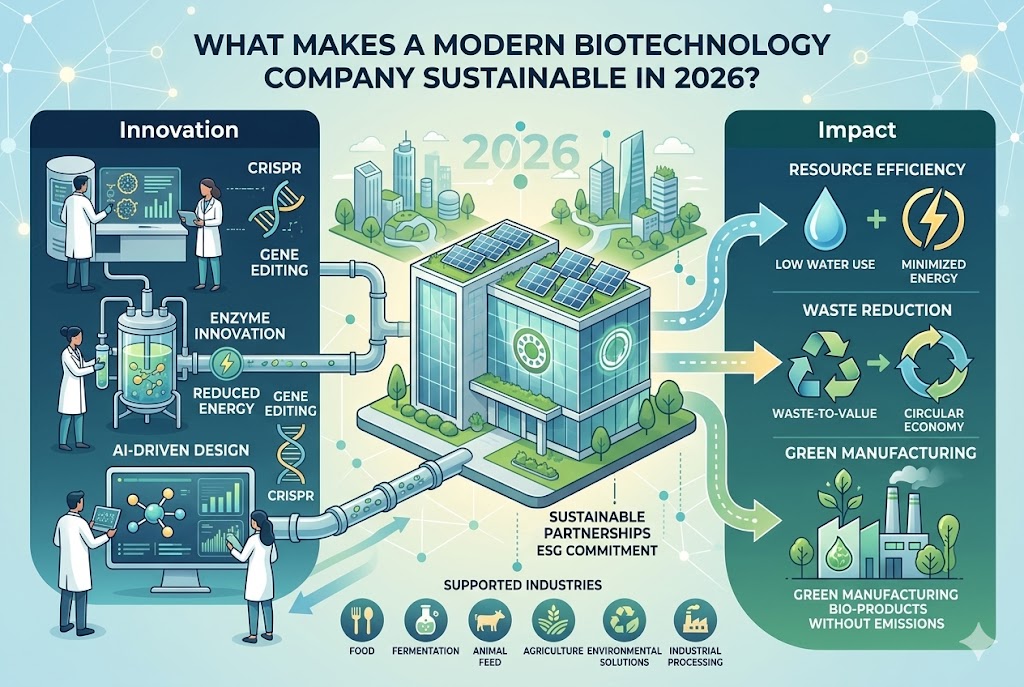
As industries grow, businesses face an important challenge: how can they improve productivity while using resources more responsibly? Today, sustainability is no longer just a trend. It is becoming an essential part of modern manufacturing, food processing and industrial development.
This is where a sustainable biotechnology company can make a meaningful difference. By combining scientific innovation with biological processes, biotechnology companies develop solutions that help industries improve efficiency, optimise production and explore more environmentally responsible practices.
One important part of this progress is enzyme technology. Industrial enzymes help manufacturers carry out specific chemical reactions under suitable processing conditions. As a result, businesses can improve selected production stages, manage raw materials more effectively and work towards their sustainability goals.
At Leaf CleanTech, we develop industrial enzyme solutions for food and nutrition, animal feed and fermentation applications. Our approach combines biotechnology expertise, application-focused formulation and technical support to address practical manufacturing challenges.
A sustainable biotechnology company uses biological science and technology to develop solutions that support efficient resource use and more responsible industrial practices.
Unlike conventional approaches that may rely heavily on certain chemical treatments or energy-intensive processes, biotechnology can offer alternative ways to carry out specific production tasks. However, the actual environmental benefits depend on the application, process conditions, energy consumption and overall product lifecycle.
For example, enzyme-based technologies can help break down complex substances such as starch, proteins and plant fibres. Consequently, manufacturers can use these biological catalysts to improve selected processing steps and achieve their desired product characteristics.
A sustainability-focused biotechnology company typically concentrates on:
Developing efficient biological and enzyme-based solutions.
Supporting consistent product quality and process performance.
Helping industries optimise raw material utilisation.
Exploring opportunities to reduce waste and unnecessary processing.
Providing application-specific solutions for different industrial needs.
Therefore, sustainable biotechnology connects scientific innovation with practical industrial requirements.
Enzymes are biological catalysts that accelerate specific chemical reactions. Because different enzymes act on different substrates, manufacturers can select suitable enzyme solutions according to their raw materials and production objectives.
When properly selected and applied, industrial enzymes can support more efficient manufacturing processes.
Many industrial processes involve breaking down complex materials into simpler compounds. For instance, amylases act on starch, proteases break down proteins, and cellulases target cellulose.
By using the appropriate enzyme, manufacturers can improve specific processing stages and achieve the required transformation more efficiently. Moreover, optimising enzyme dosage, temperature, pH and reaction time helps businesses obtain consistent results.
Raw materials represent a significant part of manufacturing costs. Therefore, improving their utilisation can benefit both operational performance and resource efficiency.
In fermentation, for example, enzymes help convert starch and other carbohydrates into fermentable sugars. This provides microorganisms with substrates they can use during fermentation.
As a result, a well-designed enzyme programme may help improve conversion efficiency and production yields, depending on the raw material and process conditions.
Some manufacturing processes generate residual materials because certain components remain difficult to break down or extract.
Appropriate enzyme applications can help release useful components from selected raw materials. For example, pectinase can support fruit juice processing, while specific fibre-degrading enzymes can assist in breaking down complex plant materials.
Consequently, manufacturers may improve extraction, manage viscosity or optimise product recovery. The results depend on the application and the effectiveness of the overall process.
Certain enzyme reactions work under comparatively moderate temperatures and suitable pH conditions. In the right application, this may create opportunities to reduce energy demand or reliance on more intensive processing treatments.
However, enzymes do not automatically make every process more sustainable. Manufacturers should evaluate energy consumption, water usage, chemical inputs and waste generation to understand the overall benefits.
Biotechnology and industrial enzymes support a wide range of manufacturing applications. At Leaf CleanTech, our core focus includes food and nutrition, animal feed and industrial fermentation.
Food manufacturers use enzymes to support processing, texture development, starch conversion, protein hydrolysis and other production requirements.
For example, amylases help break down starch, lactase converts lactose into simpler sugars, and pectinases support selected fruit and vegetable processing applications.
Similarly, proteases can help hydrolyse proteins into smaller peptides. These applications allow manufacturers to select enzyme solutions based on their desired product properties and processing conditions.
Explore our Food and Nutrition Enzyme Solutions to learn more about enzyme applications across food processing.
Animal feed manufacturers need to balance nutritional value, ingredient costs and feed performance. However, some plant-based feed ingredients contain complex components that animals cannot fully digest on their own.
Feed enzymes can help address specific challenges. For instance, phytase helps release phosphorus from phytate, while xylanase and beta-glucanase act on certain plant cell-wall components.
In addition, protease and amylase can support the breakdown of proteins and starches. When matched to the feed formulation, these enzymes can help improve nutrient availability and support feed efficiency.
Fermentation plays an important role in producing alcohol, bioethanol and other fermentation-derived products.
Before fermentation begins, many carbohydrate-rich raw materials require enzymatic treatment. Alpha-amylase breaks down starch into shorter carbohydrate chains, while glucoamylase helps release glucose that microorganisms can ferment.
Furthermore, selected fermentation booster enzymes can help convert certain residual carbohydrates into fermentable sugars.
These applications can support improved conversion and more consistent fermentation performance when manufacturers optimise the complete process.
Explore our Fermentation Enzyme Solutions for applications involving grain, molasses and other fermentation processes.
Choosing the right biotechnology partner is important because enzyme performance depends on more than the product alone. Manufacturers must also consider their raw materials, processing conditions and production targets.
Here are five important factors to evaluate.
Every production process has unique requirements. Therefore, look for a company that understands your raw materials, operating conditions and desired results.
Reliable enzyme activity and suitable quality-control practices are essential for maintaining consistent production. Ask about product specifications, quality systems and technical documentation.
Standard products may not meet every processing requirement. In such cases, customised enzyme formulations may help address specific application challenges.
Enzyme selection requires careful consideration of pH, temperature, dosage, reaction time and substrate characteristics. Consequently, application guidance can help manufacturers evaluate the most suitable solution.
Finally, evaluate sustainability through measurable process outcomes rather than general claims. Relevant factors may include energy consumption, water use, raw material conversion, waste generation and overall production efficiency.
This approach helps businesses make informed decisions while aligning operational improvements with their wider sustainability objectives.
Leaf CleanTech Pvt. Ltd. is a biotechnology company based in Bengaluru, India, specialising in industrial enzyme solutions for food and nutrition, animal feed and fermentation applications.
We focus on connecting biotechnology with practical manufacturing needs. Our enzyme portfolio supports a range of processing requirements, while our application-focused approach helps customers identify solutions suited to their operations.
Here is what defines our approach:
Biotechnology expertise: We apply enzyme technology to address specific industrial processing challenges.
Application-focused solutions: We consider raw materials, processing conditions and desired outcomes when evaluating enzyme requirements.
Custom formulation capabilities: We offer customised enzyme formulations for suitable application needs.
Quality and consistency: We focus on product quality and reliable performance.
Technical guidance: We help customers evaluate enzyme selection and opportunities for process optimisation.
Furthermore, our focus on non-GMO enzyme technologies and sustainable innovation reflects our interest in helping industries explore efficient, responsible processing approaches.
For businesses seeking a reliable industrial enzyme partner, the right solution starts with understanding the process and identifying opportunities for improvement.
The future of biotechnology will depend on how effectively scientific advances translate into practical industrial benefits.
As manufacturers look for ways to improve efficiency and manage resources, enzyme technology will continue to offer opportunities across food processing, animal nutrition and fermentation.
At the same time, continued research, better process monitoring and application-specific formulations can help businesses evaluate where biological solutions offer meaningful advantages.
Most importantly, sustainability requires a complete view of production. Companies must consider product quality, operational performance, resource consumption and environmental impact together.
By combining scientific knowledge with practical application, biotechnology companies can help industries move towards more efficient and responsible manufacturing.
A sustainable biotechnology company does more than develop innovative biological products. It connects science, industrial performance and responsible resource use to address real-world challenges.
Enzyme technology is an important part of this approach. From improving starch conversion in fermentation to supporting food processing and nutrient utilisation in animal feed, enzymes offer valuable tools for optimising specific industrial operations.
At Leaf CleanTech, we work to develop industrial enzyme solutions that meet practical application requirements while supporting process efficiency and sustainable innovation.
Looking for the right enzyme solution for your manufacturing process? Contact Leaf CleanTech to discuss your application requirements and explore suitable enzyme technologies.
At Leaf Cleantech, we deliver advanced enzyme solutions designed to support sustainable biotechnology across multiple industries. Our innovative products help improve process efficiency, optimize resource utilization, and promote environmentally responsible manufacturing practices.
Whether you operate in the food and nutrition, fermentation, animal feed, or industrial processing sector, Leaf Cleantech provides customized biotechnology solutions that drive measurable results. Contact our team today to discover how sustainable biotechnology can help your business achieve greater efficiency, profitability, and long-term growth.
©2026. Leaf CleanTech - All Rights Reserved.