
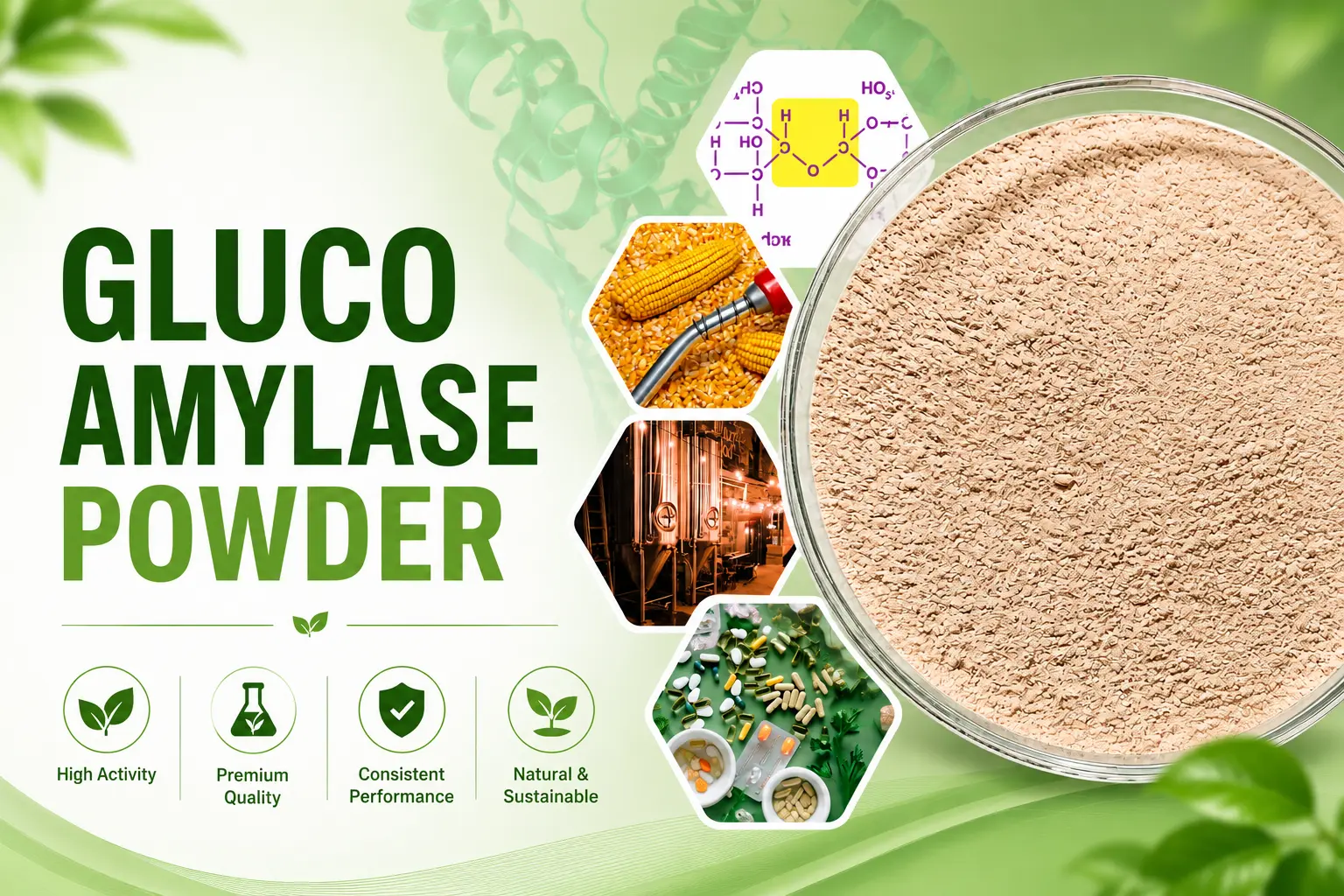
Starch conversion plays an important role in food processing, brewing and fermentation. Gluco amylase powder enzyme helps convert dextrins and starch-derived carbohydrates into glucose, making it an important enzyme for saccharification and downstream fermentation.
Leaf CleanTech develops enzyme solutions for food, nutrition and fermentation applications. Its LEAFGA glucoamylase is derived from Aspergillus and catalyses the hydrolysis of dextrin to glucose.
Glucoamylase, also known as amyloglucosidase, is a starch-converting enzyme that releases glucose from starch-derived dextrins.
Unlike alpha amylase, which breaks starch chains into shorter dextrins during liquefaction, glucoamylase works during the saccharification stage. It progressively converts dextrins into fermentable glucose.
Therefore, glucoamylase plays a key role when the process requires efficient starch-to-glucose conversion.
Glucoamylase acts on the ends of starch and dextrin molecules. It hydrolyses alpha-1,4 and alpha-1,6 glycosidic linkages, helping convert complex starch-derived carbohydrates into glucose.
The typical starch conversion process follows two major enzymatic stages:
Starch → Alpha Amylase → Dextrins → Glucoamylase → Glucose
First, alpha amylase reduces the size and viscosity of gelatinized starch. Next, glucoamylase converts the resulting dextrins into fermentable glucose. This sequence is particularly important in grain fermentation.
Glucoamylase is widely used in grain-based fermentation because yeast requires simple fermentable sugars.
It can support starch conversion from raw materials such as:
After liquefaction, glucoamylase converts dextrins into glucose, which yeast can subsequently ferment.
Efficient saccharification can help provide fermentable glucose for ethanol production.
A typical process involves:
Raw Material → Liquefaction → Saccharification → Fermentation → Ethanol
Here, alpha amylase supports liquefaction, while glucoamylase performs the key saccharification step. As a result, selecting suitable enzyme activities and process conditions can improve starch conversion efficiency.
Brewing processes also require controlled starch conversion. Glucoamylase can help convert dextrins into fermentable sugars, depending on the brewing process and desired beer characteristics.
Therefore, breweries can evaluate glucoamylase when they need additional starch saccharification or a higher proportion of fermentable sugars.
Glucoamylase can support industrial processes where starch needs to undergo further enzymatic conversion after liquefaction.
It can help transform:
Starch → Dextrins → Glucose
Consequently, manufacturers can use glucoamylase as part of starch-conversion processes designed around specific raw materials and production targets.
Using an appropriate glucoamylase enzyme can provide several process benefits:
Glucoamylase converts dextrins into glucose, supporting efficient starch saccharification.
The resulting glucose provides a readily fermentable sugar source for yeast in suitable fermentation processes.
Glucoamylase complements alpha amylase by completing the conversion of dextrins produced during liquefaction.
The enzyme can be evaluated for grain-based substrates including corn, rice, wheat, sorghum, millets and cassava.
Performance depends on factors such as substrate, pH, temperature, enzyme activity, dosage and reactiontime. Therefore, application-specific evaluation remains important.
Although both enzymes act on starch, they perform different roles.
| Enzyme | Primary Target | Main Function | Common Applications |
|---|---|---|---|
| Gluco Amylase | Dextrins and starch-derived carbohydrates | Converts dextrins into glucose during saccharification. | Grain fermentation, ethanol production, brewing and starch conversion. |
| Alpha Amylase | Starch | Breaks starch into shorter dextrins during liquefaction. | Starch processing, grain fermentation, brewing and baking. |
| Invertase | Sucrose | Hydrolyses sucrose into glucose and fructose. | Confectionery, food processing, beverages and syrup production. |
| Cellulase | Cellulose | Breaks down cellulose and helps modify plant fibre. | Fruit processing, vegetable processing and plant-based ingredients. |
| Xylanase | Xylan / Hemicellulose | Breaks down xylan and supports plant-material processing. | Baking, beverages, brewing and food processing. |
| Beta Glucanase | Beta-glucans | Breaks down beta-glucans and can help reduce viscosity. | Brewing, grain processing and fermentation. |
| Pectinase | Pectin | Breaks down pectin and supports extraction and clarification. | Fruit juices, vegetable juices, pulp processing and beverages. |
The right glucoamylase enzyme depends on the complete production process rather than the enzyme name alone.
Consider:
First, evaluate the starch source and existing liquefaction process. Then, identify the desired degree of saccharification. Finally, select an enzyme solution that matches the operating conditions.
Leaf CleanTech develops industrial enzyme solutions for Food & Nutrition, Animal Feed and Fermentation applications. Its portfolio includes amylases, glucoamylase, cellulase, pectinase, xylanase, proteases and other enzyme solutions.
We consider the substrate, processing conditions and production objectives when evaluating enzyme requirements.
Leaf CleanTech combines enzyme development, formulation and application knowledge to address industrial processing requirements.
Its fermentation portfolio includes high-temperature bacterial alpha amylase, glucoamylase, active dry yeast and fermentation booster solutions.
Our technical team can help evaluate enzyme selection, process conditions and application requirements.
When a standard enzyme does not fully meet a process requirement, Leaf CleanTech also provides customised enzyme formulations.
For stronger internal linking, I recommend connecting this page to relevant Leaf CleanTech pages using contextual anchors.
Use alpha amylase for the initial breakdown of starch into dextrins before saccharification.
know more fungal alpha amylase powder enzyme
Explore the complete enzyme sequence used for grain-based fermentation.
know more about grain fermentation enzymes
A complementary solution designed to target residual unfermentable sugars after conventional starch conversion.
Know More about fermentation booster enzyme
Invertase performs a different carbohydrate-conversion reaction by converting sucrose into glucose and fructose.
Know More about invertase enzyme powder
Link to the broader food-enzyme guide to strengthen topical relevance.
Know more about food processing enzymes
Useful for applications that require multiple enzyme activities or specific processing conditions.
Glucoamylase is a starch-converting enzyme that hydrolyses dextrins and starch-derived carbohydrates to produce glucose.
Alpha amylase primarily supports starch liquefaction by breaking starch into shorter dextrins. Glucoamylase then converts those dextrins into glucose during saccharification.
Glucoamylase is used in applications such as grain fermentation, ethanol production, brewing and starch conversion.
Yes. Glucoamylase can convert starch-derived dextrins into fermentable glucose, which yeast can use during ethanol fermentation.
Glucoamylase can be evaluated for starch-containing raw materials such as corn, rice, wheat, sorghum, millets and cassava.
Food-grade glucoamylase is available for suitable food and fermentation applications. The exact grade and specification should be confirmed against the intended application and current product documentation.
Yes. They commonly perform complementary roles: alpha amylase supports liquefaction, while glucoamylase supports saccharification.
Looking for a gluco amylase powder enzyme manufacturer in India?
Share your starch source, processing conditions and application with Leaf CleanTech. Our technical team can help evaluate a suitable enzyme solution for starch conversion, saccharification or fermentation.
[…] Instead, choose an enzyme that matches your target substrate and production objective. For example, gluco amylase powder enzyme supports starch saccharification, while fungal alpha amylase helps break starch into shorter […]
©2026. Leaf CleanTech - All Rights Reserved.
Fungal Alpha Amylase Powder Enzyme - Leaf CleanTech
May 19, 2026[…] For the next stage of starch conversion, explore Glucoamylase Enzyme. […]