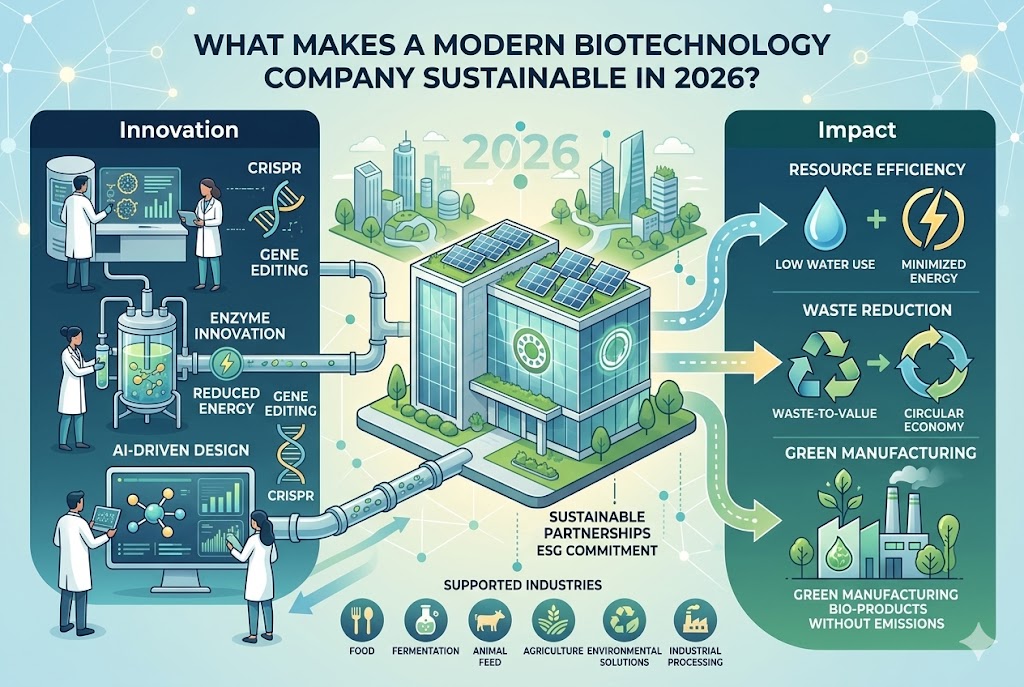
A sustainable biotechnology company helps industries use biological science to improve products, optimise manufacturing processes and make better use of resources. By combining enzyme technology, fermentation and application-focused research, biotechnology can support practical solutions for modern industrial challenges.
Leaf CleanTech Pvt. Ltd. is an industrial biotechnology and enzyme solutions company based in Bengaluru, India. We develop enzyme technologies for Food & Nutrition, Animal Feed and industrial Fermentation. Our approach combines biotechnology expertise, product development and technical support to help manufacturers address specific processing requirements.
Moreover, our focus on non-GMO enzyme technology and customised formulations supports industries looking for effective, application-specific solutions. Whether you manufacture food ingredients, formulate animal feed or operate a grain-based fermentation facility, we can help you explore suitable enzyme technologies.
Key Takeaways
- A sustainable biotechnology company applies biological science to industrial and environmental challenges.
- Industrial enzymes help manufacturers carry out specific biochemical reactions.
- Enzyme technology supports food processing, animal nutrition and industrial fermentation.
- Customised enzyme formulations can address individual raw materials and process conditions.
- Leaf CleanTech develops enzyme solutions for manufacturers across three core industry segments.
What Is a Sustainable Biotechnology Company?
A sustainable biotechnology company uses biological systems, enzymes and other biotechnology methods to develop solutions for industrial, agricultural, food and environmental applications. Its goal is to combine scientific innovation with practical outcomes while considering resource efficiency and environmental responsibility.
For example, industrial enzymes act as biological catalysts. They help speed up specific reactions involving proteins, starch, fats, fibres and other materials. As a result, manufacturers can evaluate enzyme-based processes to improve raw-material conversion, product consistency and production efficiency.
However, sustainability does not come from using biotechnology alone. Companies must assess the complete manufacturing process, including energy consumption, water use, raw materials, waste generation and product performance. Therefore, measurable process improvements should guide every sustainability initiative.
How Biotechnology Supports Sustainable Industrial Development
Industries continue to look for ways to improve production while managing resources responsibly. Biotechnology offers several useful approaches because biological systems can perform targeted reactions under suitable conditions.
1. Improving Process Efficiency
Enzymes act on specific substrates and support reactions such as starch conversion, protein hydrolysis and fibre breakdown. Consequently, manufacturers can evaluate enzyme applications to improve selected stages of their production processes.
2. Supporting Better Raw-Material Utilisation
Some raw materials contain complex components that require additional processing. Enzymes can break down these components into simpler compounds. Therefore, the right enzyme may help manufacturers improve the utilisation of selected raw materials.
3. Enabling Application-Specific Processing
Different industries have different production requirements. For instance, a food manufacturer may need an enzyme for juice clarification, while a fermentation facility may require enzymes for starch conversion. Application-focused biotechnology helps address these distinct needs.
4. Supporting Resource-Conscious Manufacturing
In suitable applications, enzyme-based processing may help manufacturers review processing time, material conversion and other operational factors. Nevertheless, companies should measure these outcomes before making environmental or cost-saving claims.
5. Encouraging Continuous Innovation
Biotechnology continues to create opportunities for new enzyme applications and improved formulations. In addition, research, testing and customer feedback help companies develop solutions that respond to changing industrial requirements.
Industrial Biotechnology Applications Across Key Industries
Industrial biotechnology has applications across several manufacturing sectors. In particular, enzyme technology plays an important role in processes involving food ingredients, animal feed and fermentation.
Food & Nutrition
Food processing involves several biochemical reactions. Enzymes can help manufacturers modify proteins, starches, carbohydrates, fats and fibres according to the intended application.
For example, food enzymes support baking, dairy processing, beverage manufacturing, fruit and vegetable processing, starch conversion and protein hydrolysis. Furthermore, manufacturers can select specific enzyme activities according to their raw materials and desired product characteristics.
Leaf CleanTech develops food enzyme solutions for a range of processing applications, including proteases, amylases, cellulases, hemicellulases, xylanases, pectinases, lactase, lipase and invertase.
Explore: Food & Nutrition Industry | Food & Nutrition Enzyme Products | Food Enzymes Guide
Animal Feed and Nutrition
Animal feed manufacturers work with ingredients that contain proteins, starches, fibres and other nutrients. However, certain plant-based feed ingredients also contain components that can affect nutrient availability.
Specific feed enzymes help break down targeted compounds. For example, phytase acts on phytate, while xylanase, cellulase, protease and beta-glucanase target different feed components.
As a result, suitable enzyme applications can support feed digestibility and nutrient utilisation. The actual outcome depends on the animal species, feed composition, enzyme activity and processing conditions.
Explore: Animal Feed Enzyme Solutions
Industrial Fermentation
Fermentation uses microorganisms to convert suitable substrates into products such as alcohol and other industrial compounds. However, raw materials such as grains often contain starch that yeast cannot directly ferment.
Therefore, enzyme technology plays an important role in preparing these materials. Alpha-amylase helps break down gelatinised starch into smaller carbohydrate chains. Next, glucoamylase supports the conversion of dextrins into fermentable sugars.
Leaf CleanTech offers enzyme and fermentation solutions for grain and molasses-based applications. These include high-temperature bacterial alpha-amylase, glucoamylase, fermentation booster enzymes and active dry yeast.
Explore: Fermentation Products | Industrial Biotechnology Applications
Why Industrial Enzymes Matter in Sustainable Biotechnology
Industrial enzymes are biological catalysts that accelerate specific chemical reactions. They work on particular substrates and help convert complex materials into simpler compounds.
Because different enzymes perform different functions, manufacturers can select an enzyme according to the process objective.
| Enzyme | Primary Function | Common Industrial Applications |
|---|---|---|
| Amylase | Breaks down starch | Food processing, baking and fermentation |
| Protease | Breaks down proteins | Protein hydrolysis, food processing and feed |
| Cellulase | Acts on cellulose | Food processing and fibre-related applications |
| Xylanase | Breaks down xylan | Baking, food processing and animal feed |
| Pectinase | Breaks down pectin | Fruit processing, pulp treatment and juice clarification |
| Phytase | Acts on phytate | Animal feed and nutrient utilisation |
| Glucoamylase | Converts dextrins into glucose | Starch processing and grain fermentation |
Choosing the right enzyme requires an understanding of the raw material, target reaction and production conditions. Therefore, manufacturers should evaluate enzyme activity, pH, temperature, dosage and reaction time before selecting a product.
What Makes a Biotechnology Company Sustainable?
A sustainable biotechnology company should combine scientific capability with responsible business practices. It should also consider the long-term impact of its products, processes and partnerships.
Research and Product Development
Research helps biotechnology companies understand industrial challenges and develop suitable biological solutions. In addition, ongoing product development supports changing customer and industry requirements.
Responsible Technology Choices
Companies should evaluate the materials, organisms and processes used in product development. For example, non-GMO enzyme technologies can be relevant to manufacturers who specifically require non-GMO solutions. However, product selection should always consider the requirements of the intended application.
Quality and Process Consistency
Reliable biotechnology solutions require appropriate quality systems, testing and process controls. These practices help manufacturers assess product consistency and suitability for their operations.
Customer-Focused Technical Support
Every manufacturing process has different requirements. Therefore, biotechnology companies should work with customers to understand their raw materials, processing conditions and desired outcomes before recommending a solution.
Measurable Sustainability Outcomes
Environmental benefits should come from measurable results rather than broad claims. Companies can assess relevant indicators such as resource consumption, process efficiency, waste generation and raw-material utilisation to understand the impact of a biotechnology application.
Why Choose Leaf CleanTech as Your Biotechnology Partner?
Leaf CleanTech Pvt. Ltd. combines industrial enzyme expertise with application-focused product development. Based in Bengaluru, India, we work with manufacturers looking for enzyme solutions across Food & Nutrition, Animal Feed and Fermentation.
1. Industrial Biotechnology Expertise
We focus on enzyme technologies that address practical processing requirements across our core industry segments.
2. Non-GMO Enzyme Technology
Our website highlights non-GMO enzyme technology as part of our product approach. This gives customers an option to explore enzyme solutions aligned with their specific sourcing and application requirements.
3. Solutions Across Multiple Industries
Our portfolio covers food processing, animal nutrition and industrial fermentation. As a result, customers can discuss different enzyme applications with one technical partner.
4. Customised Enzyme Formulations
Standard products may not address every processing challenge. Therefore, we also offer customised enzyme formulation capabilities based on customer requirements and application needs.
5. Application-Focused Technical Support
Our team can help customers evaluate enzyme selection according to their raw materials, process conditions and intended results.
6. Quality-Focused Operations
We place importance on product quality, consistency and appropriate quality systems to support industrial customers.
7. Focus on Practical Industrial Outcomes
We look beyond product supply and consider how an enzyme fits into the customer's production process. This approach helps customers assess potential applications and process requirements.
8. Bengaluru-Based Biotechnology Company
Located in Peenya Industrial Area, Bengaluru, Leaf CleanTech serves industrial customers looking for enzyme and biotechnology solutions in India and other markets.
Learn more: About Leaf CleanTech
How to Select the Right Sustainable Biotechnology Partner
Selecting a biotechnology company requires more than comparing product lists. Instead, manufacturers should evaluate technical expertise, product suitability and the company's ability to understand their process.
- Understand your application: Define the production challenge and the result you want to achieve.
- Review technical capabilities: Check whether the company has experience with your industry and raw materials.
- Evaluate product suitability: Compare enzyme activity, substrate compatibility and processing conditions.
- Ask about customisation: Find out whether the supplier can develop a formulation for specific requirements.
- Review quality practices: Discuss product specifications, testing procedures and relevant quality documentation.
- Request application guidance: Ask for technical recommendations and suitable evaluation methods.
- Measure results: Conduct trials and compare relevant production and sustainability indicators.
Ultimately, the right partner should understand both biotechnology and the realities of industrial manufacturing.
The Future of Sustainable Biotechnology in India
India's manufacturing, food processing, agriculture and bio-based industries continue to create opportunities for biotechnology innovation. As companies focus on process efficiency and responsible resource use, biological solutions can support new approaches to industrial production.
Industrial enzyme applications are particularly relevant because they can target specific materials and reactions. For example, food manufacturers can explore enzymes for starch and protein processing, while feed manufacturers can evaluate enzymes for nutrient utilisation. Similarly, fermentation facilities can use enzyme technology to support the conversion of starch-based raw materials.
Furthermore, advances in enzyme development, fermentation technology and customised formulations can help address more specialised industrial requirements.
However, long-term progress will depend on technical validation, quality standards, responsible manufacturing and measurable results. Companies that combine scientific knowledge with practical application support can contribute to the growth of sustainable biotechnology in India.
Partner with a Sustainable Biotechnology Company
Looking for an industrial enzyme manufacturer or biotechnology partner in India? Leaf CleanTech works with manufacturers across Food & Nutrition, Animal Feed and industrial Fermentation.
Tell us about your raw materials, production process and application requirements. Our team can help you explore suitable enzyme technologies and customised formulation options.
Company: Leaf CleanTech Pvt. Ltd.
Address: #371 & 372, 10th Cross, 4th Phase, Peenya Industrial Area, Bengaluru – 560058, India.
Phone: +91 80 41144713
Email: info@leafcleantech.com
Contact Leaf CleanTech to discuss your biotechnology and enzyme requirements.
Frequently Asked Questions About Sustainable Biotechnology Companies
1. What is a sustainable biotechnology company?
A sustainable biotechnology company uses biological systems, enzymes and biotechnology processes to develop solutions for industrial and other applications. It considers process efficiency, responsible resource use and measurable environmental outcomes.
2. What does a biotechnology company do?
A biotechnology company develops or applies biological technologies such as enzymes, microorganisms and fermentation processes. Depending on its expertise, it may serve industries such as food processing, agriculture, animal nutrition, healthcare and industrial manufacturing.
3. What is industrial biotechnology?
Industrial biotechnology uses biological systems, including enzymes and microorganisms, to develop or improve products and manufacturing processes. It is also known as white biotechnology.
4. How do enzymes support sustainable manufacturing?
Enzymes catalyse specific reactions involving materials such as proteins, starches, fats and fibres. In suitable applications, they can support process optimisation and raw-material conversion. Manufacturers should measure actual results to confirm sustainability benefits.
5. Which industries use industrial biotechnology?
Industrial biotechnology has applications in food and beverage manufacturing, animal feed, agriculture, fermentation, bio-based chemicals, textiles and other industrial sectors.
6. What are industrial enzymes?
Industrial enzymes are biological catalysts used to speed up specific reactions in commercial processes. Common examples include amylase, protease, cellulase, xylanase, pectinase, phytase and glucoamylase.
7. What is the role of biotechnology in food processing?
Biotechnology supports food processing through enzyme applications such as starch conversion, protein hydrolysis, baking, juice clarification, dairy processing and ingredient modification.
8. How does biotechnology help animal feed manufacturing?
Specific feed enzymes break down selected components in feed ingredients. Depending on the formulation, they can support nutrient utilisation and digestibility.
9. How are enzymes used in industrial fermentation?
Enzymes help convert complex carbohydrates and starch into simpler sugars that microorganisms can use during fermentation. For example, alpha-amylase and glucoamylase support different stages of starch conversion.
10. Does Leaf CleanTech provide customised enzyme formulations?
Yes. Leaf CleanTech offers customised enzyme formulation capabilities for specific processing requirements. Customers can discuss their raw materials, application conditions and desired process outcomes with the technical team.
11. Is Leaf CleanTech a biotechnology company in Bangalore?
Yes. Leaf CleanTech Pvt. Ltd. is based in Peenya Industrial Area, Bengaluru, India. The company develops industrial enzyme solutions for Food & Nutrition, Animal Feed and Fermentation applications.
12. How can I choose a biotechnology company in India?
Review the company's industry experience, technical capabilities, product range, quality practices, customisation options and application support. Also, evaluate product suitability through technical discussions and process trials.
Conclusion
A sustainable biotechnology company connects biological science with practical industrial needs. Through enzyme technology, fermentation and application-focused innovation, biotechnology can help manufacturers explore more efficient ways to process raw materials and develop products.
Leaf CleanTech supports this approach through industrial enzyme solutions for Food & Nutrition, Animal Feed and Fermentation. With non-GMO enzyme technology, customised formulation capabilities and technical support, we work with manufacturers to identify solutions that match their processing requirements.
If your business is exploring industrial biotechnology or enzyme-based processing, connect with Leaf CleanTech to discuss your application.