
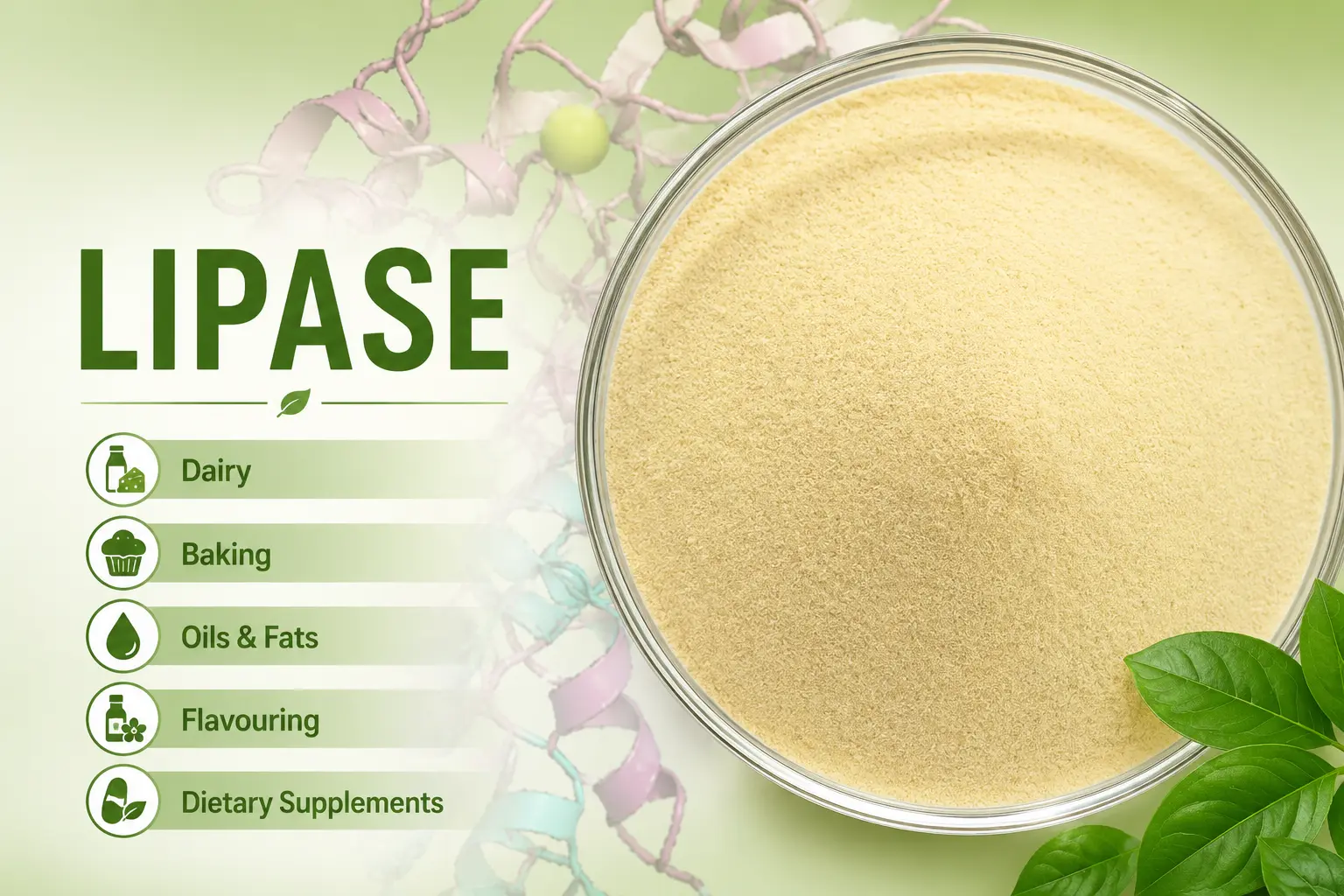
Lipase enzyme powder plays an important role in food processing and several industrial applications. It helps break down fats and oils into simpler components, making it useful for manufacturers who work with lipid-based raw materials. From dairy processing and flavour development to fat modification and food ingredient production, lipase supports a wide range of applications.
As food manufacturers look for better processing methods and consistent product quality, enzyme technology offers practical opportunities. Lipase, in particular, helps control specific reactions involving fats and oils. Therefore, manufacturers can use it to achieve desired product characteristics and improve selected processing stages.
Leaf CleanTech develops enzyme solutions for Food & Nutrition and other industrial applications. In this guide, we explain what lipase enzyme powder is, how it works, its major applications, factors affecting its performance and how to choose a suitable lipase enzyme for your production requirements.
Key Takeaways
- Lipase is an enzyme that catalyses the breakdown of fats and oils.
- It acts on triglycerides and releases fatty acids and glycerol through hydrolysis.
- Food manufacturers use lipase in dairy processing, flavour development and fat modification.
- Industrial lipase applications depend on enzyme activity, substrate, temperature and pH.
- Manufacturers should evaluate enzyme dosage and processing conditions through application trials.
- Leaf CleanTech includes lipase enzyme powder in its Food & Nutrition enzyme portfolio.
What Is Lipase Enzyme Powder?
Lipase enzyme powder is a powdered enzyme preparation that contains lipase activity. Lipase belongs to a group of enzymes known as hydrolases. It catalyses the hydrolysis of fats and oils, particularly triglycerides, into glycerol and fatty acids.
Fats and oils are important components of many food products. However, manufacturers sometimes need to modify these components to achieve specific flavour, texture or processing characteristics. Lipase helps them control these reactions under suitable conditions.
For example, lipase can release free fatty acids from milk fat during cheese ripening. These fatty acids contribute to flavour development. Similarly, manufacturers can use selected lipase preparations in fat modification and other food-processing applications.
Commercial lipase preparations may come from microbial, plant or animal sources. However, microbial lipases receive particular attention in industrial applications because manufacturers can produce them through controlled fermentation.
Leaf CleanTech includes lipase enzyme powder in its Food & Nutrition enzyme portfolio.
How Does Lipase Enzyme Work?
Lipase works by breaking the ester bonds in triglycerides. Triglycerides contain a glycerol molecule linked to three fatty acids. When lipase acts on these bonds in the presence of water, it releases fatty acids and glycerol through a hydrolysis reaction.
The reaction can take place in stages. Depending on the enzyme and process conditions, lipase may produce diglycerides, monoglycerides, free fatty acids and glycerol.
Basic Lipase Reaction
Triglyceride + Water → Glycerol + Fatty Acids
This reaction explains why lipase is useful in applications that require fat breakdown or modification. Moreover, different lipases can show different preferences for specific fatty acids or positions within a triglyceride molecule.
Factors That Influence Lipase Activity
Lipase performance depends on several operating conditions. Therefore, manufacturers should evaluate these factors before selecting an enzyme or deciding its dosage.
- Temperature: Temperature affects enzyme activity and stability. Each lipase preparation has its own suitable operating range.
- pH: The pH of the processing medium can influence enzyme performance.
- Enzyme dosage: The required quantity depends on the substrate, activity level and desired reaction.
- Reaction time: Processing time affects the degree of fat hydrolysis.
- Substrate composition: Different fats and oils can respond differently to the same enzyme.
- Water availability: Lipase-catalysed hydrolysis requires suitable water availability at the reaction site.
- Mixing and contact: Effective contact between the enzyme and fat substrate can influence reaction performance.
Consequently, manufacturers should establish application conditions through suitable testing rather than applying one universal dosage to every process.
Major Applications of Lipase Enzyme Powder
Lipase enzyme powder has applications across food manufacturing and other industries that process fats and oils. Its ability to modify lipid components makes it useful for several specialised production requirements.
1. Dairy Processing
Dairy products contain milk fat, which contributes to their flavour, texture and overall characteristics. Lipase can break down milk fat and release free fatty acids that influence flavour development.
Cheese manufacturers may use selected lipase preparations to support flavour formation during processing and ripening. In addition, lipase can help develop specific flavour profiles in certain dairy products.
Common dairy applications include:
- Cheese flavour development
- Milk fat hydrolysis
- Specialty dairy ingredient processing
- Fat modification in selected dairy formulations
2. Cheese Manufacturing
Cheese flavour develops through several biochemical reactions during ripening. Lipolysis, which involves the breakdown of milk fat, contributes to this process.
Lipase releases free fatty acids from milk fat. These compounds can contribute to the characteristic flavour and aroma of certain cheese varieties. Therefore, manufacturers may select specific lipase preparations according to the cheese type and desired flavour profile.
However, the right enzyme and dosage depend on the milk composition, cheese formulation, ripening conditions and target flavour characteristics.
3. Bakery and Food Processing
Lipase can support selected bakery and food-processing applications by modifying lipid components. In some formulations, lipase activity can influence dough properties and the interaction between fats and other ingredients.
Depending on the enzyme preparation and formulation, manufacturers may evaluate lipase for:
- Bakery ingredient modification
- Fat-related dough properties
- Specialty food formulations
- Processing of lipid-containing ingredients
Because bakery formulations differ, manufacturers should conduct trials to confirm the desired effect on dough handling and finished-product quality.
4. Fat and Oil Modification
Fat and oil modification is an important application of lipase technology. Selected lipases can catalyse reactions that change the composition or structure of triglycerides.
Depending on the enzyme and reaction conditions, manufacturers can explore applications such as:
- Fat hydrolysis
- Oil modification
- Structured lipid production
- Enzymatic interesterification
- Specialty lipid ingredient development
For example, enzymatic interesterification can rearrange fatty acids within triglycerides. As a result, manufacturers can develop fats with selected functional properties without relying solely on conventional chemical modification methods.
5. Flavour Development
Fats and oils contribute significantly to food flavour. Lipase can release fatty acids that participate in flavour development or act as precursors for additional reactions.
Food manufacturers may use lipase in selected flavour-development applications, particularly in dairy and specialty food processing. Moreover, enzyme selection allows manufacturers to target particular flavour characteristics through controlled processing.
6. Nutritional and Food Ingredient Applications
Lipase also has applications in the development and processing of selected nutritional ingredients. It can help modify lipid components and support specific ingredient-processing requirements.
However, the suitability of a lipase preparation depends on the intended product, food-grade requirements and processing conditions. Manufacturers should confirm product specifications before using an enzyme in a food or nutritional formulation.
7. Industrial and Specialty Applications
Beyond food manufacturing, lipases have applications in selected industrial processes involving fats and oils. These include certain oleochemical processes, specialty chemical production and enzyme-based cleaning formulations.
Nevertheless, each application requires an enzyme with suitable activity, stability and substrate compatibility. Therefore, manufacturers should select the preparation according to the intended industrial process.
Benefits of Lipase Enzyme in Food Processing
Lipase offers several processing opportunities because it acts directly on fats and oils. When manufacturers select the right enzyme for their application, it can help them achieve specific product and process objectives.
1. Supports Controlled Fat Breakdown
Lipase catalyses the breakdown of triglycerides into smaller lipid components. Therefore, manufacturers can use it in processes that require controlled fat hydrolysis.
2. Helps Develop Specific Flavour Profiles
Free fatty acids released through lipase activity can contribute to flavour development. This makes the enzyme useful in selected cheese and dairy applications.
3. Supports Specialty Fat Modification
Selected lipases can catalyse interesterification and other lipid-modification reactions. Consequently, manufacturers can explore enzyme-based routes for developing specialty fat ingredients.
4. Offers Application Flexibility
Different lipase preparations can work with different fat substrates and processing conditions. As a result, manufacturers can evaluate suitable enzyme options for specific production requirements.
5. Supports Enzyme-Based Processing
Enzymes provide targeted catalytic activity. In suitable applications, lipase can help manufacturers carry out specific reactions under controlled processing conditions.
6. Enables Process Customisation
Manufacturers can evaluate enzyme dosage, temperature, pH and reaction time to achieve their target outcome. Thus, lipase technology can support application-specific process development.
Lipase Enzyme Powder vs Other Food Enzymes
Food manufacturers use different enzymes to process proteins, carbohydrates, fibres and fats. Although these enzymes may appear in the same production environment, each one targets a different substrate.
| Enzyme | Primary Function | Main Substrate | Common Applications |
|---|---|---|---|
| Lipase | Breaks down fats into fatty acids and glycerol | Triglycerides and other lipids | Dairy processing, cheese flavour development and fat modification |
| Protease | Breaks down proteins into smaller peptides | Proteins | Protein hydrolysis, food processing and baking |
| Amylase | Breaks down starch into smaller carbohydrates | Starch | Baking, starch processing and fermentation |
| Lactase | Breaks lactose into glucose and galactose | Lactose | Lactose-reduced dairy and milk processing |
| Cellulase | Breaks down cellulose | Cellulose | Fruit processing, fibre modification and ingredient processing |
| Pectinase | Breaks down pectin | Pectin | Juice extraction and fruit processing |
| Invertase | Converts sucrose into glucose and fructose | Sucrose | Confectionery and invert sugar production |
Each enzyme performs a specific function. Therefore, manufacturers should choose the enzyme that matches the target substrate and desired processing outcome.
Explore Leaf CleanTech's other food enzyme products, including lactase enzyme powder, food-grade cellulase and invertase enzyme powder.
How to Select the Right Lipase Enzyme Powder
Choosing a suitable lipase enzyme powder requires an understanding of your raw material and production process. A product that works well in one application may not deliver the same performance in another. Therefore, evaluate the following parameters before selecting an enzyme.
1. Application Requirements
First, identify the intended application. For example, cheese flavour development, fat hydrolysis and oil modification may require different lipase characteristics.
2. Enzyme Activity
Enzyme activity indicates the catalytic performance of a preparation under defined test conditions. Always compare activity units and testing methods when evaluating different products.
3. Temperature Range
Temperature affects both enzyme activity and stability. Therefore, select a lipase that suits your processing temperature and required reaction time.
4. pH Compatibility
The pH of the processing medium can influence lipase performance. Check the recommended pH range and compare it with your production conditions.
5. Substrate Compatibility
Different fats and oils have different compositions. Consequently, a lipase that performs well with one substrate may behave differently with another.
6. Product Grade and Quality
For food applications, check the product grade, quality documentation and applicable regulatory requirements. In addition, confirm that the enzyme meets your intended application standards.
7. Technical Support
Choose an enzyme supplier that understands industrial processing requirements. Application guidance can help you evaluate dosage, operating conditions and expected results more effectively.
Factors Affecting Lipase Enzyme Performance
Several factors influence lipase activity during industrial processing. Understanding them helps manufacturers establish suitable operating conditions and maintain consistent results.
| Factor | Effect on Lipase Activity | What to Consider |
|---|---|---|
| Temperature | Influences reaction rate and enzyme stability | Use the recommended operating range |
| pH | Can affect enzyme structure and catalytic activity | Evaluate the pH of the substrate |
| Dosage | Influences the rate and extent of hydrolysis | Establish dosage through application trials |
| Reaction Time | Determines the time available for enzyme action | Monitor the desired degree of fat breakdown |
| Substrate Type | Different fats and oils show different responses | Test the actual production material |
| Water Availability | Influences hydrolysis reactions | Check moisture and process conditions |
| Mixing | Affects contact between enzyme and substrate | Evaluate mixing and dispersion conditions |
For reliable results, manufacturers should assess these factors together. In addition, pilot trials can help establish suitable conditions before full-scale production.
Lipase Enzyme Powder for Industrial Food Manufacturers
Industrial food manufacturers need enzyme solutions that match their raw materials, production equipment and quality requirements. Lipase can support selected applications where controlled fat breakdown or lipid modification forms part of the process.
Manufacturers involved in the following activities may evaluate lipase enzyme technology:
- Dairy and cheese manufacturing
- Food ingredient production
- Specialty fat and oil processing
- Flavour ingredient development
- Bakery ingredient processing
- Nutritional ingredient manufacturing
- Research and product development
However, not every lipase preparation suits every application. Product grade, enzyme activity, source and operating conditions all influence suitability. Therefore, manufacturers should discuss their requirements with the enzyme supplier before commercial use.
Why Choose Leaf CleanTech for Lipase Enzyme Powder?
Leaf CleanTech Pvt. Ltd. is an industrial enzyme manufacturer based in Bengaluru, India. The company develops enzyme solutions for Food & Nutrition, Animal Feed and Fermentation applications.
Its Food & Nutrition portfolio includes lipase along with other enzymes used in food manufacturing and processing. Furthermore, Leaf CleanTech focuses on application requirements, product quality and technical guidance to help manufacturers identify suitable enzyme solutions.
1. Food & Nutrition Enzyme Portfolio
Leaf CleanTech offers a range of enzymes for food-processing applications, including lipase, protease, amylase, lactase, cellulase, pectinase and other enzyme solutions.
Explore the complete Food & Nutrition enzyme portfolio.
2. Application-Focused Solutions
Different manufacturing processes require different enzyme characteristics. Leaf CleanTech considers application requirements when helping manufacturers evaluate suitable enzyme products.
3. Biotechnology Expertise
The company combines enzyme technology and application knowledge to develop solutions for industrial processing requirements.
4. Technical Support
Leaf CleanTech works with customers to understand their process conditions and identify relevant enzyme solutions. This support can help manufacturers plan application trials and evaluate product performance.
5. Customized Enzyme Formulations
Some industrial processes require a specific combination of enzyme activities. In such cases, Leaf CleanTech can discuss customized formulation requirements based on the raw material and production objectives.
Learn more about customized food enzyme formulations.
How to Use Lipase Enzyme Powder in Your Production Process
The correct method of using lipase depends on the application, substrate and product specification. Therefore, manufacturers should follow the supplier's technical recommendations and validate the process before commercial production.
Step 1: Identify the Target Substrate
Determine the type of fat or oil you want to process. For example, milk fat, vegetable oil and other lipid materials have different compositions.
Step 2: Define the Desired Outcome
Decide whether your process requires fat hydrolysis, flavour development or lipid modification. This objective helps determine the appropriate enzyme characteristics.
Step 3: Review Operating Conditions
Check the substrate composition, temperature, pH, moisture and processing time. These parameters can influence enzyme performance.
Step 4: Establish the Enzyme Dosage
Determine the initial dosage through laboratory or pilot-scale trials. Avoid applying a general dosage without considering enzyme activity and substrate characteristics.
Step 5: Monitor the Reaction
Track the reaction using suitable analytical or process measurements. For example, manufacturers may evaluate free fatty acid formation when monitoring fat hydrolysis.
Step 6: Validate the Final Product
Check the finished product against the required quality and performance specifications. Then, adjust the process if the results do not meet the target.
Frequently Asked Questions About Lipase Enzyme Powder
1. What is lipase enzyme powder?
Lipase enzyme powder is a powdered enzyme preparation that catalyses the breakdown of fats and oils. It acts on triglycerides and releases fatty acids and glycerol through hydrolysis.
2. What is lipase enzyme used for?
Lipase is used in dairy processing, cheese flavour development, fat and oil modification, selected bakery applications and specialty food ingredient production. It also has applications in certain non-food industrial processes.
3. How does lipase break down fats?
Lipase breaks the ester bonds in triglycerides through hydrolysis. This reaction releases fatty acids and glycerol. Depending on the reaction conditions, it may also produce intermediate compounds such as diglycerides and monoglycerides.
4. What is the difference between lipase and protease?
Lipase acts on fats and oils, while protease breaks down proteins into smaller peptides and amino acids. Therefore, the two enzymes serve different purposes in food processing.
5. Can lipase be used in dairy processing?
Yes. Selected lipase preparations can support dairy applications, particularly cheese flavour development and milk-fat hydrolysis. The enzyme should match the dairy product and intended flavour profile.
6. What is the role of lipase in cheese manufacturing?
Lipase breaks down milk fat and releases free fatty acids. These compounds can contribute to the characteristic flavour and aroma of certain cheese varieties.
7. Can lipase be used in bakery applications?
Selected lipase preparations can support bakery processing by modifying lipid components and influencing certain dough properties. However, manufacturers should evaluate the enzyme in their specific formulation.
8. What are the main factors affecting lipase activity?
Temperature, pH, enzyme dosage, reaction time, substrate composition, water availability and mixing can influence lipase performance.
9. What is the difference between lipase and amylase?
Lipase breaks down fats and oils, whereas amylase acts on starch. Lipase supports lipid processing, while amylase is useful in applications such as baking, starch conversion and fermentation.
10. Is lipase enzyme powder suitable for food processing?
Some lipase preparations are suitable for food-processing applications. However, manufacturers must verify the product grade, specifications, regulatory suitability and intended use before incorporating it into food production.
11. How much lipase enzyme powder should I use?
There is no universal dosage for every application. The required amount depends on enzyme activity, substrate composition, temperature, pH, reaction time and the desired degree of fat hydrolysis. Conduct application trials to establish the appropriate dosage.
12. What is the difference between food-grade lipase and industrial lipase?
Food-grade lipase meets the applicable requirements for its intended food application. Industrial lipase may serve other processes and may not meet food-use requirements. Always check the product documentation and intended application before selection.
13. Does Leaf CleanTech offer lipase enzyme powder?
Yes. Leaf CleanTech lists lipase enzyme powder in its Food & Nutrition enzyme portfolio. Contact the company to confirm current product specifications, availability and application suitability.
14. Can Leaf CleanTech help with enzyme selection?
Yes. Leaf CleanTech provides application-focused technical guidance to help manufacturers evaluate enzyme solutions according to their raw materials and process conditions.
15. Can I request a customized lipase formulation?
You can discuss your specific processing requirements with Leaf CleanTech. The technical team can evaluate whether a customized enzyme formulation is suitable for your application.
Conclusion: Choose the Right Lipase Enzyme Powder for Your Application
Lipase enzyme powder is an important processing tool for industries that work with fats and oils. Its ability to catalyse triglyceride hydrolysis makes it useful in dairy processing, cheese flavour development, fat modification and selected food ingredient applications.
However, successful enzyme application depends on selecting the right preparation and establishing suitable operating conditions. Manufacturers should consider enzyme activity, substrate composition, temperature, pH, dosage and reaction time before introducing lipase into commercial production.
With the right application approach, lipase can support controlled lipid processing and specific product development goals. Therefore, working with an experienced enzyme manufacturer can help simplify product selection and application evaluation.
Looking for Lipase Enzyme Powder?
Are you looking for lipase enzyme powder for dairy processing, cheese flavour development, fat modification or another food-processing application?
Leaf CleanTech offers industrial enzyme solutions for Food & Nutrition and other manufacturing sectors. Share your raw material, application and processing conditions with our team to discuss a suitable lipase enzyme solution.
Contact Leaf CleanTech
Company: Leaf CleanTech Pvt. Ltd.
Address: #371 & 372, 10th Cross, 4th Phase, Peenya Industrial Area, Bengaluru – 560058, India.
Phone: +91 80 41144713
Email: info@leafcleantech.com
Alpha Galactosidase Enzyme for Food Processing
May 27, 2026[…] Lipase Enzyme Powder […]