
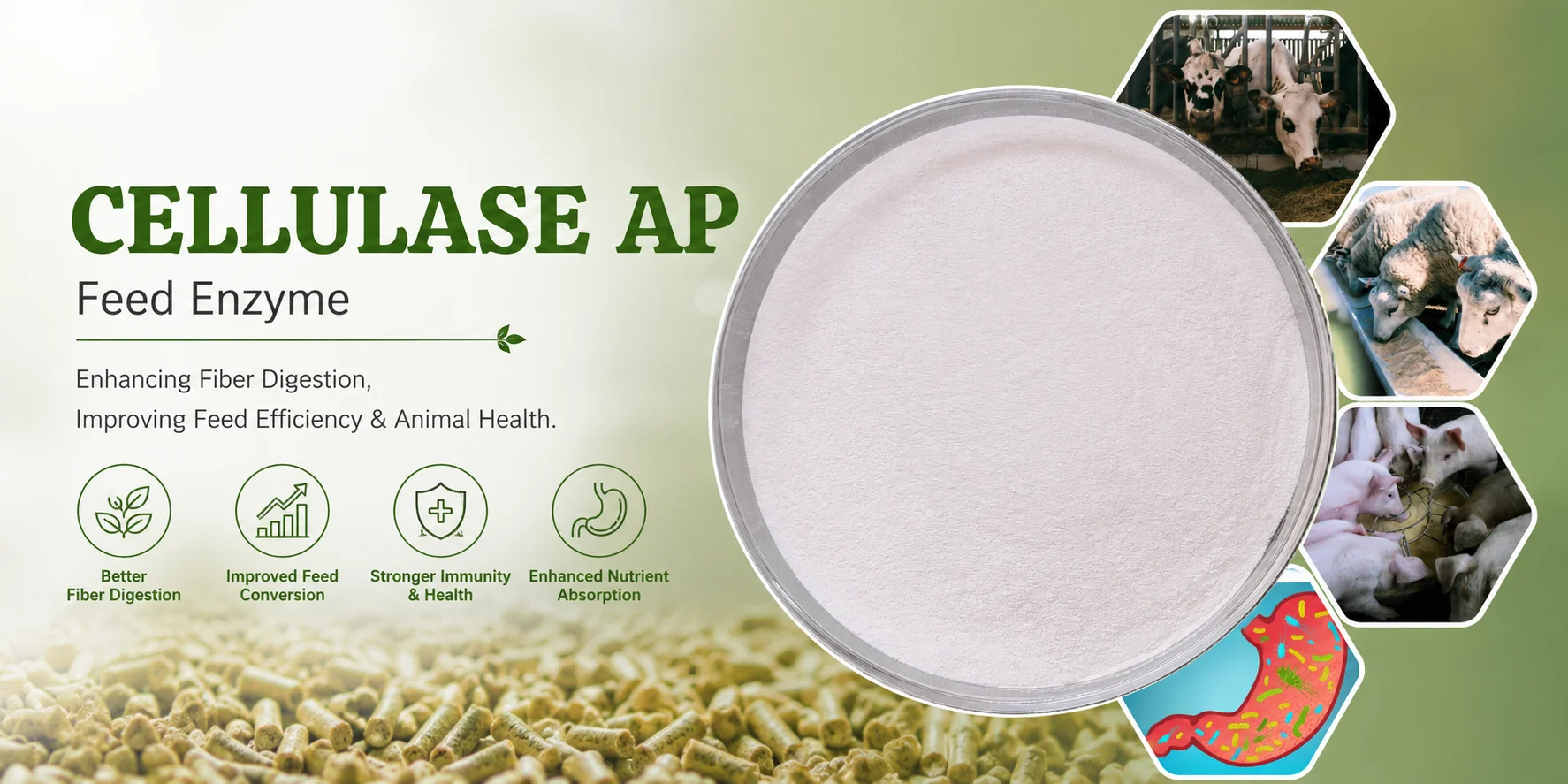
Plant-based ingredients contribute valuable nutrients to animal feed. However, their cell walls contain cellulose, a structural carbohydrate that many animals cannot digest efficiently on their own. As a result, some nutrients within fibrous feed ingredients may remain less accessible.
A feed cellulase enzyme helps address this challenge by breaking down cellulose into smaller carbohydrate molecules. Therefore, feed manufacturers can evaluate cellulase when formulating diets containing fibrous raw materials. The right enzyme can support feed ingredient utilisation when its activity matches the formulation and processing conditions.
Leaf CleanTech offers LEAFCEL AP for animal feed applications. Explore its product specifications and discuss your feed formulation requirements with the technical team.
What Is Feed Cellulase Enzyme?
Cellulase is an enzyme that breaks down cellulose, a major component of plant cell walls. It works by hydrolysing the bonds within cellulose, producing smaller carbohydrate fragments and, depending on the enzyme system and reaction conditions, simpler sugars.
Many feed ingredients contain cellulose, including forage, bran, crop residues and other plant-derived materials. However, the cellulose content and structure vary between ingredients. Consequently, cellulase activity may differ depending on the raw material, enzyme formulation, pH, temperature and processing conditions.
Feed cellulase can also complement other enzymes. For example, xylanase targets xylans within plant cell walls, while beta glucanase acts on beta-glucans. Using the right combination may help address different components of a complex feed formulation.
How Does Cellulase Work in Animal Feed?
Cellulose consists of long chains of glucose units linked by beta-1,4 glycosidic bonds. These chains form a strong structure within plant cell walls. Cellulase helps break down this structure through enzymatic hydrolysis.
- Substrate identification: The enzyme encounters cellulose in suitable plant-based feed ingredients.
- Cellulose breakdown: Cellulase acts on the cellulose structure and breaks it into smaller carbohydrate fragments.
- Greater substrate accessibility: Cell wall breakdown may improve access to some components trapped within plant material.
- Feed evaluation: Feed manufacturers assess the enzyme's contribution through digestibility studies and appropriate animal performance measurements.
However, cellulase does not deliver the same results in every diet. Therefore, manufacturers should evaluate the enzyme against their specific feed ingredients, inclusion rate and processing conditions before making performance claims.
Key Benefits of Feed Cellulase Enzyme
1. Supports Fibre Breakdown
Cellulase targets cellulose in plant materials. Consequently, it can help break down a portion of the structural fibre present in suitable feed ingredients.
2. Improves Nutrient Accessibility
Plant cell walls can restrict access to some nutrients. Cellulase-assisted breakdown may help make certain components more accessible, depending on the feed matrix.
3. Supports Feed Formulation
Feed formulators can evaluate cellulase when working with fibrous ingredients. Moreover, enzyme selection can form part of a broader strategy for improving ingredient utilisation.
4. Complements Other Enzymes
Cellulase targets cellulose, whereas other feed enzymes act on proteins, starches or different fibre components. Therefore, a suitable enzyme blend may address multiple formulation needs.
Actual benefits depend on the enzyme's activity, the feed composition, the target animal and the conditions in which the enzyme operates. Controlled testing helps determine whether cellulase provides a measurable advantage in a particular formulation.
Applications of Cellulase in Animal Feed
1. Poultry Feed
Poultry diets may contain cereal grains, bran and other plant-based ingredients with varying fibre levels. Feed cellulase can be evaluated in suitable formulations to help break down cellulose and improve access to selected feed components. However, the response depends on the substrate and the enzyme's activity under relevant digestive conditions.
2. Cattle and Ruminant Feed
Ruminants consume forage and other fibrous feed materials. Their rumen microorganisms naturally help digest plant fibre. Supplemental cellulase may be evaluated as part of a feeding strategy, particularly when the objective is to improve fibre utilisation. Nevertheless, results depend on forage quality, the existing rumen microbial population and the specific enzyme formulation.
3. Swine Feed
Swine diets often include cereal grains and plant-derived by-products. Some of these ingredients contain structural carbohydrates that pigs cannot fully digest using their own enzymes. Therefore, cellulase may be considered when formulators want to evaluate fibre breakdown in suitable diets.
4. Fibrous Feed Ingredients
Bran, crop-derived materials and other plant-based by-products can contribute fibre to animal diets. However, the structure and accessibility of cellulose vary across raw materials. A feed cellulase enzyme may help break down accessible cellulose when the formulation and application conditions support effective activity.
5. Multi-Enzyme Feed Formulations
Some feed formulations contain cellulose, xylan, beta-glucans, proteins and starches. In these cases, a combination of selected enzymes may be worth evaluating. For example, cellulase can complement feed xylanase and feed beta glucanase when the corresponding substrates are present.
Feed Cellulase vs Other Feed Enzymes
Different feed enzymes target different components of feed ingredients. Therefore, the best choice depends on the composition of the diet and the nutritional or processing objective.
| Enzyme | Primary Target | Potential Role in Feed | Related Resource |
|---|---|---|---|
| Cellulase | Cellulose | Supports the breakdown of cellulose in plant materials. | Feed Cellulase |
| Xylanase | Xylans and related xylan substrates | Targets selected hemicellulose components in cereal-based feeds. | Feed Xylanase |
| Beta Glucanase | Beta-glucans | Helps break down suitable beta-glucan substrates in grain-based diets. | Feed Beta Glucanase |
| Protease | Proteins | Hydrolyses dietary proteins into smaller peptides and amino acids. | Neutral Protease |
| Pectinase | Pectin | Breaks down pectin in suitable plant-based feed ingredients. | Feed Pectinase |
These enzymes perform different functions and are not interchangeable. In addition, combining enzymes does not automatically improve feed performance. Manufacturers should confirm substrate suitability, enzyme compatibility and inclusion rates before adopting a multi-enzyme formulation.
Product Specifications: LEAFCEL AP
Leaf CleanTech lists LEAFCEL AP as its cellulase enzyme for animal feed applications. The following table summarises the product information published on its feed cellulase page.
| Specification | Listed Details |
|---|---|
| Product name | LEAFCEL AP |
| Enzyme type | Cellulase |
| Application | Animal feed |
| Physical form | Feed-grade powder |
| Listed activity | 4,500 U/g |
| Packaging | 25 kg HDPE drums |
| Listed shelf life | 2 years |
| Minimum order quantity | 25 kg |
How to Select Feed Cellulase Enzyme
Choosing a suitable cellulase requires more than checking its activity value. Instead, consider the feed ingredients, production process and intended outcome.
- Analyse the feed ingredients: Identify the main fibre sources and assess their cellulose content where relevant.
- Define the objective: Decide whether the priority is fibre breakdown, ingredient utilisation or another measurable formulation goal.
- Check enzyme activity: Review the declared activity and test method in the product datasheet.
- Evaluate operating conditions: Consider pH, temperature, moisture and reaction time during feed production and digestion.
- Assess processing stability: If the feed undergoes pelleting or heat treatment, request relevant stability data from the supplier.
- Confirm the inclusion rate: Follow the manufacturer's technical guidance and the requirements of a qualified animal nutritionist.
- Measure the response: Use appropriate trials to assess digestibility, feed conversion and animal performance against a suitable control.
This structured approach helps manufacturers identify whether cellulase is suitable for their application. Moreover, it supports better purchasing decisions by connecting enzyme selection with measurable formulation goals.
Best Practices for Cellulase Application
Correct storage, handling and mixing help maintain enzyme quality. Follow the product-specific instructions provided by the manufacturer.
- Store the product under the recommended temperature and humidity conditions.
- Protect the powder from moisture and unsuitable storage environments.
- Follow the recommended inclusion rate and mixing procedure.
- Check enzyme stability under the actual feed-processing conditions.
- Maintain consistent mixing to support uniform distribution throughout the feed.
- Use appropriate protective equipment and follow the product safety documentation.
- Record batch information and evaluate results using consistent measurement methods.
Furthermore, avoid assuming that a higher dosage will always produce better results. The right inclusion rate depends on the product, substrate, processing conditions and target application.
Why Choose Leaf CleanTech for Feed Enzymes?
Leaf CleanTech develops industrial enzyme solutions for animal feed, food processing and fermentation applications. Its feed enzyme portfolio includes cellulase, xylanase, protease, beta glucanase, phytase, amylase and other enzyme options.
Application-Focused Solutions
Choose enzyme options according to your feed ingredients and intended processing requirements.
Multiple Enzyme Options
Explore complementary enzyme activities for different substrates and feed formulation needs.
Technical Evaluation
Discuss product activity, application conditions and suitability with the technical team.
Custom Formulation Discussions
Ask about enzyme combinations when a formulation requires more than one enzyme activity.
To explore the wider product range, visit Leaf CleanTech's animal feed enzyme portfolio.
Frequently Asked Questions About Feed Cellulase Enzyme
1. What is feed cellulase enzyme?
Feed cellulase is an enzyme that breaks down cellulose, a structural carbohydrate found in plant cell walls. Feed manufacturers can evaluate it to support fibre breakdown in suitable animal feed formulations.
2. What does cellulase do in animal feed?
Cellulase hydrolyses cellulose into smaller carbohydrate fragments. Depending on the feed ingredients and application conditions, this process may improve access to selected components of fibrous plant material.
3. What are the benefits of cellulase in poultry feed?
Cellulase may help break down cellulose in suitable poultry feed ingredients. The potential benefit depends on the diet composition, enzyme activity and conditions in which the enzyme operates.
4. Can cellulase be used in cattle feed?
Cellulase can be evaluated for suitable cattle feed and forage applications. However, the response depends on forage quality, the existing rumen microbial activity and the specific enzyme formulation.
5. What is the difference between cellulase and xylanase?
Cellulase targets cellulose, while xylanase acts on xylans and related substrates in hemicellulose. Therefore, they target different components of plant cell walls and may serve complementary roles in suitable feed formulations.
6. What is the listed activity of LEAFCEL AP?
Leaf CleanTech lists LEAFCEL AP at 4,500 U/g. Confirm the latest product specification and activity assay method with the manufacturer before comparing it with other cellulase products.
7. What is the packaging and shelf life of feed cellulase?
The product page lists 25 kg HDPE drums and a two-year shelf life. Contact Leaf CleanTech to confirm the current packaging, storage conditions and shelf-life details.
8. Can cellulase be combined with other feed enzymes?
Cellulase may be combined with other enzymes when the feed contains suitable target substrates. For example, xylanase targets xylans and beta glucanase targets beta-glucans. Confirm compatibility and inclusion rates with the manufacturer.
9. How do I select the right cellulase dosage?
The appropriate inclusion rate depends on the product activity, feed ingredients, processing conditions and intended application. Follow the manufacturer's guidance and validate the dosage through suitable testing.
10. How can I order feed cellulase enzyme from Leaf CleanTech?
Contact Leaf CleanTech with your required quantity, feed application and processing details. Its team can help you confirm the current specifications and discuss product availability.
Find the Right Feed Cellulase
Looking for a feed-grade cellulase enzyme for your formulation? Contact Leaf CleanTech to discuss LEAFCEL AP, request the latest product datasheet and evaluate its suitability for your application.
Contact Leaf CleanTech
Industrial Biotechnology Applications - Leaf CleanTech
August 22, 2026[…] animal feed enzyme portfolio includes enzyme solutions such as phytase, xylanase, protease, cellulase, beta-glucanase, mannanase and […]