
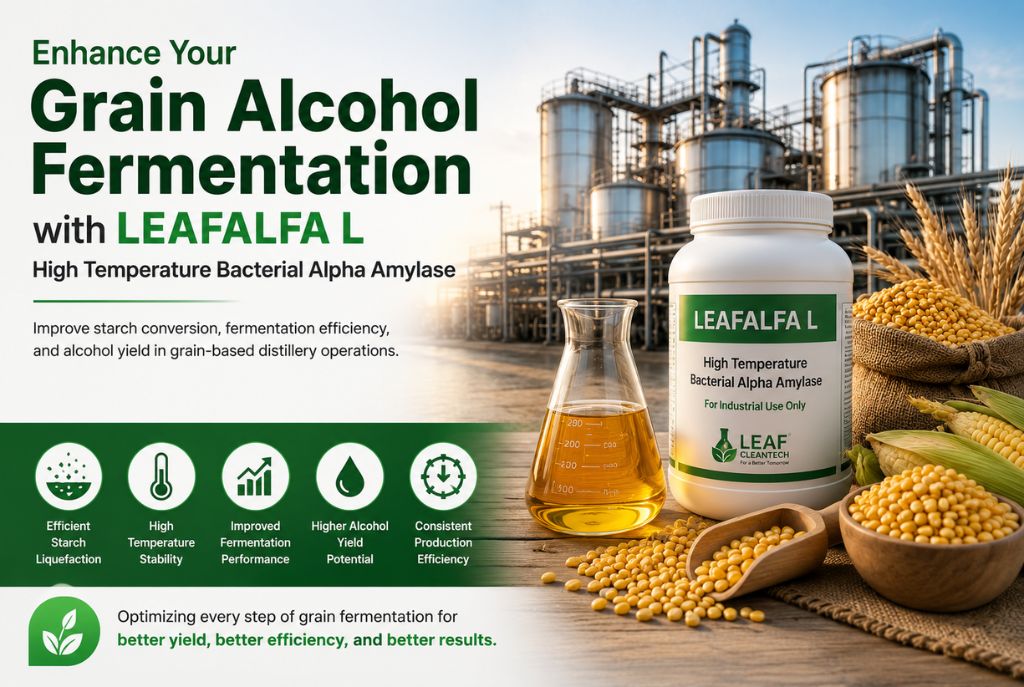
Grain alcohol fermentation is an important process in industrial alcohol and ethanol production. It converts starch-rich raw materials such as corn, rice, wheat, sorghum and millets into alcohol through enzyme-assisted starch conversion and yeast fermentation. However, successful production requires more than grain and yeast. Manufacturers must also manage starch liquefaction, sugar conversion, fermentation conditions and residual carbohydrates.
That is where specialised enzymes make a difference. First, alpha amylase breaks down gelatinised starch into smaller carbohydrate chains. Next, glucoamylase converts these chains into fermentable sugars. Finally, yeast converts the available sugars into alcohol and carbon dioxide. In addition, fermentation booster enzymes can help convert certain residual carbohydrates that yeast cannot use directly.
At Leaf CleanTech, we provide enzyme and yeast solutions for grain-based fermentation applications. Our range includes high-temperature bacterial alpha amylase, glucoamylase, active dry yeast and fermentation booster enzymes. Therefore, manufacturers can explore solutions that match their raw materials, processing conditions and production objectives.
Key Takeaways
- Grain alcohol fermentation converts starch-rich raw materials into alcohol through enzyme action and yeast activity.
- Alpha amylase supports starch liquefaction and reduces mash viscosity.
- Glucoamylase converts liquefied starch products into fermentable glucose.
- Active dry yeast converts fermentable sugars into alcohol and carbon dioxide.
- Fermentation booster enzymes can help recover additional fermentable sugars from suitable residual carbohydrates.
- Raw material quality, enzyme selection, yeast performance and process control all influence fermentation results.
What Is Grain Alcohol Fermentation?
Grain alcohol fermentation is a biological process that converts carbohydrates in grains into alcohol. Since grains contain starch rather than large quantities of directly fermentable sugar, manufacturers must first break down the starch. Enzymes perform this essential conversion before yeast begins the main fermentation stage.
For example, corn, rice, wheat, sorghum and millets can serve as raw materials for different alcohol production applications. However, each grain has a different starch structure and processing behaviour. Consequently, manufacturers must select suitable enzymes and adjust process conditions according to the feedstock.
The overall process follows a simple sequence:
Grain preparation → Starch gelatinisation → Liquefaction → Saccharification → Yeast fermentation → Alcohol recovery
During the first stages, enzymes convert complex starch into smaller carbohydrates and fermentable sugars. Subsequently, yeast uses these sugars to produce alcohol. As a result, effective coordination between enzyme activity and yeast performance is essential for consistent production.
How Does the Grain Alcohol Fermentation Process Work?
Although plant configurations differ, most grain alcohol fermentation operations follow a series of connected stages. Each stage prepares the material for the next one. Therefore, a problem during starch conversion can affect the entire production cycle.
1. Grain Selection and Milling
First, manufacturers select suitable grains based on availability, starch content, cost and the intended alcohol application. Common choices include corn, rice, wheat, sorghum and millets. Next, the plant cleans and mills the grains to improve water absorption and expose more starch for processing.
Consistent milling also supports better slurry preparation. However, the ideal particle size depends on the grain type and plant equipment.
2. Slurry Preparation and Starch Gelatinisation
After milling, operators mix the grain flour with water to create a slurry. They then apply heat under controlled conditions. During this stage, starch granules absorb water, swell and gelatinise. Consequently, the starch becomes more accessible to enzymes.
Proper temperature management matters because incomplete gelatinisation can limit enzyme access. Therefore, manufacturers should align the process conditions with the raw material and enzyme formulation.
3. Starch Liquefaction
Next, high-temperature bacterial alpha amylase breaks down gelatinised starch. It hydrolyses internal alpha-1,4 glycosidic linkages and produces shorter carbohydrate chains, including dextrins and oligosaccharides.
At the same time, this reaction reduces mash viscosity. As a result, the slurry becomes easier to handle during downstream processing. A suitable thermostable enzyme helps maintain starch conversion under the plant's liquefaction conditions.
Explore our high-temperature bacterial alpha amylase for grain fermentation to understand its role in this stage.
4. Saccharification
Once liquefaction produces shorter carbohydrate chains, glucoamylase continues the conversion. It acts on dextrins and other suitable starch-derived carbohydrates to release glucose and other fermentable sugars.
This stage prepares the mash for yeast fermentation. Therefore, effective saccharification helps provide the fermentable sugar that yeast needs for alcohol production. In contrast, incomplete conversion may leave residual dextrins and reduce the amount of sugar available to yeast.
Read more about glucoamylase enzyme for grain fermentation and saccharification.
5. Yeast Fermentation
After sugar formation, manufacturers introduce a suitable yeast strain into the prepared mash. Yeast metabolises fermentable sugars and produces ethanol and carbon dioxide. However, fermentation performance depends on several factors, including yeast strain, sugar concentration, temperature, pH, nutrients and alcohol tolerance.
For this reason, yeast selection should match the feedstock and production conditions. A suitable active dry yeast can support consistent fermentation performance across grain-based applications.
Discover active dry yeast for grain fermentation and its role in alcohol production.
6. Fermentation Yield Recovery
Even when liquefaction and saccharification work well, some carbohydrate fragments may remain unfermented. Yeast cannot directly use every carbohydrate produced during starch conversion. Consequently, residual sugars can remain in the fermentation system.
A suitable fermentation booster enzyme can act on certain unfermentable carbohydrates and help release additional fermentable sugars. Therefore, manufacturers can evaluate booster enzyme applications when residual carbohydrate levels limit fermentation performance.
Learn how fermentation booster enzymes help address unfermentable sugars.
7. Distillation and Alcohol Recovery
Finally, the fermented mash moves to distillation. This stage separates and concentrates alcohol from the fermented mixture. Depending on the final application, manufacturers may carry out additional purification or dehydration steps to meet the required product specifications.
Although distillation follows fermentation, upstream process efficiency still matters. Better starch conversion and fermentation control can help plants manage the overall production process more effectively.
Which Enzymes Are Used in Grain Alcohol Fermentation?
Enzymes play different roles at different stages of grain alcohol fermentation. Therefore, manufacturers should not treat all fermentation enzymes as interchangeable. Instead, they should select each enzyme according to its function and the processing conditions.
| Enzyme or Product | Process Stage | Main Function | Application Benefit |
|---|---|---|---|
| High-Temperature Bacterial Alpha Amylase | Liquefaction | Breaks gelatinised starch into dextrins and oligosaccharides. | Supports starch conversion and viscosity reduction. |
| Glucoamylase | Saccharification | Converts suitable dextrins into fermentable glucose. | Provides fermentable sugars for yeast. |
| Active Dry Yeast | Fermentation | Converts fermentable sugars into alcohol and carbon dioxide. | Drives the biological alcohol production stage. |
| Fermentation Booster Enzyme | Yield recovery during fermentation | Acts on certain residual unfermentable carbohydrates. | Can support additional fermentable sugar recovery. |
However, enzyme selection alone does not guarantee a particular alcohol yield. Raw material quality, starch accessibility, enzyme activity, dosage, process conditions and yeast performance also influence the outcome. Therefore, manufacturers should evaluate enzyme performance under their actual operating conditions.
Leaf CleanTech Enzyme Solutions for Grain Alcohol Fermentation
Leaf CleanTech offers specialised enzyme and yeast products for grain fermentation applications. Each product supports a specific stage of the process. In addition, manufacturers can explore the product range according to their feedstock, production setup and process requirements.
1. LEAFALFA L – High-Temperature Bacterial Alpha Amylase
LEAFALFA L is a thermostable bacterial alpha amylase for grain fermentation. It catalyses the hydrolysis of alpha-1,4 glycosidic linkages in gelatinised starch. Consequently, it helps reduce mash viscosity and produces dextrins and oligosaccharides.
Furthermore, its role in liquefaction helps prepare starch-derived carbohydrates for the next processing stage. Manufacturers can evaluate this enzyme based on their liquefaction temperature profile, starch load and process requirements.
Explore LEAFALFA L high-temperature bacterial alpha amylase.
2. Glucoamylase Liquid Enzyme
Glucoamylase supports the saccharification stage of grain alcohol fermentation. After alpha amylase breaks down starch into shorter chains, glucoamylase converts suitable dextrins into glucose and other fermentable sugars.
As a result, yeast receives the sugars required for alcohol production. However, manufacturers should match glucoamylase activity and application conditions to the mash composition and desired conversion level.
Explore glucoamylase for grain fermentation.
3. LEAFALCO YEAST – Active Dry Yeast
LEAFALCO YEAST is an active dry yeast solution designed for grain-based fermentation. It is suitable for applications involving corn, rice, wheat, sorghum, millets and cassava, as well as other listed fermentation feedstocks.
Yeast converts fermentable sugars into alcohol and carbon dioxide. Therefore, selecting a strain that suits the raw material and fermentation environment is important. In particular, manufacturers should assess yeast performance under their target sugar concentration and alcohol conditions.
Explore LEAFALCO YEAST for grain fermentation.
4. BOOSTERZYME – Fermentation Booster Enzyme
BOOSTERZYME is designed for grain fermentation applications. It acts on certain unfermentable sugars that remain after the main starch conversion stages. By helping convert these carbohydrates into fermentable sugars, it can support improved fermentation efficiency.
Additionally, manufacturers can evaluate its application when residual carbohydrates remain a concern despite effective liquefaction and saccharification. The actual benefit depends on the carbohydrate profile and operating conditions.
Common Challenges in Grain Alcohol Fermentation
Grain alcohol production involves several connected biological and processing stages. Therefore, a challenge in one stage can affect downstream performance. Identifying the source of the problem helps manufacturers select a suitable corrective approach.
1. Incomplete Starch Liquefaction
When starch does not liquefy adequately, the mash may retain higher viscosity or contain incompletely converted starch. Consequently, downstream saccharification may not receive the expected substrate. Manufacturers should review gelatinisation, enzyme suitability, temperature and mixing conditions.
2. Incomplete Saccharification
Insufficient conversion during saccharification can leave residual dextrins and reduce the fermentable sugar available to yeast. Therefore, manufacturers should evaluate glucoamylase activity, contact time, pH and process conditions.
3. Unfermentable Sugars
Some carbohydrate fragments remain difficult for yeast to ferment directly. As a result, the process may leave residual sugars even when the main conversion stages operate effectively. A suitable fermentation booster enzyme may help address this issue, depending on the residual carbohydrate composition.
4. Poor Yeast Performance
Yeast performance can decline when the strain does not suit the feedstock or operating conditions. Moreover, high sugar concentration, increasing alcohol levels, temperature variation, nutrient availability and microbial competition can affect fermentation.
5. Raw Material Variation
Different grains contain different levels of starch, protein, fibre and other components. Even batches of the same grain can vary. Therefore, manufacturers should monitor raw material quality and adjust processing conditions when necessary.
6. Inconsistent Fermentation Cycles
Variations in enzyme conversion, yeast activity and fermentation conditions can create inconsistent batch performance. Consequently, plants should monitor key process indicators and investigate changes before making formulation or dosage adjustments.
Factors That Influence Grain Alcohol Fermentation Efficiency
Efficient grain alcohol fermentation depends on the combined performance of raw materials, enzymes, yeast and process controls. In other words, improving one stage without considering the others may not deliver the expected result.
- Grain quality: Starch content, moisture, particle size and raw material consistency influence processing.
- Milling efficiency: Suitable particle size helps expose starch for gelatinisation and enzyme action.
- Liquefaction conditions: Temperature, pH, mixing and alpha amylase activity affect starch breakdown.
- Saccharification performance: Glucoamylase activity and contact conditions influence fermentable sugar formation.
- Yeast selection: The strain should match the feedstock and expected fermentation environment.
- Fermentation conditions: Temperature, pH, sugar concentration, nutrients and contamination control influence yeast activity.
- Residual carbohydrate levels: Monitoring residual sugars can help identify opportunities for yield recovery.
- Process consistency: Regular monitoring helps identify deviations and maintain stable production.
For better process evaluation, manufacturers can monitor alcohol concentration, residual sugars, fermentation time, yeast viability, mash characteristics and batch-to-batch variation. Furthermore, comparing these indicators over several production cycles can help identify recurring process limitations.
Grain Alcohol Fermentation: Corn, Rice, Wheat and Other Feedstocks
Manufacturers use different starch-rich raw materials depending on regional availability, cost and the intended alcohol product. However, each feedstock presents different processing characteristics. Therefore, enzyme and yeast selection should reflect the grain being used.
| Grain or Feedstock | Common Applications | Processing Considerations |
|---|---|---|
| Corn | Fuel ethanol and industrial alcohol | Starch conversion and mash handling require suitable process control. |
| Rice | Alcohol and beverage fermentation | Enzyme selection should account for rice starch characteristics. |
| Wheat | Industrial alcohol and beverage production | Mash viscosity and raw material composition need attention. |
| Sorghum | Alcohol and ethanol production | Processing conditions should match the grain variety and starch profile. |
| Millets | Regional alcohol and fermentation applications | Grain size, milling and starch accessibility influence conversion. |
| Cassava | Industrial alcohol and ethanol production | Raw material preparation and starch conversion need suitable control. |
Although these feedstocks share a starch-based conversion route, they do not always require identical processing conditions. Consequently, manufacturers should evaluate enzyme compatibility and yeast performance for each raw material.
Grain Alcohol Fermentation vs Molasses Fermentation
Grain and molasses fermentation both support alcohol production. However, their raw materials differ significantly. Grain contains starch that requires enzymatic conversion, whereas molasses already contains fermentable sugars. Therefore, each process needs a different enzyme and yeast strategy.
| Parameter | Grain Alcohol Fermentation | Molasses Fermentation |
|---|---|---|
| Main raw material | Starch-rich grains | Sugarcane molasses |
| Initial carbohydrate | Primarily starch | Primarily fermentable sugars, with other components |
| Key conversion stages | Liquefaction and saccharification | Feed preparation and fermentation management |
| Important enzyme solutions | Alpha amylase, glucoamylase and fermentation booster | Molasses-specific fermentation booster and other application-specific enzymes |
| Yeast requirement | Yeast suited to grain-based fermentation | Yeast suited to molasses-based fermentation |
| Key process focus | Starch conversion and fermentable sugar availability | Sugar utilisation, yeast performance and contamination management |
For molasses-based production, explore our molasses fermentation enzyme solutions. This separate product range addresses the specific requirements of sugar-based fermentation.
How to Select the Right Grain Fermentation Enzyme Manufacturer
Selecting an enzyme manufacturer is an important decision for industrial alcohol producers. However, price alone should not determine the choice. Instead, manufacturers should assess product suitability, technical support, quality systems and application knowledge.
- Application-specific products: Choose a supplier with enzymes designed for liquefaction, saccharification and fermentation support.
- Technical documentation: Review product specifications, activity details, recommended application conditions and handling guidance.
- Raw material compatibility: Confirm that the enzyme and yeast solutions suit the grain used in your plant.
- Quality and consistency: Evaluate the manufacturer's quality systems and batch consistency.
- Technical support: Look for application guidance and assistance with process evaluation.
- Plant-level evaluation: Conduct controlled trials before making large-scale formulation or dosage changes.
Additionally, discuss your current process limitations with the supplier. A technical discussion can help identify whether the main challenge lies in liquefaction, saccharification, yeast performance or residual carbohydrate conversion.
Why Choose Leaf CleanTech for Grain Alcohol Fermentation?
Leaf CleanTech develops industrial enzyme solutions for food, feed and fermentation applications. With biotechnology and enzyme formulation expertise, the company supports manufacturers looking for application-focused solutions.
- Grain fermentation portfolio: Solutions include LEAFALFA L, glucoamylase, LEAFALCO YEAST and BOOSTERZYME.
- Application-focused products: Each solution supports a specific stage or requirement within the grain fermentation process.
- Biotechnology expertise: The company applies enzyme technology to industrial processing challenges.
- Technical guidance: Manufacturers can discuss process requirements and product suitability with the team.
- Customised approach: Product selection can consider raw material characteristics and operating conditions.
Furthermore, Leaf CleanTech supports fermentation applications beyond grain processing. Explore the complete fermentation enzyme and yeast product range to understand the available solutions.
Improve Your Grain Alcohol Fermentation Process with Leaf CleanTech
Are you looking for enzymes or yeast for grain-based alcohol production? Leaf CleanTech offers solutions for starch liquefaction, saccharification, yeast fermentation and residual carbohydrate management.
Share your grain type, process conditions and production challenges with our team. We can help you explore suitable enzyme and yeast options for your application.
Company: Leaf CleanTech Pvt. Ltd.
Address: #371 & 372, 10th Cross, 4th Phase, Peenya Industrial Area, Bengaluru – 560058, India
Phone: +91 80 41144713
Email: info@leafcleantech.com
Contact Leaf CleanTech for grain fermentation enzyme solutions.
Frequently Asked Questions About Grain Alcohol Fermentation
1. What is grain alcohol fermentation?
Grain alcohol fermentation is the process of converting starch from grains into fermentable sugars and then using yeast to produce alcohol. It involves starch liquefaction, saccharification and yeast fermentation.
2. Which grains are used for alcohol fermentation?
Common feedstocks include corn, rice, wheat, sorghum and millets. Cassava can also serve as a starch-rich raw material in suitable industrial fermentation processes.
3. Which enzymes are used in grain alcohol fermentation?
High-temperature bacterial alpha amylase supports liquefaction, while glucoamylase supports saccharification. In addition, fermentation booster enzymes can help convert certain residual unfermentable carbohydrates into fermentable sugars.
4. What is the role of alpha amylase in grain fermentation?
Alpha amylase breaks down gelatinised starch into shorter carbohydrate chains, including dextrins and oligosaccharides. As a result, it reduces mash viscosity and prepares the material for saccharification.
5. Why is glucoamylase important in alcohol production?
Glucoamylase converts suitable starch-derived dextrins into glucose and other fermentable sugars. Therefore, it helps prepare the mash for yeast fermentation.
6. What is the role of yeast in grain alcohol fermentation?
Yeast converts fermentable sugars into ethanol and carbon dioxide. However, its performance depends on strain suitability, temperature, pH, sugar concentration and other fermentation conditions.
7. What is a fermentation booster enzyme?
A fermentation booster enzyme acts on certain carbohydrates that remain unfermented after the main starch conversion stages. It can help release additional fermentable sugars, depending on the carbohydrate composition.
8. What causes low alcohol yield in grain fermentation?
Low alcohol yield can result from incomplete starch conversion, insufficient saccharification, residual unfermentable sugars, poor yeast performance, contamination or unsuitable process conditions. Therefore, manufacturers should investigate each stage before changing enzyme dosage.
9. How can manufacturers improve grain fermentation efficiency?
Manufacturers can review grain quality, milling, liquefaction, saccharification, yeast selection and fermentation controls. Additionally, monitoring residual sugars and other process indicators can help identify opportunities for improvement.
10. What is the difference between liquefaction and saccharification?
Liquefaction uses alpha amylase to break gelatinised starch into shorter carbohydrate chains. Saccharification then uses enzymes such as glucoamylase to convert those chains into fermentable sugars.
11. Can the same enzymes be used for grain and molasses fermentation?
Not necessarily. Grain fermentation requires enzymes that support starch conversion, whereas molasses fermentation starts with a sugar-rich raw material. Therefore, manufacturers should select products according to the feedstock and process requirements.
12. Which yeast is suitable for grain alcohol fermentation?
The suitable yeast depends on the grain, sugar concentration, target alcohol level and fermentation conditions. LEAFALCO YEAST from Leaf CleanTech is designed for grain-based fermentation applications.
13. What is high-gravity fermentation?
High-gravity fermentation uses a mash with a relatively high concentration of fermentable sugars. However, the resulting conditions can place greater demands on yeast performance and alcohol tolerance.
14. How do manufacturers select a grain fermentation enzyme supplier in India?
Manufacturers should assess product suitability, technical specifications, quality systems, raw material compatibility and technical support. Furthermore, plant-level trials can help verify performance under actual operating conditions.
15. Does Leaf CleanTech provide enzymes for industrial grain fermentation?
Yes. Leaf CleanTech offers LEAFALFA L high-temperature bacterial alpha amylase, glucoamylase, LEAFALCO YEAST active dry yeast and BOOSTERZYME fermentation booster enzyme for grain fermentation applications.
Conclusion
Grain alcohol fermentation depends on effective starch conversion, fermentable sugar availability and consistent yeast activity. First, alpha amylase supports liquefaction. Next, glucoamylase helps produce fermentable sugars. Then, yeast converts those sugars into alcohol. Additionally, a suitable fermentation booster enzyme can help address certain residual carbohydrates.
However, every plant has different raw materials and operating conditions. Therefore, manufacturers should select enzymes and yeast based on their specific process requirements. With its grain fermentation product range, Leaf CleanTech supports manufacturers exploring enzyme-based solutions for industrial alcohol production.
Explore Leaf CleanTech fermentation products or contact the technical team to discuss your application.