
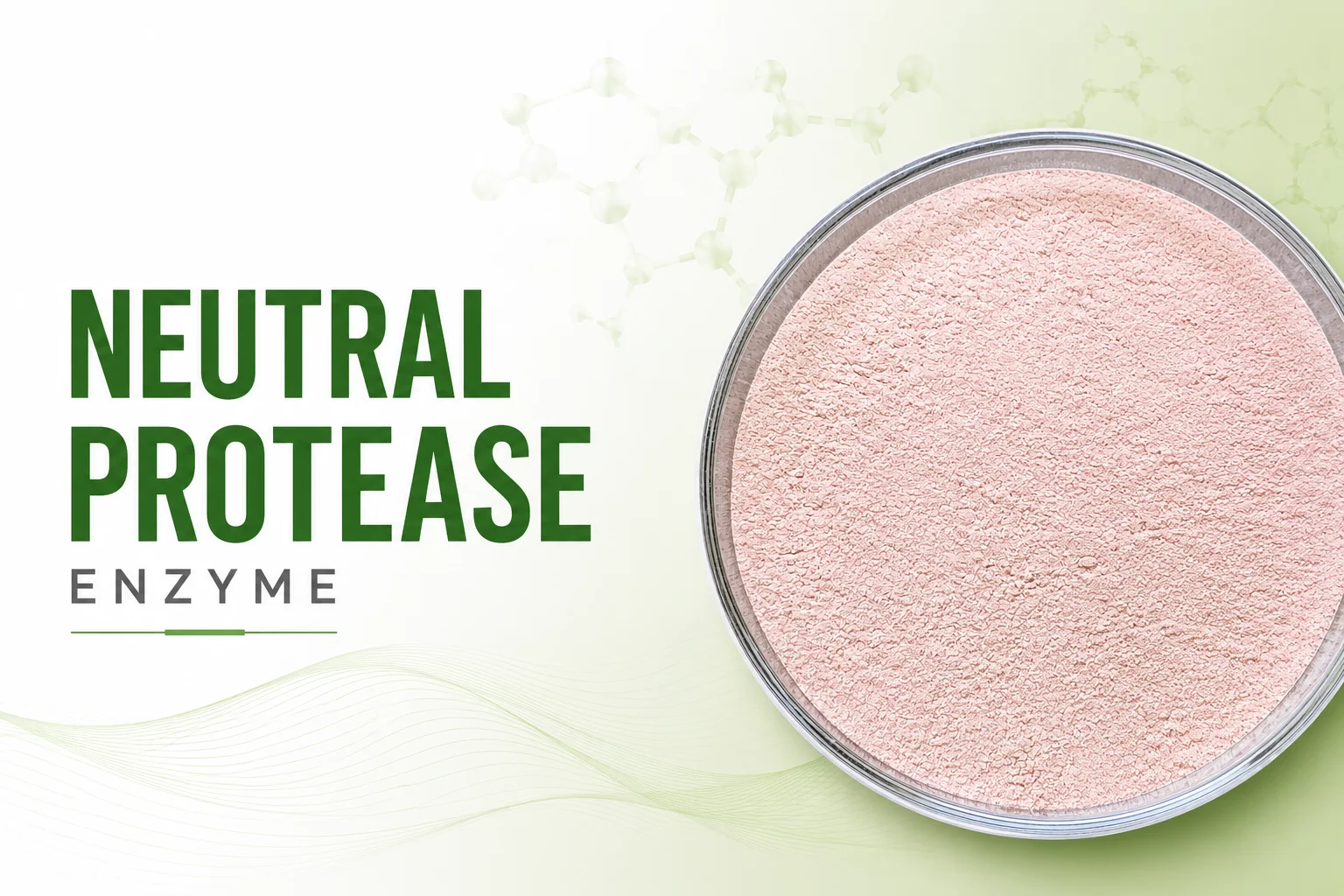
Looking for a neutral protease enzyme for your food manufacturing process? Neutral protease breaks down proteins into smaller peptides and amino acids under suitable processing conditions. It is useful in applications where protein hydrolysis is required near neutral pH levels.
Leaf CleanTech offers LEAFNPROT, a neutral protease solution for selected food-processing applications. Explore its potential use in protein hydrolysis and other suitable processes, and contact our team to confirm the right grade and technical specifications for your requirements.
Neutral protease is a proteolytic enzyme that catalyses the breakdown of peptide bonds in proteins. This reaction, known as protein hydrolysis, converts larger protein molecules into smaller peptides and, depending on the reaction, free amino acids.
Unlike acid proteases, which are designed to work under acidic conditions, neutral proteases are generally selected for processes operating closer to neutral pH. The exact activity range depends on the enzyme preparation, substrate and operating conditions.
Food manufacturers use proteases in applications that require controlled protein modification. For example, neutral protease may be suitable for selected plant-protein hydrolysis, meat processing and other protein-based formulations. However, the final results depend on the raw material, enzyme activity, dosage, pH, temperature and reaction time.
Leaf CleanTech lists LEAFNPROT in its enzyme portfolio. Visit the food and nutrition enzyme range to explore other solutions for food manufacturing.
Neutral protease can help manufacturers modify protein ingredients and control hydrolysis under suitable conditions. Its performance should be assessed against the needs of each production process.
Neutral protease breaks proteins into smaller peptides. Manufacturers can monitor the reaction to achieve their target degree of hydrolysis.
Proteolysis can change the solubility, functionality and other properties of protein ingredients. The outcome depends on the protein source and processing conditions.
A suitable neutral protease can support processes that require protein breakdown near neutral pH, subject to the enzyme's verified activity range.
Controlled trials help identify the right enzyme activity, dosage and reaction time for consistent production results.
Neutral protease has potential applications across several protein-processing operations. Manufacturers should select a product grade based on the substrate, process conditions and intended outcome.
Neutral protease can hydrolyse proteins from selected plant-based ingredients, including soy protein. The reaction produces smaller peptides and may change solubility and other functional properties. Manufacturers should monitor hydrolysis levels and assess flavour, solubility and product performance before scaling up.
Food manufacturers may use proteases to modify protein concentrates and other protein-rich raw materials. The resulting hydrolysates can have different functional properties from the original proteins. Therefore, the process should be tailored to the intended use, rather than relying on a single dosage for every ingredient.
Proteolytic enzymes can modify meat proteins and influence tenderness. However, enzyme selection is important because different proteases vary in their substrate specificity, activity and operating conditions. Confirm that the selected neutral protease is suitable for the intended meat-processing application before use.
Proteases can be used in selected dairy and casein applications where controlled protein modification is required. The effects on texture, solubility, flavour and other product characteristics depend on the substrate and the degree of hydrolysis.
Certain proteases are used in brewing and beverage processing to modify proteins and help manage product characteristics, including haze formation in suitable systems. The effectiveness of neutral protease depends on the process, substrate and validated operating conditions. Confirm the suitability of the specific grade before using it for this purpose.
Proteins consist of amino acids linked by peptide bonds. Neutral protease catalyses the hydrolysis of these bonds, breaking larger protein molecules into smaller peptides. The extent of breakdown depends on the enzyme, protein source and reaction conditions.
Manufacturers can control the process by monitoring pH, temperature, enzyme dosage and reaction time. These factors influence the rate of hydrolysis and the properties of the resulting protein hydrolysate.
Before purchasing a neutral protease enzyme, review its activity, physical form, operating conditions and quality documentation. The following table provides a selection guide; confirm all commercial specifications with Leaf CleanTech.
| Parameter | Details |
|---|---|
| Product name | Neutral Protease Enzyme |
| Product code | LEAFNPROT |
| Enzyme class | Protease |
| Primary function | Protein hydrolysis |
| Operating pH | Confirm the activity range for the supplied grade and application |
| Operating temperature | Confirm the recommended temperature range on the technical data sheet |
| Enzyme activity | Confirm the activity value, units and test method with Leaf CleanTech |
| Physical form | Confirm the available form for the supplied grade |
| Applications | Selected protein hydrolysis and other suitable food-processing applications |
| Dosage | Determine through application trials and supplier guidance |
| Packaging | Confirm available packaging options with the supplier |
| Storage and shelf life | Follow the approved product label and technical data sheet |
Note: This table is an enquiry guide, not a certified product specification. Request the current technical data sheet and certificate of analysis before commercial use.
Neutral protease and acid protease both break down proteins. However, they differ in the pH conditions for which they are designed. Selecting the right enzyme helps align its activity with the characteristics of the process.
| Comparison | Neutral Protease | Acid Protease |
|---|---|---|
| Operating environment | Near-neutral pH, depending on grade | Acidic pH, depending on grade |
| Main function | Protein hydrolysis | Protein hydrolysis under acidic conditions |
| Potential applications | Selected plant protein, meat and other protein-processing applications | Selected acidic food-processing and protein applications |
| Selection factor | Substrate and near-neutral process conditions | Substrate and acidic process conditions |
Neither enzyme is universally better. The correct choice depends on the process pH, substrate, desired hydrolysis level and verified product performance.
Explore the acid protease enzyme page to compare another protease option.
Leaf CleanTech develops enzyme solutions for food and nutrition, animal feed and fermentation applications. Its portfolio includes neutral protease and other enzyme products designed for different processing requirements.
Discuss your raw material, process conditions and target outcome when selecting an enzyme.
Explore proteases and other enzyme categories for protein, carbohydrate and food-processing applications.
Request the product documentation needed to assess enzyme activity and process suitability.
Discuss specialised process requirements with the team if a standard product does not meet your needs.
Read more about protease applications in food processing and protein hydrolysis , or explore the complete food and nutrition enzyme portfolio .
Neutral protease breaks proteins into smaller peptides and amino acids. It can be used in suitable protein hydrolysis and food-processing applications where the operating conditions match the enzyme grade.
Neutral protease is selected for processes closer to neutral pH, while acid protease is designed for acidic conditions. The best option depends on the substrate and the operating conditions of the process.
A suitable neutral protease can be evaluated for soy protein hydrolysis. Manufacturers should test the selected grade and monitor the resulting hydrolysate for the required functional and sensory properties.
Proteolytic enzymes can modify meat proteins and influence tenderness. However, suitability depends on the specific enzyme grade, application method and processing conditions. Confirm the intended use with the supplier.
Activity depends on pH, temperature, enzyme dosage, reaction time, substrate composition and the properties of the enzyme preparation. Follow the technical data sheet for the selected product.
LEAFNPROT is the neutral protease product listed in Leaf CleanTech's enzyme portfolio. Contact the company to confirm the current product specifications, availability and application suitability.
Dosage depends on the enzyme activity, substrate, desired degree of hydrolysis and processing conditions. Establish the appropriate dosage through controlled trials and supplier guidance.
Contact Leaf CleanTech to request the latest technical data sheet, enzyme activity details, recommended operating conditions and relevant quality documentation.
Tell us about your protein source, operating pH, temperature and production objectives. Leaf CleanTech can help you explore suitable enzyme options and confirm the technical details required for your application.
[…] For applications requiring neutral-pH protein hydrolysis, explore Leaf CleanTech's [Neutral Protease Enzyme]. […]
[…] Neutral proteases generally perform around neutral pH conditions. […]
[…] targets fats specifically. For protein breakdown instead, see our neutral protease enzyme or acid protease enzyme […]
©2026. Leaf CleanTech - All Rights Reserved.
Industrial Biotechnology Applications - Leaf CleanTech
June 2, 2026[…] example, proteases can support protein hydrolysis, while enzymes such as pectinases can be used in fruit and vegetable […]