
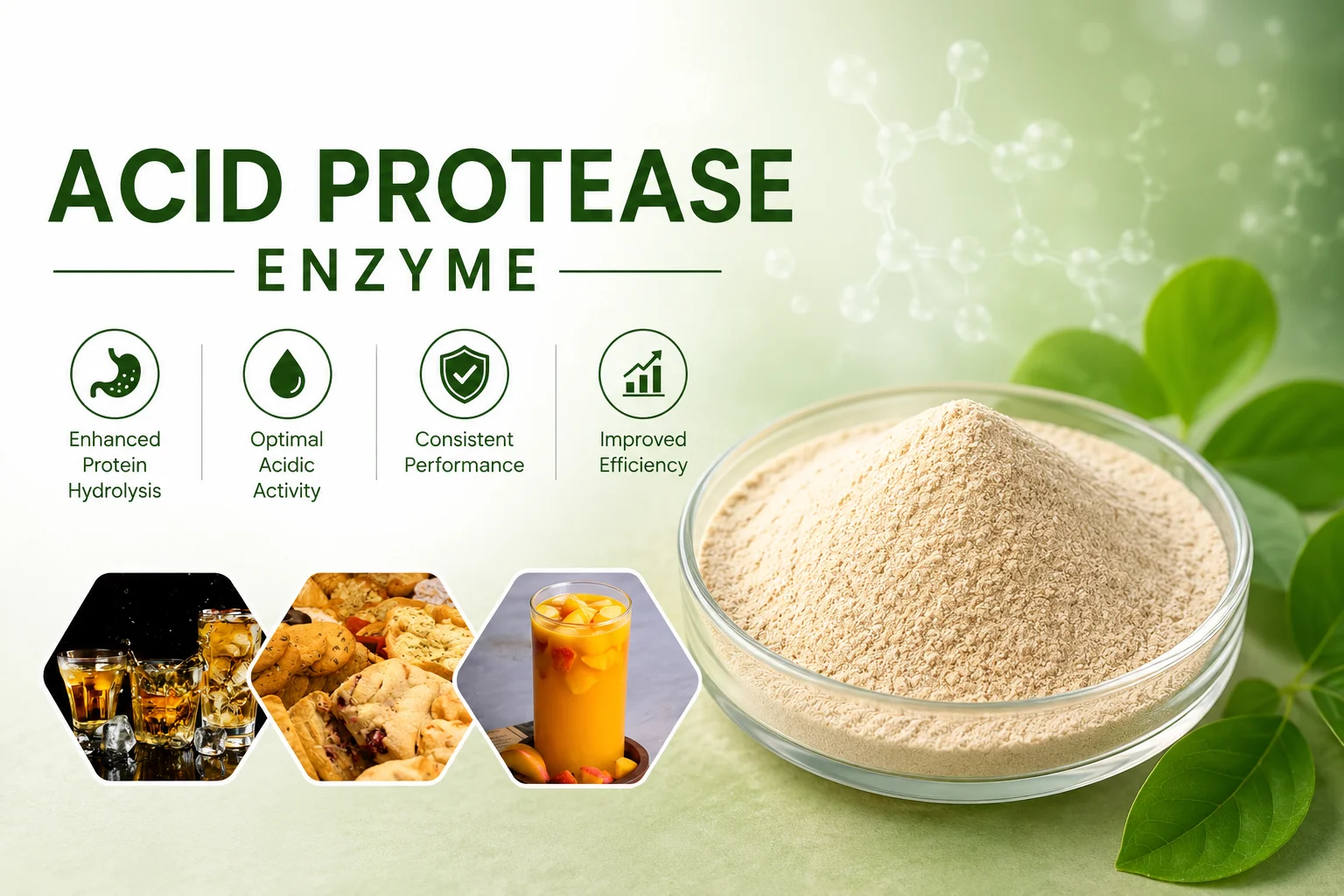
Acid protease enzyme is a specialised proteolytic enzyme that breaks down proteins under acidic conditions. Because many food, nutrition and biotechnology processes operate at low pH, acid protease can provide effective protein hydrolysis where other proteases may not perform efficiently.
From protein hydrolysis and food processing to nutraceutical applications, acid protease supports manufacturers that need controlled and efficient protein breakdown.
In this guide, we explain what acid protease enzyme is, how it works, its major applications, benefits, factors affecting performance, and how to select the right enzyme for your process.
Acid protease is a proteolytic enzyme that hydrolyses proteins under acidic or low-pH conditions.
Proteins consist of long chains of amino acids connected by peptide bonds. Acid protease breaks these bonds and converts large protein molecules into smaller peptides and, depending on the process conditions, amino acids.
Unlike proteases designed for neutral or alkaline conditions, acid protease performs specifically in acidic environments. Therefore, it can be useful when the processing pH falls below the optimal range of conventional neutral proteases.
Protein → Peptides → Smaller peptides → Amino acids
The exact level of hydrolysis depends on the enzyme activity, substrate, dosage, pH, temperature, reaction time and processing conditions.
Acid protease works by catalysing the hydrolysis of peptide bonds within proteins.
First, the enzyme comes into contact with the protein substrate. Then, it acts on susceptible peptide bonds and gradually breaks large protein structures into smaller components.
As hydrolysis progresses, the protein becomes easier to process and, depending on the application, may show changes in:
Consequently, manufacturers can use acid protease to achieve controlled protein modification rather than relying solely on chemical or thermal processing.
The pH of a manufacturing process can strongly influence enzyme performance.
For example, some food and fermentation processes naturally operate under acidic conditions. In such environments, a neutral protease may not deliver the desired activity.
Acid protease addresses this requirement by providing proteolytic activity in acidic conditions.
Therefore, it can help manufacturers:
The ideal enzyme, however, always depends on the substrate and process conditions.
Acid protease has applications across several industries where controlled protein hydrolysis is required.
One of the primary applications of acid protease is protein hydrolysis.
The enzyme breaks large protein molecules into smaller peptides. As a result, manufacturers can produce protein hydrolysates with characteristics suited to specific applications.
The degree of hydrolysis can be adjusted by controlling factors such as enzyme dosage, pH, temperature and reaction time.
Acid protease can support food-processing applications where protein modification is required under acidic conditions.
Depending on the food matrix, controlled proteolysis can influence protein solubility, texture and processing characteristics.
Therefore, manufacturers can evaluate acid protease when conventional processing methods do not provide the desired protein modification.
Protein hydrolysates play an important role in nutritional and functional food formulations.
Acid protease can help hydrolyse selected protein sources into smaller peptides. Consequently, it can support the production of specialised protein ingredients and hydrolysed protein formulations.
However, the final peptide profile depends on the protein source and processing conditions.
Manufacturers producing protein-based ingredients may use protease enzymes to modify the functional properties of proteins.
For example, controlled hydrolysis can change protein solubility and molecular size. Therefore, enzyme selection becomes an important part of developing a consistent protein-processing workflow.
Proteolytic enzymes can also support biotechnology and fermentation-related processes where protein breakdown forms part of the overall production system.
In these applications, manufacturers should consider the complete process environment, including pH, temperature, substrate concentration and fermentation conditions.
Acid protease and neutral protease both break down proteins. However, their preferred operating environments differ.
| Feature | Acid Protease | Neutral Protease |
|---|---|---|
| Primary Function | Breaks down proteins through enzymatic hydrolysis | Breaks down proteins through enzymatic hydrolysis |
| Preferred pH Environment | Acidic or low-pH conditions | Near-neutral pH conditions |
| Main Substrate | Proteins and protein-rich substrates | Proteins and protein-rich substrates |
| Hydrolysis Products | Smaller peptides and protein fragments | Smaller peptides and protein fragments |
| Typical Applications | Protein hydrolysis, food processing, nutraceutical and biotechnology applications | Food processing, protein hydrolysis, brewing and other industrial applications |
| Process Compatibility | Suitable when the process operates under acidic conditions | Suitable when the process operates around neutral pH |
| Key Selection Factor | Process pH, substrate, temperature and required degree of hydrolysis | Process pH, substrate, temperature and required degree of hydrolysis |
| Best Suited For | Processes requiring effective protein hydrolysis in acidic environments | Processes requiring protein hydrolysis under neutral-pH conditions |
Therefore, pH should be one of the first factors considered when selecting a protease enzyme.
For applications requiring neutral-pH protein hydrolysis, explore Leaf CleanTech's [Neutral Protease Enzyme].
Acid protease is not the only option for protein hydrolysis.
Plant-derived proteases such as papain and bromelain offer different enzyme characteristics and may suit particular processing requirements.
For example:
The right choice depends on the protein substrate, pH, temperature, desired hydrolysis level, processing time and final-product requirements.
Explore the [Papain Food Enzyme] and [Bromelain Enzyme Powder] pages to compare different protease options.
Several process parameters influence enzyme activity.
pH directly affects enzyme activity. Since acid protease is intended for acidic environments, manufacturers should determine the optimum pH range for their specific enzyme preparation.
Temperature influences reaction speed and enzyme stability.
As temperature increases within a suitable operating range, enzymatic reactions can become faster. However, excessive heat can reduce enzyme activity.
Therefore, temperature should remain within the recommended operating range.
The required dosage depends on several variables, including:
Using more enzyme does not automatically produce a better result. Instead, manufacturers should establish dosage through application trials.
Longer reaction times generally allow more protein hydrolysis. However, excessive hydrolysis may change the taste, texture or functional properties of the final product.
Therefore, process monitoring remains important.
Different proteins respond differently to enzymatic hydrolysis.
Whey, soy, casein, gelatin and other protein substrates have different structures. Consequently, the same enzyme dosage may produce different results across different substrates.
Several process parameters influence enzyme activity.
pH directly affects enzyme activity. Since acid protease is intended for acidic environments, manufacturers should determine the optimum pH range for their specific enzyme preparation.
Temperature influences reaction speed and enzyme stability.
As temperature increases within a suitable operating range, enzymatic reactions can become faster. However, excessive heat can reduce enzyme activity.
Therefore, temperature should remain within the recommended operating range.
The required dosage depends on several variables, including:
Using more enzyme does not automatically produce a better result. Instead, manufacturers should establish dosage through application trials.
Longer reaction times generally allow more protein hydrolysis. However, excessive hydrolysis may change the taste, texture or functional properties of the final product.
Therefore, process monitoring remains important.
Different proteins respond differently to enzymatic hydrolysis.
Whey, soy, casein, gelatin and other protein substrates have different structures. Consequently, the same enzyme dosage may produce different results across different substrates.
When matched correctly to a process, acid protease can offer several potential advantages.
Acid protease supports the conversion of large protein molecules into smaller peptides.
Manufacturers can adjust enzyme dosage, temperature, pH and reaction time to control the degree of hydrolysis.
The enzyme provides a suitable option when protein hydrolysis needs to occur under acidic conditions.
Acid protease can support different protein-processing applications, depending on the substrate and required outcome.
Manufacturers can select enzyme activity based on their specific raw material and processing requirements rather than using a one-size-fits-all approach.
Choosing an enzyme only by its name or activity value may not provide the best process outcome.
Instead, consider the following factors:
This approach helps manufacturers identify an enzyme solution that fits the actual process.
For industrial production, enzyme consistency matters as much as enzyme activity.
Manufacturers should evaluate:
Leaf CleanTech develops enzyme solutions for food, nutrition, biotechnology and animal-feed applications. Its broader food and nutrition portfolio includes proteases, amylases, cellulases, hemicellulases, xylanases, pectinases, lactase, lipase, invertase, bromelain, papain and customised enzyme formulations.
Leaf CleanTech focuses on application-oriented enzyme solutions rather than treating every process the same way.
The company supports customers with:
Enzyme selection can be matched to the raw material, process conditions and desired outcome.
Consistent enzyme activity helps manufacturers maintain more predictable processing performance.
When a standard enzyme does not fully meet the process requirement, customised enzyme formulations can be considered.
Leaf CleanTech can assist manufacturers in evaluating enzyme selection, application requirements and process optimisation.
Acid protease is a proteolytic enzyme that breaks down proteins under acidic conditions. It converts larger protein molecules into smaller peptides and protein fragments.
Acid protease hydrolyses peptide bonds in proteins. Depending on the process, it can support protein hydrolysis, protein modification and the production of protein-based ingredients.
The main difference is their preferred operating environment. Acid protease is designed for acidic conditions, while neutral protease performs better around neutral pH conditions.
Acid protease can be used in selected food-processing, protein-hydrolysis, nutraceutical and biotechnology applications where acidic conditions are part of the process.
pH, temperature, enzyme dosage, substrate concentration, protein source and reaction time can all affect enzyme performance.
Yes. Acid protease can hydrolyse proteins into smaller peptides and protein fragments. The final degree of hydrolysis depends on the enzyme and processing conditions.
Start by evaluating the protein substrate, process pH, temperature, desired hydrolysis level and reaction time. Then select an enzyme preparation that matches those requirements.
Yes. Leaf CleanTech offers acid protease as part of its enzyme portfolio and supports industrial customers looking for application-specific enzyme solutions.
If you are evaluating acid protease for a specific process, these related Leaf CleanTech resources can help:
Choosing the right protease can improve process control, protein hydrolysis and product consistency. However, the best enzyme depends on your raw material and processing conditions.
Looking for an acid protease enzyme for your food, nutrition or industrial application?
Talk to the Leaf CleanTech technical team about your:
Contact Leaf CleanTech today to discuss your enzyme requirement and request a suitable solution for your process.
Leaf CleanTech – Application-Focused Enzyme Solutions for Food, Nutrition & Biotechnology.
[…] Related service: Acid Protease Enzyme […]
[…] Leaf CleanTech's food and nutrition enzyme portfolio or explore bromelain enzyme powder and acid protease enzyme for other enzyme […]
©2026. Leaf CleanTech - All Rights Reserved.
Protease Enzyme Applications in Food Processing & Protein Hydrolysis
May 9, 2026[…] Acid proteases perform effectively under acidic conditions. […]