
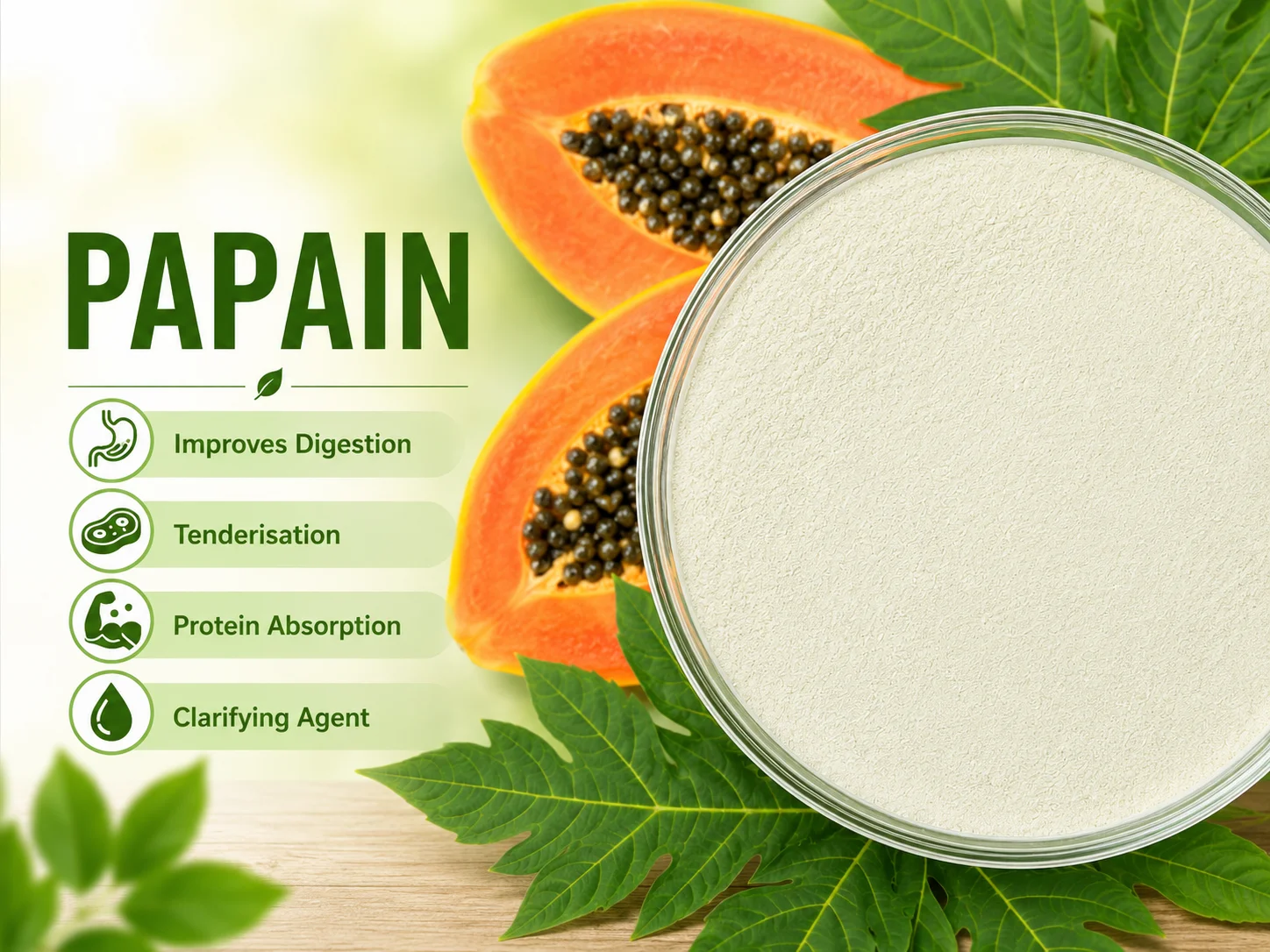
Looking for a reliable papain food enzyme for your food manufacturing process? Papain is a natural proteolytic enzyme obtained from papaya. It breaks down proteins into smaller peptides and helps modify protein structure under suitable processing conditions.
In particular, papain has useful applications in biscuit manufacturing and selected food-processing operations. By controlling protein breakdown, manufacturers can adjust dough characteristics and achieve product qualities that match their processing requirements.
Leaf CleanTech develops food enzyme solutions for industrial applications. Our team can help you evaluate papain enzyme options according to your raw materials, processing conditions and desired product characteristics.
Key Takeaways
- Papain is a proteolytic enzyme naturally associated with papaya.
- It breaks down proteins into smaller peptides through enzymatic hydrolysis.
- Food manufacturers use papain for selected baking and protein-processing applications.
- In biscuit manufacturing, controlled proteolytic activity can help modify dough properties.
- Enzyme performance depends on activity, dosage, temperature, pH and processing time.
- Leaf CleanTech offers papain as part of its food and nutrition enzyme portfolio.
What Is Papain Food Enzyme?
Papain food enzyme is a protease enzyme obtained from papaya (Carica papaya). It acts as a biological catalyst and helps break down proteins into smaller peptides and amino acids through a process called proteolysis.
Proteins influence important food properties, including texture, elasticity, structure and functionality. Therefore, controlled protein hydrolysis can help food manufacturers modify specific product characteristics.
Moreover, papain offers useful proteolytic activity for selected food applications. Manufacturers can evaluate it for biscuit production, protein hydrolysis and other processes that require controlled protein modification.
However, every food application has different requirements. Therefore, manufacturers should select an appropriate enzyme grade after reviewing the raw material, processing conditions and final product specifications.
How Does Papain Enzyme Work?
Papain works by breaking peptide bonds within protein molecules. These bonds connect amino acids and form the structure of proteins. When papain acts on a suitable protein substrate, it separates larger protein molecules into smaller fragments.
This process is known as enzymatic protein hydrolysis. As a result, the treated protein may show changes in its functional properties, depending on the degree of hydrolysis and the processing environment.
How the Enzymatic Reaction Takes Place
- Substrate contact: Papain comes into contact with the protein present in the food material.
- Protein breakdown: The enzyme catalyses the hydrolysis of peptide bonds.
- Peptide formation: Larger proteins break down into smaller peptides and other hydrolysis products.
- Property modification: The change in protein structure can influence the functional properties of the processed material.
- Process control: Manufacturers control enzyme activity to achieve the required processing result.
Consequently, controlled papain application can help manufacturers achieve more consistent processing outcomes.
Applications of Papain Food Enzyme
Papain has several potential applications in food manufacturing because of its ability to hydrolyse proteins. The most suitable application depends on the enzyme grade, substrate and process conditions.
1. Papain Enzyme for Biscuit Manufacturing
Biscuit production requires careful control of dough properties. Protein content and gluten development can influence dough handling, spread, structure and finished biscuit texture.
Papain can help modify proteins in biscuit dough through controlled proteolytic activity. Therefore, manufacturers can evaluate papain as a processing aid when they need to adjust dough characteristics.
Depending on the formulation and processing conditions, suitable papain application may support:
- Controlled modification of dough proteins.
- Changes in dough handling and processing characteristics.
- Adjustment of biscuit texture and structure.
- Process-specific improvements in biscuit volume and product consistency.
- Better control over dough properties during manufacturing.
However, excessive proteolysis can negatively affect dough structure. Therefore, manufacturers should establish the correct dosage through controlled production trials.
2. Protein Hydrolysis in Food Processing
Protein hydrolysis is an important operation in food ingredient manufacturing. Papain can break down suitable protein materials into smaller peptides, depending on the substrate and operating conditions.
Food manufacturers can evaluate papain for selected protein-processing applications where controlled hydrolysis is required. In addition, the degree of protein breakdown can influence solubility, functionality and other ingredient properties.
3. Meat Processing and Protein Modification
Papain is known for its ability to break down meat proteins. Therefore, proteolytic enzymes can play a role in selected meat-processing applications, including meat tenderisation.
Nevertheless, manufacturers must carefully control enzyme concentration, treatment time and processing conditions. This helps prevent excessive protein breakdown and unwanted changes in product texture.
4. Food Ingredient Development
Food ingredient manufacturers often require specific protein properties for their formulations. Papain can support protein hydrolysis when the process requires a controlled reduction in protein size.
Furthermore, manufacturers can assess the resulting hydrolysate for its functional properties and suitability for the intended food application.
Benefits of Papain Food Enzyme in Food Processing
Papain offers several processing advantages when manufacturers use it under suitable conditions. Its main value comes from controlled protein breakdown.
- Protein modification: Helps break down complex proteins into smaller peptides.
- Dough property control: Supports controlled modification of proteins in selected bakery applications.
- Biscuit processing: Helps manufacturers evaluate and adjust dough characteristics for biscuit production.
- Protein hydrolysis: Supports processing operations that require enzymatic protein breakdown.
- Application flexibility: Can be evaluated for different protein-based food-processing requirements.
- Process-specific performance: Allows manufacturers to adjust enzyme application according to raw materials and production conditions.
Importantly, these benefits depend on the enzyme's activity profile and the application. Therefore, manufacturers should validate performance through suitable trials rather than assume identical results across different food products.
Factors Affecting Papain Enzyme Performance
Several processing variables influence papain activity. Therefore, manufacturers should evaluate these factors before introducing the enzyme into a production line.
1. Enzyme Activity
Enzyme activity indicates the ability of papain to catalyse protein hydrolysis under defined test conditions. Always review the supplier's technical data sheet to understand the activity specification.
2. Temperature
Temperature influences the rate of enzymatic reactions. However, excessive heat can reduce enzyme activity. Manufacturers should therefore confirm the suitable operating temperature for the selected product grade.
3. pH Conditions
Every enzyme has a suitable pH operating range. Consequently, manufacturers should check the process pH and compare it with the recommended conditions for their papain product.
4. Enzyme Dosage
Dosage directly affects the degree of protein hydrolysis. A suitable dosage depends on enzyme activity, substrate concentration and the required processing outcome. Start with supplier guidance and validate the dosage through controlled trials.
5. Reaction Time
Longer reaction times can increase the extent of protein breakdown, depending on the process conditions. Therefore, manufacturers should monitor the reaction and establish an appropriate treatment duration.
6. Raw Material Quality
Protein content, substrate composition and raw material variation can influence enzyme performance. For this reason, manufacturers should evaluate papain using representative production materials.
Papain vs Other Food Processing Enzymes
Different food enzymes act on different substrates. Therefore, selecting the correct enzyme depends on the target component and the intended processing result.
| Enzyme | Main Substrate | Primary Function | Food Applications |
|---|---|---|---|
| Papain | Proteins | Breaks proteins into smaller peptides | Biscuit manufacturing and protein processing |
| Acid Protease | Proteins | Hydrolyses proteins under suitable acidic conditions | Protein hydrolysis and food processing |
| Neutral Protease | Proteins | Breaks down proteins under suitable near-neutral conditions | Protein processing and food applications |
| Bromelain | Proteins | Supports proteolytic protein breakdown | Food and protein-processing applications |
| Amylase | Starch | Breaks starch into smaller carbohydrates | Baking and starch processing |
| Lipase | Fats and oils | Hydrolyses fats into smaller lipid components | Dairy and fat-processing applications |
Although papain, bromelain and other proteases act on proteins, their activity profiles and application suitability can differ. Therefore, manufacturers should compare technical specifications before choosing an enzyme.
Explore related products: Acid Protease Enzyme, Bromelain Enzyme Powder and Protease Enzyme Solutions.
How to Select the Right Papain Food Enzyme
Choosing the right papain product requires more than checking its enzyme name. Instead, manufacturers should evaluate the product against their actual production requirements.
Consider the following points before selecting a papain food enzyme:
- Application: Define whether the enzyme is intended for biscuit manufacturing, protein hydrolysis or another food-processing operation.
- Substrate: Identify the protein source and its composition.
- Activity specification: Review the enzyme activity and test method provided by the supplier.
- Operating conditions: Confirm the process temperature, pH and reaction time.
- Dosage: Establish the required dosage through application trials.
- Food safety documentation: Request relevant technical, quality and regulatory documentation for the intended market and application.
- Technical support: Work with a supplier who understands your processing requirements.
By reviewing these factors, manufacturers can make a more informed purchasing decision and improve the chances of achieving consistent processing results.
Why Choose Leaf CleanTech for Papain Food Enzyme?
Leaf CleanTech develops and manufactures enzyme solutions for the food and nutrition industry. We combine biotechnology expertise with application-focused product development to help food manufacturers address specific processing requirements.
Our food enzyme portfolio includes papain, proteases, amylases, cellulases, hemicellulases, xylanases, pectinases, lactase, lipase, invertase and other enzyme solutions.
Application-Focused Enzyme Solutions
We consider the raw material, manufacturing process and desired product characteristics when evaluating enzyme requirements.
Food and Nutrition Enzyme Portfolio
Our portfolio supports different food-processing applications, including baking, protein processing, dairy, beverages and other food manufacturing operations.
Technical Guidance
Our technical team can help evaluate enzyme selection, processing conditions and application requirements.
Customised Enzyme Formulations
When a standard enzyme does not fully address a processing challenge, we can discuss customised enzyme formulation options based on the application.
Explore our Food & Nutrition Enzyme Products to learn more about our solutions.
How to Use Papain Enzyme in Food Manufacturing
Successful enzyme application requires a controlled process. Although the exact procedure varies by product and application, manufacturers can follow these general steps:
- Identify the application: Define the food product and the processing objective.
- Evaluate raw materials: Check the protein content and characteristics of the substrate.
- Review technical specifications: Confirm the papain activity, recommended conditions and product documentation.
- Conduct laboratory trials: Test suitable dosage levels, pH, temperature and reaction time.
- Evaluate the results: Check dough handling, texture or other application-specific quality parameters.
- Validate production conditions: Confirm the selected process on a suitable production scale.
- Control enzyme activity: Follow the validated process, including any required enzyme inactivation step.
Always follow the supplier's technical recommendations and applicable food regulations. In addition, validate the final product quality before commercial production.
Frequently Asked Questions About Papain Food Enzyme
1. What is papain food enzyme?
Papain is a proteolytic enzyme obtained from papaya. It breaks down proteins into smaller peptides through enzymatic hydrolysis. Food manufacturers use it in selected applications that require controlled protein modification.
2. What is papain enzyme used for in food processing?
Papain can be used for selected protein-processing applications, including biscuit manufacturing and protein hydrolysis. Its suitability depends on the raw material, enzyme activity and processing conditions.
3. How does papain improve biscuit manufacturing?
Papain can modify proteins in biscuit dough through controlled proteolytic activity. This may help manufacturers adjust dough characteristics and evaluate changes in biscuit texture, structure and processing performance.
4. Is papain a protease enzyme?
Yes. Papain is a protease enzyme. It catalyses the breakdown of proteins by hydrolysing peptide bonds and producing smaller peptides.
5. What factors affect papain enzyme activity?
Important factors include enzyme activity, dosage, pH, temperature, reaction time and substrate composition. Manufacturers should evaluate these factors to achieve the desired processing result.
6. How do I choose the right papain enzyme for biscuits?
Consider the flour and protein characteristics, dough formulation, production conditions and desired biscuit properties. Then, evaluate the enzyme through controlled trials and confirm the suitable dosage with the supplier.
7. Can papain be used for protein hydrolysis?
Yes. Papain catalyses protein hydrolysis and can produce smaller peptides from suitable protein substrates. Manufacturers should evaluate the resulting ingredient properties for their intended application.
8. Does Leaf CleanTech offer papain food enzyme?
Yes. Leaf CleanTech lists papain in its food and nutrition enzyme portfolio. Contact the team to confirm current availability, suitable grades, activity specifications and application guidance.
9. How can I request papain enzyme specifications?
Share your application, raw material details and processing conditions with Leaf CleanTech. The team can help you review the suitable enzyme option and request the relevant technical documentation.
10. Can Leaf CleanTech help with customised food enzyme formulations?
Yes. Leaf CleanTech develops customised food enzyme formulations based on specific raw materials, processing conditions and product requirements. Contact the technical team to discuss your application.
Looking for a Papain Food Enzyme for Your Manufacturing Process?
Choosing the right papain enzyme can help you manage protein modification and improve control over selected food-processing operations. Whether you manufacture biscuits or process protein-based ingredients, the right enzyme selection starts with understanding your application.
Connect with Leaf CleanTech to discuss your raw materials, production conditions and enzyme requirements. Our team can help you evaluate suitable papain enzyme solutions for your process.
Leaf CleanTech Pvt. Ltd.
#371 & 372, 10th Cross, 4th Phase, Peenya Industrial Area, Bengaluru – 560058, India.
Phone: +91 80 41144713
Email: info@leafcleantech.com
Neutral Protease Enzyme - Leaf CleanTech
May 29, 2026[…] you need a plant-based protease option, our bromelain enzyme powder and papain food enzyme pages cover those […]