
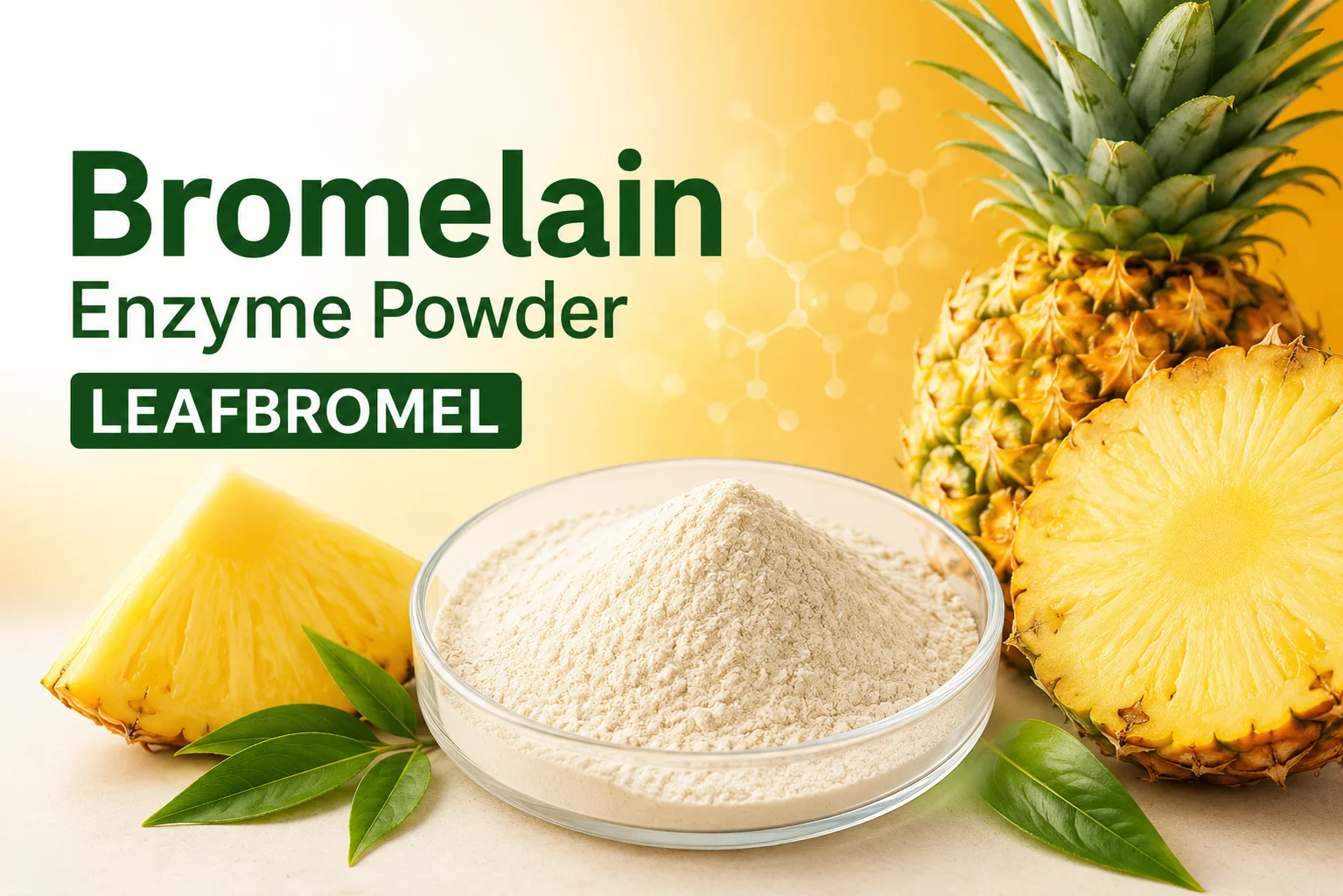
Bromelain enzyme is a plant-derived protease obtained from pineapple and is widely recognized for its ability to hydrolyze proteins into smaller peptides and amino acids. Because of its proteolytic activity, bromelain enzyme powder can be used in a range of food processing, beverage, protein processing, nutraceutical and other industrial applications.
Leaf CleanTech develops and supplies LEAFBROMEL, a food-grade bromelain enzyme powder, designed for industrial applications where controlled protein hydrolysis and enzymatic processing are required.
Whether you are looking for a bromelain enzyme manufacturer in India, food-grade bromelain supplier, pineapple protease, or an enzyme solution for protein processing, Leaf CleanTech can support your application with technical guidance and customized enzyme solutions.
Bromelain is a protease enzyme naturally associated with the pineapple plant. Its primary function is to break down proteins into smaller peptides and amino acids through enzymatic hydrolysis.
Commercial bromelain enzyme is processed and purified to provide a consistent enzyme preparation suitable for specific industrial applications. Leaf CleanTech's LEAFBROMEL is a food-grade bromelain enzyme powder supplied for industrial use.
Unlike carbohydrate-degrading enzymes such as amylase or pectinase, bromelain primarily targets proteins. This makes it particularly relevant for applications involving protein modification, tenderization, hydrolysis and clarification.
Bromelain works through proteolytic activity, meaning that it hydrolyzes peptide bonds within proteins.
During enzymatic processing:
The actual performance of bromelain depends on factors such as enzyme dosage, substrate concentration, pH, temperature, reaction time and process conditions. Therefore, application trials are recommended before establishing commercial processing parameters.
Bromelain enzyme has applications across several industries because of its protein-hydrolyzing activity.
Bromelain can be used in food processing applications where controlled protein modification is required.
Potential applications include:
The appropriate bromelain grade and dosage depend on the raw material, process conditions and desired outcome.
One of the well-known applications of bromelain is meat tenderization.
Proteins in muscle tissue contribute to meat texture. Bromelain's proteolytic activity can help break down selected protein structures, which can contribute to a softer texture when the enzyme is properly applied.
For commercial meat processing, enzyme concentration, contact time, temperature and processing method should be optimized according to the meat type and desired degree of tenderization.
Bromelain can be used as a protein hydrolysis enzyme in applications where proteins need to be converted into smaller peptides.
Protein hydrolysis can be relevant to:
Leaf CleanTech can help evaluate enzyme selection according to the protein source and processing requirements.
Proteins can sometimes contribute to haze or stability challenges in beverages.
Bromelain and other proteolytic enzymes can therefore be evaluated for selected beverage-processing applications where controlled protein hydrolysis is required.
For beverage manufacturers, enzyme selection should consider:
For fruit and vegetable beverages, pectinase and fibre-degrading enzymes may also be relevant depending on the processing objective.
Explore our Pectinase Enzyme Powder for applications involving fruit and vegetable pulp processing.
Bromelain belongs to the broader protease enzyme family. However, not every protease is suitable for the same process.
The choice of enzyme depends on the target protein, pH, temperature, substrate and desired hydrolysis profile.
A plant-derived protease associated with pineapple and used for selected food, protein-processing and industrial applications.
Papain is another plant-derived protease and can be evaluated for applications such as food processing and baking.
Explore: Papain Food Enzyme
Acid protease is designed for protein hydrolysis under acidic processing conditions and can be relevant to selected food and nutraceutical applications.
Explore: Acid Protease Enzyme
Neutral protease works under neutral-pH conditions and can be useful in applications involving protein hydrolysis and food processing.
Explore: Neutral Protease Enzyme
Bromelain is only one part of a complete food-enzyme solution.
Different enzymes target different food components. For example, proteases act on proteins, amylases act on starch, pectinases act on pectin, cellulases act on cellulose, lactase acts on lactose and lipases act on fats.
Leaf CleanTech's food-enzyme portfolio includes proteases, amylases, carbohydrases, fibre-degrading enzymes, dairy enzymes and customized enzyme formulations.
A proteolytic enzyme for applications requiring protein hydrolysis under acidic conditions.
A neutral-pH protease for selected food processing and protein hydrolysis applications.
A plant-based protease used in food-processing applications including selected baking and meat-processing applications.
An amylase enzyme used for starch modification and hydrolysis applications.
Glucoamylase helps hydrolyze dextrins and starch-derived compounds to produce glucose.
Invertase hydrolyzes sucrose into glucose and fructose and is used in selected confectionery and food applications.
Alpha-galactosidase helps hydrolyze specific complex carbohydrates such as raffinose and stachyose.
Pectinase is particularly useful for fruit and vegetable processing, including pulp treatment, viscosity reduction and clarification.
Cellulase supports the enzymatic breakdown of cellulose and can be used in selected food and nutritional applications.
Hemicellulase helps break down components of plant cell walls and can complement other fibre-degrading enzymes.
Xylanase targets xylan and hemicellulose components and is widely relevant to food-processing applications.
Beta glucanase helps hydrolyze beta-glucans and is particularly relevant to selected grain and brewing processes.
Lactase hydrolyzes lactose into glucose and galactose and is used in dairy and lactose-reduced food applications.
Lipase supports controlled fat hydrolysis and has applications in selected food, dairy and nutritional processing applications.
For processes that require multiple enzyme activities or application-specific performance, Leaf CleanTech can develop customized enzyme formulations.
Explore the complete range of food-processing enzymes and understand how different enzyme families support baking, beverages, dairy, fruit processing, starch conversion, brewing and protein processing.
Bromelain can be evaluated for protein modification and meat tenderization applications where controlled proteolytic activity is required.
Proteases can be used in selected beverage-processing applications involving protein-related haze and stability challenges.
Bromelain can support protein hydrolysis and modification in selected food ingredient applications.
Bromelain is also used as an ingredient in certain nutritional and supplement formulations. Application and regulatory requirements should be evaluated according to the intended market and finished product.
While bromelain is a protease rather than a starch-degrading enzyme, protein modification can be relevant to certain specialized food formulations. For conventional baking applications, other enzymes such as amylase, xylanase and protease may be selected according to the desired dough and product characteristics.
Leaf CleanTech develops enzyme solutions around real processing requirements rather than taking a one-size-fits-all approach.
Bromelain is part of a broader portfolio covering proteases, amylases, pectinases, cellulases, xylanases, lactase, lipase and other food enzymes.
LEAFBROMEL is supplied as a food-grade bromelain enzyme powder with an activity specification of 2000 U/g and a minimum order quantity of 25 kg, according to the current product information.
The right enzyme depends on the raw material, target reaction and process conditions. Leaf CleanTech works with customers to evaluate enzyme selection, application requirements and process optimization.
If a standard bromelain preparation does not meet a particular application requirement, customized enzyme formulation can be considered.
Selecting a bromelain enzyme for industrial processing requires more than simply choosing an enzyme powder.
Consider the following factors:
1. Target substrate
Identify the type of protein or food material being processed.
2. Desired reaction
Determine whether the objective is protein hydrolysis, tenderization, clarification or another type of protein modification.
3. pH
The processing pH can influence enzyme performance.
4. Temperature
Enzyme activity is affected by processing temperature. Excessive heat can reduce or deactivate enzyme activity.
5. Enzyme dosage
Dosage should be established according to substrate concentration, activity, reaction time and desired results.
6. Reaction time
The required contact time depends on the application and process conditions.
7. Final product requirements
The desired texture, clarity, degree of hydrolysis or other product characteristics should guide enzyme selection.
For commercial production, laboratory or pilot-scale application trials can help establish appropriate process parameters.
Food enzymes can help manufacturers address specific processing challenges while improving process control and product consistency.
Depending on the enzyme and application, food enzymes can support:
Leaf CleanTech's broader portfolio is designed for applications across baking, beverages, dairy, fruit and vegetable processing, protein processing, starch conversion, brewing and nutritional ingredient manufacturing.
Bromelain is a protease enzyme associated with pineapple. It hydrolyzes proteins into smaller peptides and amino acids and can be used in selected food, protein-processing and industrial applications.
Bromelain enzyme powder is a powdered preparation containing bromelain proteolytic activity. Food-grade preparations can be used for specific industrial food-processing applications.
Bromelain can be used in applications involving protein hydrolysis, meat tenderization, selected beverage processing and other food-processing applications where proteolytic activity is required.
Yes. Bromelain is classified as a protease because its primary enzymatic function involves hydrolyzing proteins.
Bromelain is a plant-derived protease associated with pineapple.
Both are plant-derived proteolytic enzymes, but they originate from different plants. Bromelain is associated with pineapple, while papain is obtained from papaya.
Yes. Bromelain's proteolytic activity can be used in meat tenderization applications by acting on selected protein structures.
Yes. Bromelain can hydrolyze proteins into smaller peptides and amino acids. The appropriate process conditions depend on the protein substrate and desired hydrolysis level.
Bromelain is a protease that acts primarily on proteins, whereas amylase acts on starch. Therefore, the two enzymes are selected for different processing objectives.
Bromelain targets proteins, while pectinase targets pectin and related plant-cell-wall components. Pectinase is therefore more commonly considered for fruit pulp, juice extraction and clarification applications.
The choice depends on the substrate, pH, temperature, enzyme activity, processing time and desired result. Leaf CleanTech can help evaluate the appropriate enzyme based on your application.
Yes. Leaf CleanTech lists LEAFBROMEL as its food-grade bromelain enzyme powder and operates from Bengaluru, India.
Yes. Leaf CleanTech provides customized enzyme formulations for applications where standard enzyme products may not fully address specific process requirements.
Choosing the right enzyme starts with understanding your process.
If you are looking for bromelain enzyme powder, food-grade bromelain, bromelain protease or a customized food enzyme solution, share your raw material, application, process conditions and desired outcome with the Leaf CleanTech technical team.
Let's identify the right enzyme solution for your production process.
Get a Quote | Discuss Your Application | Request Technical Support
©2026. Leaf CleanTech - All Rights Reserved.