
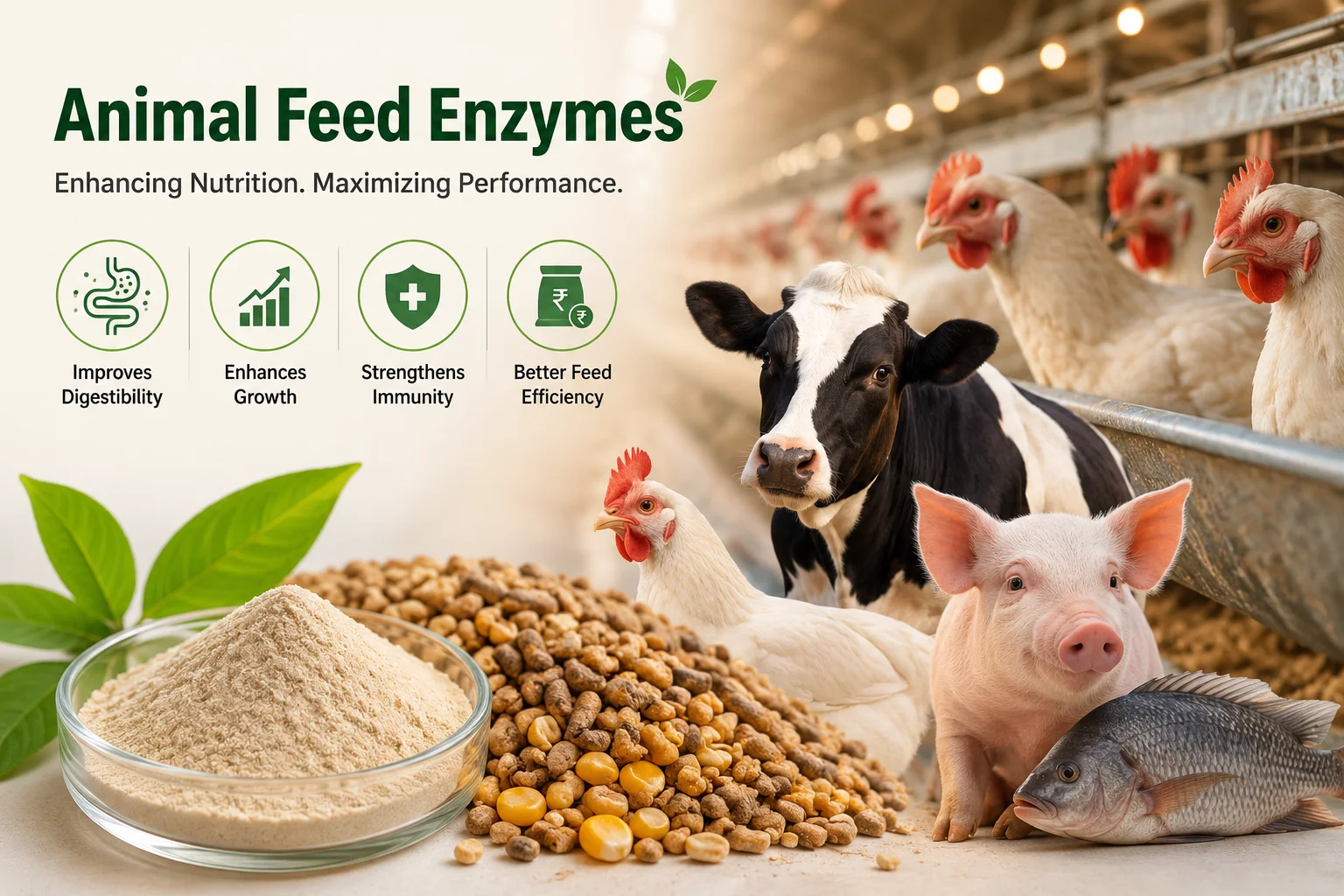
Animal feed enzymes have changed how farmers and feed manufacturers think about nutrition. So, what makes these enzymes so important? And how do you choose the right one for your feed formulation?
This guide answers both questions. It also breaks down every major feed enzyme category, so you can match the right solution to your animals.
Animal feed enzymes are natural proteins. Specifically, they speed up the breakdown of complex compounds inside feed ingredients. As a result, animals absorb more nutrients from the same amount of feed.
In simple terms, these enzymes work like digestive helpers. Because they are not consumed during the reaction, they simply make digestion faster and more complete over and over.
As a result, enzymes now play a central role in poultry, swine, cattle, and aquaculture feed formulations.
Feed costs represent one of the largest expenses in livestock production. Therefore, anything that improves feed efficiency has a direct impact on profitability.
Here is why feed enzymes matter so much:
Consequently, feed enzymes have become standard practice across modern livestock and poultry operations.
Feed enzymes generally fall into a few broad families, and each family targets a different compound inside feed ingredients.
Protease enzymes break down proteins into smaller peptides and amino acids. As a result, animals digest protein-rich feed ingredients far more efficiently.
Specifically, this category includes papain feed enzyme, a plant-based protease, acid protease feed enzyme, built for acidic digestive conditions, and neutral protease feed enzyme, which performs best at neutral pH.
Similarly, fibre-degrading enzymes target the tough plant material found in grains and cereals. Because of this, they unlock nutrients that would otherwise pass through undigested.
Accordingly, this group includes feed cellulase enzyme, which breaks down cellulose, feed beta glucanase, which clears thick beta-glucan compounds in grain-based feed, xylanase feed enzyme, which digests arabinoxylans, and pectinase feed enzyme, which breaks down pectin in fruit and vegetable feed ingredients.
In addition, this category supports fat breakdown and complex sugar digestion.
Sometimes, however, a single enzyme cannot address every digestive challenge in a feed formulation. In that case, manufacturers turn to poultry feed cocktail enzyme, which combines multiple enzyme activities into one product.
Meanwhile, phytase enzymes unlock bound phosphorus from phytic acid in grain-based feed. We cover this enzyme in detail in our existing guide on phytase enzyme benefits in animal feed.
To begin with, choosing the right enzyme starts with your feed ingredients. First, identify which compounds dominate your formulation: protein, fibre, starch, or fat.
Next, consider the animal species you are feeding. Because poultry, swine, and ruminants all digest feed differently, enzyme needs vary accordingly.
Then, think about your processing conditions. For instance, pelleting temperature can affect enzyme stability, so heat-tolerant formulations sometimes become necessary.
Finally, consider whether a single enzyme solves your problem, or whether a multi-enzyme cocktail would perform better across a varied feed mix.
Leaf CleanTech manufactures a complete range of feed-grade enzymes. Because every product undergoes strict quality testing, you get consistent activity levels across every batch.
Moreover, our technical team helps you match the right enzyme, or enzyme blend, to your exact feed formulation and species requirements.
Each enzyme above has its own detailed guide. Click through to learn about specific applications, dosage guidance, and product specifications:
Need help selecting the right feed enzyme for your formulation? Contact Leaf CleanTech today, and our team will guide you to the best fit.
©2026. Leaf CleanTech - All Rights Reserved.